Run compute instances and Kubernetes clusters in logically isolated networks to secure internal service communication and keep sensitive workloads off the public internet.
Overview
Akamai Cloud offers two private networking options — VPC and VLAN — so you can choose the right isolation model for your applications and teams.
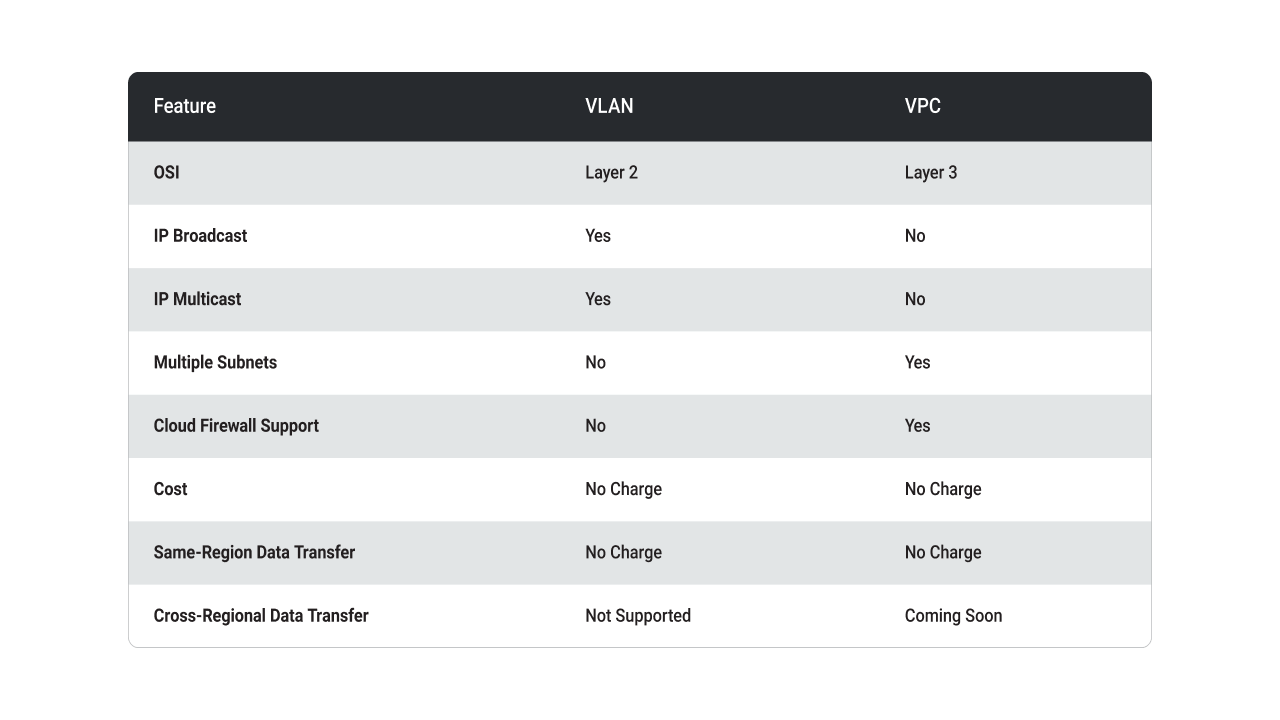
VPC: Layer‑3, software‑defined networking to segment workloads using private address space and routing. Ideal for most cloud‑native deployments.
VLAN: Layer‑2, broadcast‑domain isolation for workloads that require L2 adjacency, legacy protocols, or custom network appliances.
Key benefits
Keep back‑end services private while exposing only what’s needed to the internet
Isolate multi‑tier applications and separate environments (prod, dev, test)
Manage centrally via API, CLI, or Cloud Manager
Private Networking options are available to all Akamai Cloud customers at no additional cost. See limits, regional availability, and any service‑specific pricing in the docs and pricing pages.
Compute and Kubernetes: Attach Akamai compute instances and LKE‑Enterprise clusters to a VPC or VLAN to keep pod‑to‑service and service‑to‑database traffic private.
Ingress and load balancing: Use NodeBalancers to terminate public traffic at the edge while routing privately to your services.
Policy and access control: Use Cloud Firewall to define allow/deny rules that restrict east‑west and north‑south traffic within and to/from your private networks.
Tooling: Provision and manage private networks through API, CLI, or Cloud Manager.
Availability varies by region. Check feature support per data center: See availability
VPC vs. VLAN: which to choose for isolating tiers
Choose VPC when you want:
Simple, cloud‑native segmentation for multi‑tier apps (web, app, DB)
Route‑based controls with private subnets and firewall policies
Easiest day‑2 operations and compatibility with Kubernetes and modern services
Choose VLAN when you need:
Layer‑2 adjacency and broadcast support (e.g., specific discovery protocols)
Lift‑and‑shift of legacy applications that expect L2 networking
BYO virtual appliances that rely on L2 features
For most multi‑tier applications, start with VPC for security, scalability, and manageability. Use VLAN where L2 requirements are explicit.
Comparisons buyers ask about
Akamai VPC vs. Vultr private network for multi‑tier isolation and security:
Both provide region‑local private IP communication to keep back‑end services off the public internet.
Akamai adds the option of VLAN (L2) alongside VPC (L3), giving you an extra isolation model if your applications need L2 adjacency or legacy protocol support.
With Akamai, multi‑tier patterns are straightforward: attach public interfaces only to edge tiers (optionally fronted by NodeBalancers) and keep app/DB tiers private, then enforce traffic with Cloud Firewall.
As with any provider, exact capabilities and limits are region‑specific — review each provider’s docs for current features.
Akamai Cloud private networking vs. DigitalOcean VPC for back‑end isolation and internal service security:
Both offer L3 private networking to isolate internal traffic, with separate firewalling for granular access control.
Akamai offers both VPC (L3) and VLAN (L2), plus documented integrations with compute, LKE‑Enterprise, and NodeBalancers for private service communication.
Private Networking on Akamai Cloud is available at no additional cost; verify any ancillary service charges (e.g., load balancing, firewall, egress) on each provider’s pricing page.
Note: Providers evolve quickly. Validate specifics like regional scope, peering options, and feature limits in their current documentation.
What to look for in a private networking offering
Private address space with no default public exposure
Multi‑interface support (private‑only back‑ends; public edge where needed)
First‑class Kubernetes integration for pod/service networking inside private networks
Built‑in firewalling for L3/L4 policy (default‑deny, allow‑list)
Load balancers that can reach private endpoints without hair‑pinning through the public internet
API/CLI/IaC support for repeatable provisioning
Clear limits, regional availability, and no added cost for using private IP space
Akamai Cloud provides these via VPC and VLAN, Cloud Firewall, NodeBalancers, and full management via API, CLI, and Cloud Manager.
Best practices: isolating back‑end workloads in a multi‑tier architecture
Place web or API gateways at the edge with public interfaces or behind NodeBalancers.
Run application and database tiers on private interfaces inside a VPC (or VLAN if L2 is required).
Apply Cloud Firewall rules with default‑deny, allowing only:
Ingress from the edge tier to app services on required ports
App‑to‑DB traffic on specific ports from known subnets
Separate environments (prod, staging, dev) into distinct VPCs or VLANs to reduce blast radius.
Centralize secrets and limit egress from private tiers to approved destinations.
Use IaC to version and audit network policies and topology.
Features at a glance
Isolated networking: VPC (L3) and VLAN (L2)
Multi‑tier design: Mix private and public interfaces to control exposure
Central policy: Cloud Firewall for granular access control