


Artificial intelligence (AI) has revolutionized numerous industries, from healthcare to autonomous vehicles, by enabling systems to make intelligent decisions based on data. At the heart of these AI systems lies the process of AI inferencing, a critical phase where trained AI models are deployed to make predictions or decisions in real time. This process is essential for applications that require immediate responses, such as chatbots and self-driving cars, where the ability to process input data and generate outputs quickly can be a matter of safety and efficiency.
Introduction to AI inference
AI inference is the process by which a trained machine learning model takes input data and produces an output, such as a prediction or a decision. Unlike the training phase, which involves feeding large datasets into an algorithm to learn patterns and relationships, inference is the application of that learned knowledge to new, unseen data. This distinction is crucial in understanding the role of AI inference in real-world applications. For instance, in autonomous vehicles, the model must process sensor data in real time to make decisions about steering, braking, and accelerating, all of which require low latency and high accuracy.
In the realm of chatbots, AI inference enables natural language processing (NLP) to understand and respond to user queries in a conversational manner. This real-time decision-making is what makes AI applications like chatbots and virtual assistants so powerful and user-friendly. The ability to handle unseen data and make accurate predictions is a testament to the robustness of the trained AI model and the efficiency of the inference process.
AI training vs. AI inferencing
The development of AI systems involves two primary phases: the AI training phase and inferencing. During the AI training phase, AI models are fed large datasets to learn and identify patterns. This process often requires significant computational resources and time, as the model must iteratively adjust its parameters to minimize errors. The algorithms used in training, such as deep learning neural networks, are designed to optimize the model’s performance on the training data.
In contrast, AI inferencing is the deployment phase where the trained model is used to make predictions or decisions based on new, incoming data. The focus here is on low latency and real-time performance, as delays can be detrimental in applications like autonomous vehicles and real-time decision-making systems. The computational requirements for inference are generally lower than those for training, but they still demand efficient use of processors, such as GPUs (graphics processing units) and CPUs (central processing units), to ensure high performance and quick response times. To learn more about AI training and inference, read our introduction to machine learning training and inference.
The split between the two phases is not just conceptual. Because inference is live, continuous, and user-facing, it places almost completely opposite demands on infrastructure than training does. The video below covers what each phase requires, from the data it works with to the compute it runs on, and why that difference should shape how you plan capacity.
Steps in AI inference
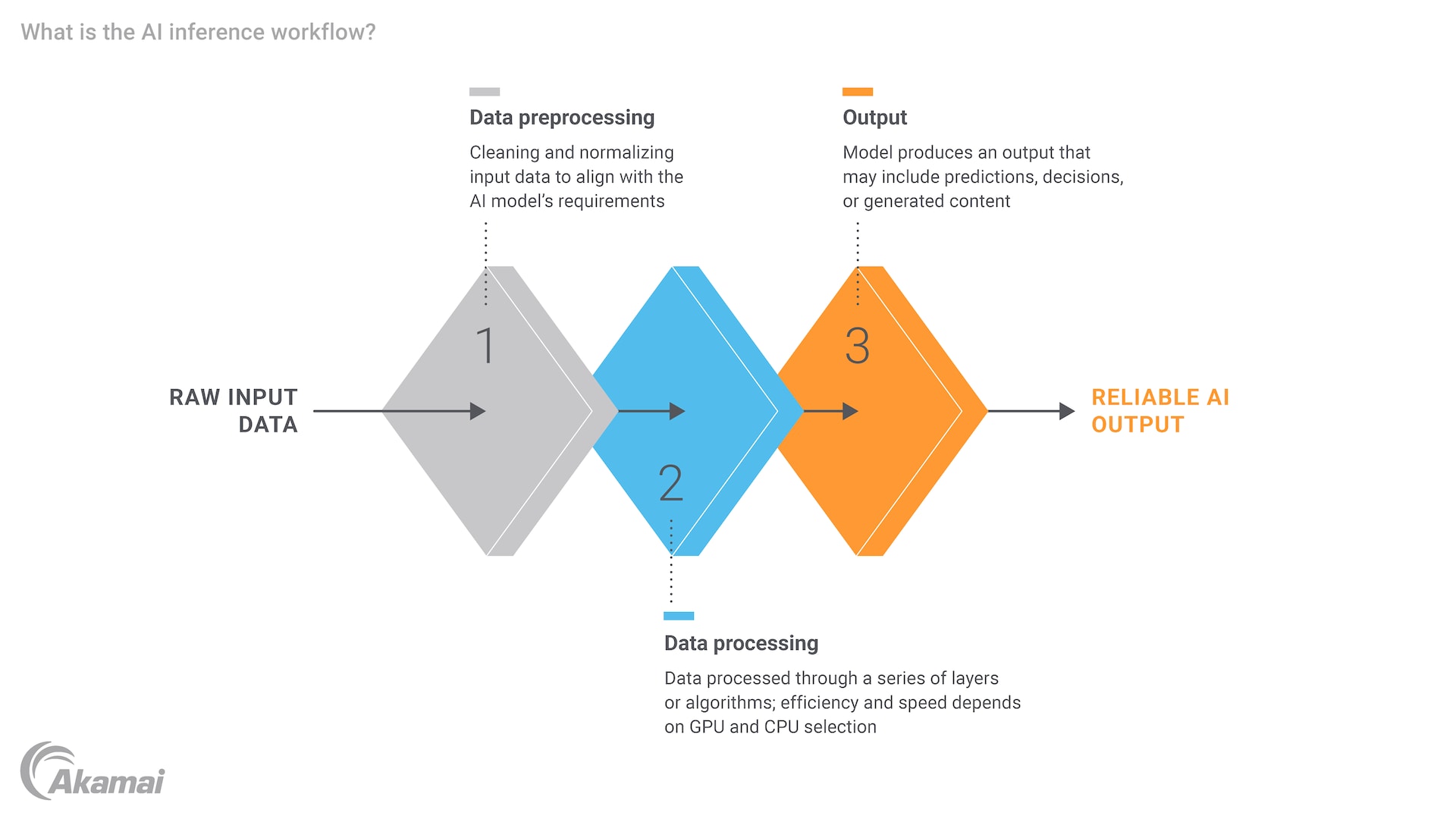
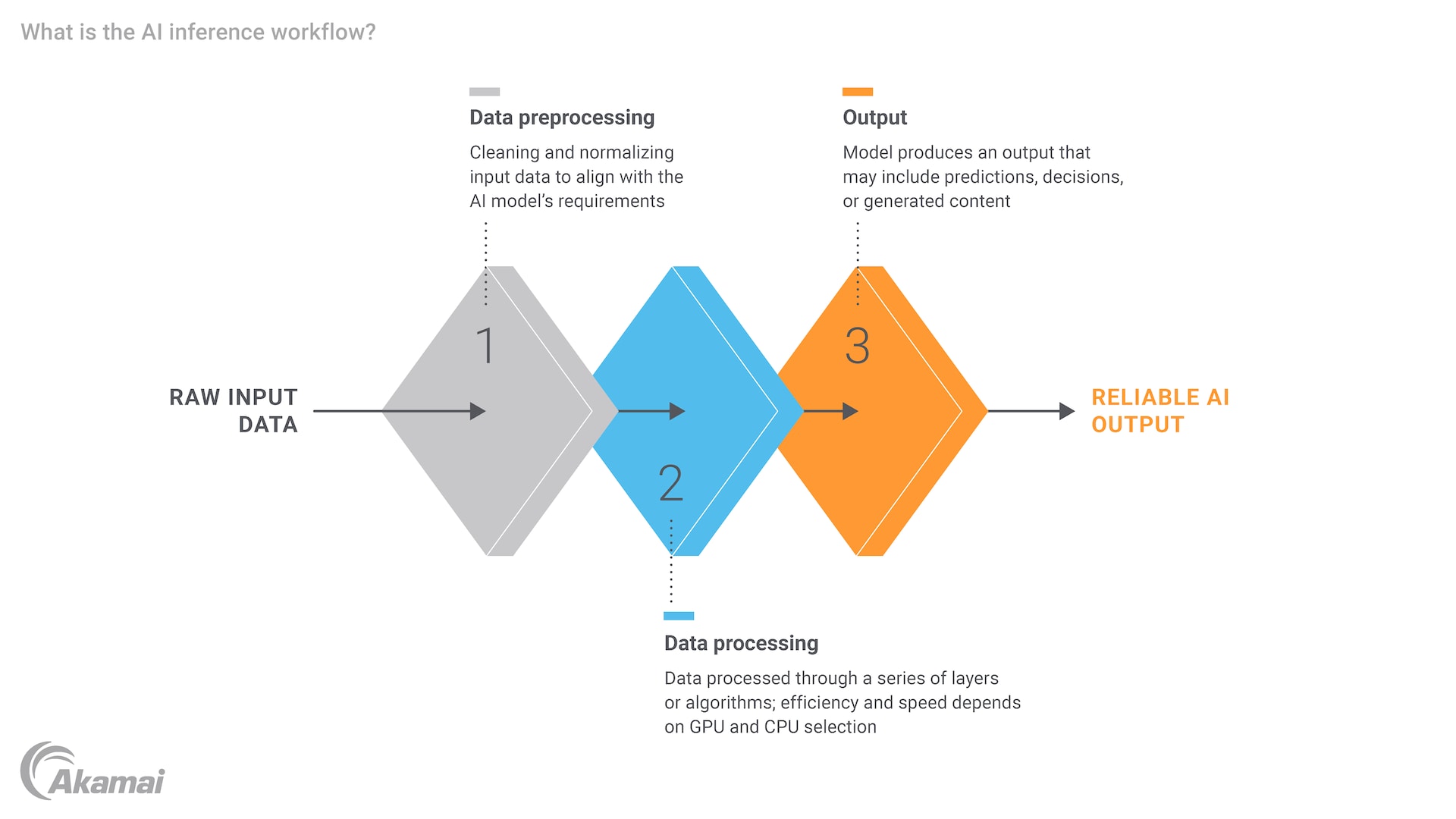
The process of AI inference involves several key steps, each requiring careful consideration of computational resources and efficiency. First, input data must be preprocessed to ensure it is in a format suitable for the model. This might involve normalizing data, converting text to numerical vectors, or resizing images. Once the data is prepared, it is fed into the trained AI model, which processes the input and generates an output. This output could be a prediction, a classification, or a decision, depending on the application.
For example, in a healthcare setting, an AI model might be trained to diagnose diseases based on medical images. During inference, the model would process a new patient’s image and provide a diagnosis, which could then be reviewed by a healthcare professional. The entire process must be efficient and accurate, as delays or errors could have serious consequences. The need for compute power and computational resources is evident, especially in scenarios where the model must handle large datasets and complex tasks.
The role of AI inference engines
An AI inference engine is a software component that manages the execution of trained AI models, optimizing for low latency and high-performance workloads. These engines are designed to handle the compute-intensive tasks of processing input data and generating outputs, ensuring that the model can operate efficiently in real-time environments. Advances in hardware, such as GPUs and CPUs, have significantly enhanced the capabilities of inference engines, allowing them to handle increasingly complex and data-intensive tasks.
For instance, NVIDIA has made significant contributions to the field of AI inference with its GPUs, which are particularly well-suited for parallel processing tasks. These GPUs can significantly reduce the latency of inference, making them ideal for applications that require real-time decision-making. Additionally, the rise of edge computing has further expanded the potential of AI inference, enabling processing to occur closer to the data source, reducing the need for data to travel to centralized data centers and improving overall performance.
Latency and time to first token in AI inference
Latency is the delay between a user asking for something and the system responding. It’s one of the most critical metrics in production-grade AI. It dictates customer satisfaction directly, and by extension, operational productivity and conversion rates. The video below covers where that delay actually originates, and why the answer is usually not the model itself.
Latency is easiest to act on when you measure the part of the experience users notice first. Time to first token, or TTFT, measures how long it takes a model to begin generating its response, rather than how long it takes to finish the entire answer. It is the metric that determines whether an application feels responsive or feels frozen.
This video covers the technical variables that influence TTFT, including model size, hardware queue lengths, and application architecture, and identifies the one bottleneck that tends to matter more than the rest.
Examples and use cases of AI inference
AI inference has a wide range of applications across various sectors, each leveraging the power of trained AI models to solve specific problems. In healthcare, AI inference is used for disease diagnosis, drug discovery, and patient monitoring. For example, a deep learning model trained on medical imaging data can quickly and accurately diagnose conditions like cancer or pneumonia, providing valuable insights to healthcare professionals.
In the Internet of Things (IoT), AI inference plays a crucial role in enabling smart devices to make autonomous decisions. For instance, a smart home system might use AI inference to adjust heating and cooling based on occupancy patterns, or a smart city might use it to optimize traffic flow and reduce congestion. Advancements in AI capabilities, particularly in object detection, have further enhanced these systems. The ability to process and respond to data in real time is essential for the seamless operation of these systems.
Another notable application of AI inference is in the realm of generative AI and large language models (LLMs). Models like ChatGPT, which are based on deep learning and neural networks, use inference to generate human-like text in response to user inputs. This has opened up new possibilities for natural language processing and has the potential to transform how we interact with AI systems, making them more intuitive and user-friendly.
Conclusion
AI inference is a critical component of modern AI solutions, enabling real-time decision-making and the application of trained models to new, unseen data. The distinction between training and inference is essential to understand, as each phase has its own set of requirements and challenges. While training involves building and optimizing models, inference focuses on deploying these models to make accurate and timely predictions.
The future of AI inferencing looks promising, with advancements in hardware, such as GPUs and edge computing, and the development of optimized inference engines. These advancements will not only improve the scalability of AI systems but also enable them to handle new data challenges and increasingly complex tasks. As AI continues to evolve, the importance of efficient and low-latency inference will only grow, driving innovation and opening up new possibilities in various industries.
