Network layers define how data transmission occurs across a computer network by separating communication functions into standardized layers. This layered approach improves interoperability between network devices and software applications, simplifies troubleshooting, and enables reliable communication across different networks.
In computer technologies, network layers are a conceptual framework that provides a common understanding of how a computer network is architected and how different technologies interrelate to enable network communications. Network layers define how data moves from an end user and their endpoint (such as a laptop or mobile device) through the network to a receiving device, and how that data is reassembled at its destination. Two network architecture reference models are widely referenced today: the Open Systems Interconnection (OSI) model and the TCP/IP model.
There are also many network protocols, such as User Datagram Protocol (UDP) and Internet Control Message Protocol (ICMP), that operate within these layered models. For example, UDP functions at the transport layer, while ICMP operates at the network (internet) layer. The TCP/IP model originated from research funded by the U.S. Department of Defense for ARPANET. It is sometimes referred to as the DoD model due to its historical origins.
Why is a network layer framework needed?
Computer networks are highly complex technologies that involve multiple types of software applications, operating systems, computers, routers, switches, firewalls, network interface cards (NICs), repeaters, and wireless technologies such as Wi-Fi. A framework that divides all this technology into different categories or layers helps to organize system communications, define syntax and rules for data units, and troubleshoot issues more efficiently. The network layer framework also enhances vendor interoperability by creating standards for how network layer protocols operate and how checkpoints for flow and error control are enforced. By clearly defining how each layer interacts with the layers above and below it, network layers ensure consistent behavior across Ethernet, wireless, and other networking environments.
What is the OSI model for network layers?
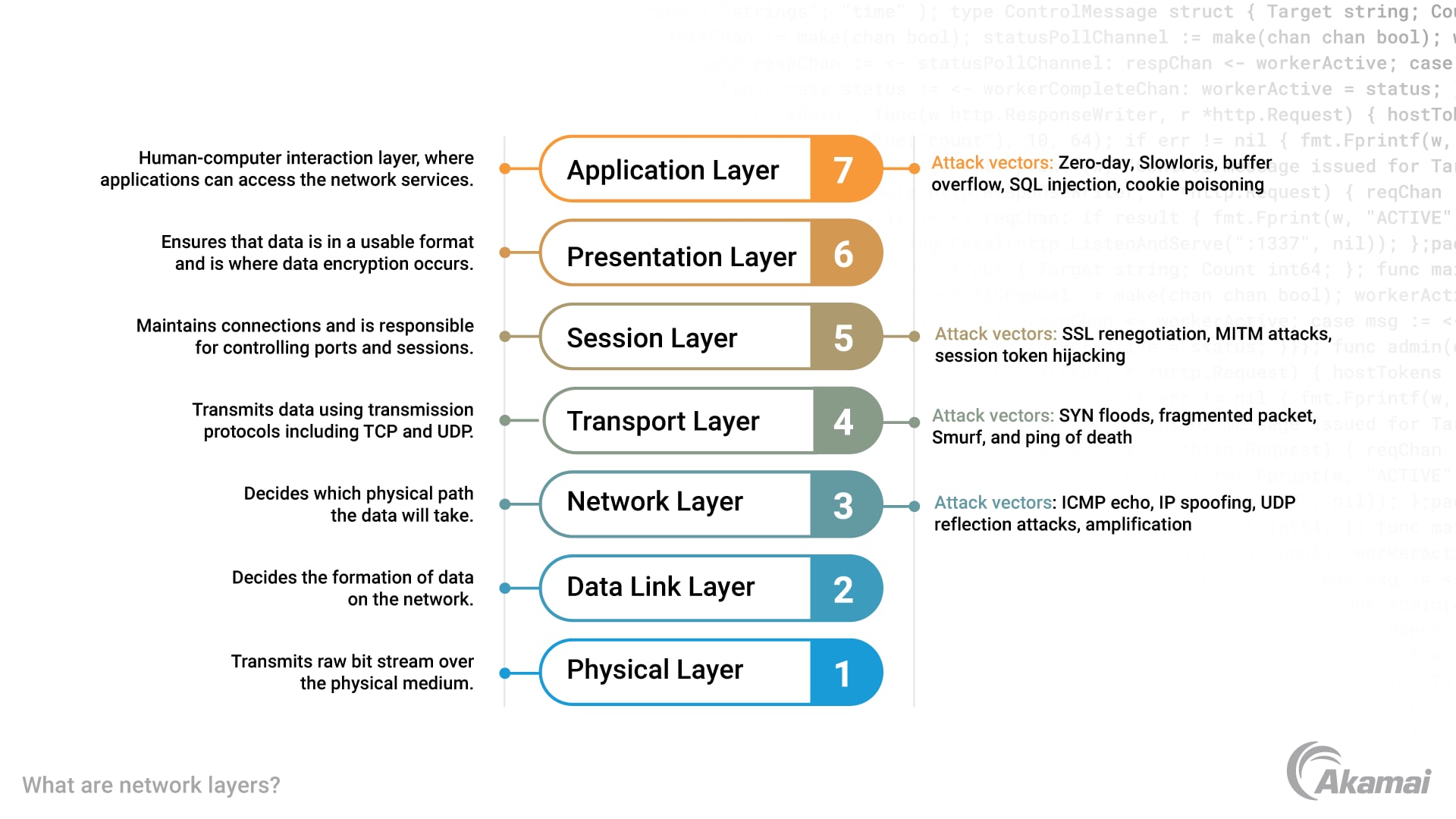
The OSI model (Open Systems Interconnection) was developed by the International Organization for Standardization (ISO) and first published in 1984. The OSI reference model breaks down complex network systems into seven discrete layers based on the type of tasks performed and the role of each system within the networking stack. The OSI network layers include:
- Layer 1 — the Physical Layer. The physical layer sends and receives raw bit streams over a physical medium, such as cables, fiber optics, or wireless signals. It defines hardware components, signaling, and transmission characteristics used by network devices.
- Layer 2 — the Data Link Layer. This layer encapsulates network-layer packets into frames for transmission over the physical medium. This layer handles physical addressing by managing access to shared media through Media Access Control (MAC), including Logical Link Control (LLC) sublayers for flow control and error checking.
- Layer 3 — the Network Layer. The network layer is responsible for forwarding and routing data packets efficiently across multiple networks. It uses logical addressing such as IP addresses, including IPv4 and IPv6, to determine the best path for data delivery between endpoints.
- Layer 4 — the Transport Layer. This layer coordinates end-to-end, connection-oriented or connectionless data transfer between hosts. It manages segmentation, reassembling, and reliability through mechanisms like acknowledgments, flow control, and error recovery.
- Layer 5 — the Session Layer. The session layer manages the communication sessions and synchronization between applications on different devices. It manages session establishment, synchronization, and termination between applications. In modern TCP/IP implementations, many session-related functions are handled within application-layer protocols.
- Layer 6 — the Presentation Layer. This layer translates data for the application layer, handling data formatting, compression, encryption, and decryption to ensure consistent interpretation of information.
- Layer 7 — the Application Layer. This layer provides network services directly to applications, including protocols used by web browsers, email clients, and file transfer tools.
What is the TCP/IP model for network layers?
The TCP/IP model is another widely used reference for understanding network layers. The four layers of the TCP/IP model include:
- The application layer. This layer combines the application, presentation, and session layers of the OSI model. The application layer provides application-specific protocols for services like web browsing (HTTP), email (SMTP), and file transfers (FTP). DNS services also operate at the application layer.
- The transport layer. This layer maps to the transport layer of the OSI model and manages communication services, including reliable transmission through the transmission control protocol (TCP) or connectionless datagram delivery through the User Datagram Protocol (UDP).
- The internet layer. This layer is equivalent to the network layer in the OSI model and is responsible for addressing, routing, and managing the fragmentation of IP packets. In addition to the internet protocol (IP), ARP, IGMP, and ICMP also operate at this layer.
- The network access layer. This layer correlates to the physical and data link layers of the OSI model and handles the data transmission over specific physical networks.
What are the differences between OSI and TCP/IP?
In general, the OSI model provides a more comprehensive and modular framework, while TCP/IP is a simpler model with practical relevance and widespread adoption.
- OSI is a generic, protocol-agnostic model designed to encompass and describe all forms of network communication. In contrast, TCP/IP is a functional model that’s based on specific, standard protocols to address specific communication issues.
- In the modular framework of the OSI model, each OSI layer is distinct and has specific functions, allowing for easier troubleshooting and interoperability of protocols between layers. OSI also provides a standardized framework for network communications, enhancing compatibility and interoperability between different vendor products.
- The TCP/IP model aligns closely with the actual implementation of network protocols used on the internet today. Its flexibility and simplicity make it suitable for a wide range of network sizes and topologies.
Frequently Asked Questions
The OSI model benefits network administrators by providing a seven-layer framework that isolates network functions into clear checkpoints. This structure makes it easier to identify, troubleshoot, and resolve issues related to physical connections, data link errors, network routing, transport reliability, or application performance.
Imagine sending an email from your computer to a friend across the world. The Application Layer handles your email client, the Transport Layer ensures your message arrives intact, and the Network Layer routes it through different networks, all following the OSI model’s principles.
If a network layer fails, it can disrupt communication. For example, a failure in the Data Link Layer can prevent frames from being transmitted using MAC addresses, even if higher network layers such as IP routing or application protocols are operating normally.
Yes, While the OSI model is a conceptual reference with seven layers, the TCP/IP model is a practical networking model that combines layers and reflects how network layer protocols are implemented on the internet today.
Why customers choose Akamai
Akamai is the cybersecurity and cloud computing company that powers and protects business online. Our market-leading security solutions, superior threat intelligence, and global operations team provide defense in depth to safeguard enterprise data and applications everywhere. Akamai’s full-stack cloud computing solutions deliver performance and affordability on the world’s most distributed platform. Global enterprises trust Akamai to provide the industry-leading reliability, scale, and expertise they need to grow their business with confidence.