Myota, the cyberstorage provider known for its patented Shard & Spread™ technology, needed a cloud partner that supported its vision for uncompromising resilience and Zero Trust data protection. The team struggled with rigid design patterns on its previous cloud provider, limiting its ability to build a fully distributed, ultra-secure storage platform. By moving to Akamai cloud computing services, Myota gained the flexibility, openness, and reliability required to deliver a global, always-available cyberstorage platform while accelerating development velocity.
[00:00 - 00:23] Myota Overview & Cloud Infrastructure: Myota is the sole provider of storage-native security that makes infrastructure resilient to IT and cyber issues. As a security-first organization, Myota runs a globally distributed, highly available, zero-trust cyber object storage platform that operates entirely on the Akamai platform.
[00:23 - 00:46] Resiliency Philosophy & Akamai Partnership: Built on the philosophy that data should be resilient, portable, and accessible from anywhere at all times despite IT or security control failures, Myota partnered with Akamai to gain the flexibility, portability, and freedom required to build their platform.
[00:46 - 01:21] Customer Impact & Future Outlook: Myota's partnership with Akamai delivers immunity from downtime, IT failures, and ransomware attacks; during recent news-making outages across other storage providers, Myota customers experienced no outages or SE 1 issues. Myota aims to continue working closely with Akamai to bring secure, highly available storage globally and make cloud outage headlines a thing of the past.
Delivering uncompromising data resilience and security
Breaking free from rigid hyperscaler patterns
As the only data security and ransomware prevention solution that guarantees 100% data security and availability, Myota launched its business with on-premises infrastructure. It soon shifted to AWS, but quickly ran into architectural barriers.
Myota’s goal from the start was to reinvent how data infrastructure withstands ransomware, regional outages, and IT failures. Its mission required a cloud partner that didn’t force it to conform to prescriptive design patterns.
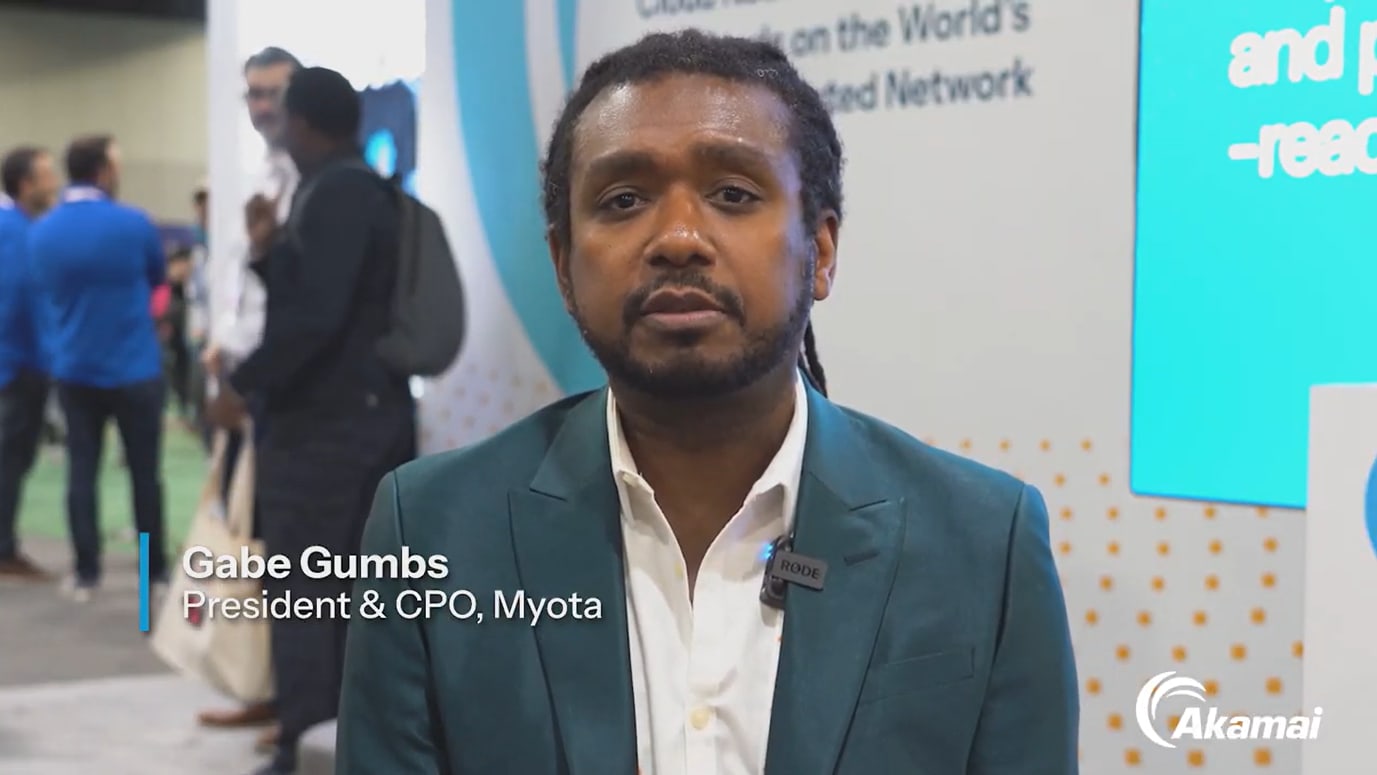
“We set out to improve the resilience of cloud data infrastructure, but our early cloud setup didn’t enable that,” said Gabe Gumbs, president and CPO. “We were constrained by design patterns that made it impossible to build the platform we envisioned.”
According to Gumbs, those constraints included not being able to easily extend data across regions or protect data by splitting it across accounts.
The limitations were more than technical. Hiring became harder because engineers needed deep expertise in one specific cloud ecosystem. Myota wanted an open environment that allowed it to diversify both its technology and talent pool.
Choosing a cloud provider with a shared resilience philosophy
Myota prioritized resilience, openness, and freedom of movement when evaluating new cloud platforms. Gumbs said the team sought a partner aligned with its belief that infrastructure should operate from anywhere, at any time, without failure.
“We are a security-first organization,” Gumbs said. “We wanted a partner who shared our resilience philosophy. We got that with Akamai.”
Myota adopted several Akamai cloud computing services to support its global cyberstorage architecture:
- LKE: Managed Kubernetes Engine: This fully managed Kubernetes service simplifies deploying and managing containerized applications, enabling Myota to orchestrate across distributed nodes in a portable, flexible way.
- Accelerated Compute: These specialized cloud computing resources designed for demanding tasks deliver the performance Myota needs for intensive cryptographic and storage operations.
- Object Storage: This globally available, highly durable, and scalable storage for unstructured data provides a foundation for Myota’s Zero Trust cyberstorage platform.
Building a resilient, distributed, secure platform
Implementation on Akamai was smooth and fast. Myota encountered none of the complexity or hidden architectural constraints of hyperscalers.
“Everything just worked,” Gumbs said. “With the other cloud providers, you are forced to work around a lot of undocumented features. Akamai’s open technology worked the same across platforms.”
This consistency allowed Myota to deploy a globally distributed, highly available, secure object storage platform.
Hands-on cloud expertise kept Myota moving fast
Akamai’s support allowed Myota to enhance its platform without slowing deployment or compromising on its core Zero Trust principles. Throughout the migration from AWS to Akamai Cloud, Myota worked closely with Akamai’s engineering team, especially as it built its ultra-secure storage platform on top of Object Storage. “The Akamai team was fabulous,” Gumbs said. “It was responsive, knowledgeable, and met every challenge.”

Delivering immunity from outages and ransomware
With the entire Myota technology stack running on Akamai, the company can deliver its Zero Trust cyberstorage service with confidence. Myota’s Shard & Spread technology, paired with Akamai’s resilient global cloud, enables immunity from downtime, IT failures, and ransomware attacks.
Myota customers experienced measurable benefits almost immediately. When other storage providers face service disruptions, Myota and its customers remain fully operational.
“When you read about outages across other storage providers, those leveraging the Myota–Akamai platform do not experience them,” Gumbs continued. “Severity 1 issues simply don’t exist.”
Accelerating innovation with open, flexible tooling
In addition to improving resilience, Akamai’s open architecture sped up development. This velocity helps Myota push product innovation faster while maintaining its strict security and resilience standards.
Gumbs estimated at least a threefold improvement in development velocity. “The open tooling allows us to build exactly what we need,” he said. “We aren’t forced to build around rigid architectural constraints.”
Myota plans to continue working to eliminate the headlines of cloud outages and ransomware-related downtime. “Our vision is to make availability challenges a nonissue, whether due to regional outages or ransomware. With Akamai, we can help the world move past the fear of outages,” Gumbs concluded.
About Myota
Myota is a leading cyberstorage solution that provides active defense at the storage layer through proven/patented Shard & Spread technology. Myota encrypts each file at the moment it is written and uses cryptographic secret sharing to shard the data, metadata, and encryption keys, spreading the resulting bits of data across multiple storage repositories. Advanced mathematical techniques make it computationally impossible for attackers to reconstitute sharded data, while at the same time allowing data owners to instantly and completely reconstruct their data even if fragments are lost or unavailable. Myota is proven to successfully eliminate data risk and enable instant rewind while cutting storage infrastructure costs by 50%.
About Akamai
Akamai is the cloud company that powers and protects an AI-driven world. Our cloud platform extends high-performance cloud computing from the core to the edge, enabling organizations to build and scale next-generation AI applications and providing comprehensive, multilayered security to safeguard enterprises against evolving cyberthreats. Learn more at akamai.com and akamai.com/blog, or follow Akamai Technologies on X and LinkedIn.