


AI-powered threats are often not novel zero-day vulnerabilities by themselves. However, attackers can use AI to automate reconnaissance, personalize social engineering campaigns, identify latent vulnerabilities, and orchestrate attacks that quickly learn and adapt according to defensive responses. Additionally, the time between discovering vulnerabilities to exploiting them has collapsed from weeks and months to hours and minutes. This is the real risk in the AI era.
AI Threat Landscape
AI is changing how humans and agents get work done and how attackers rapidly turn exposure into business disruption
People are increasingly using AI agents now to transfer data, call APIs, invoke tools, and connect services across cloud and on-prem environments. At the same time, AI helps attackers discover and exploit weaknesses faster. Resilient security must follow each interaction as AI-enabled work evolves.
Akamai AI Security secures AI-driven work and digital interactions with intelligence that adapts in real time
Akamai brings together visibility, edge-to-client enforcement, and east-west containment to reduce exposure, govern human and agent activity, protect applications and APIs, and contain attacks before they spread.
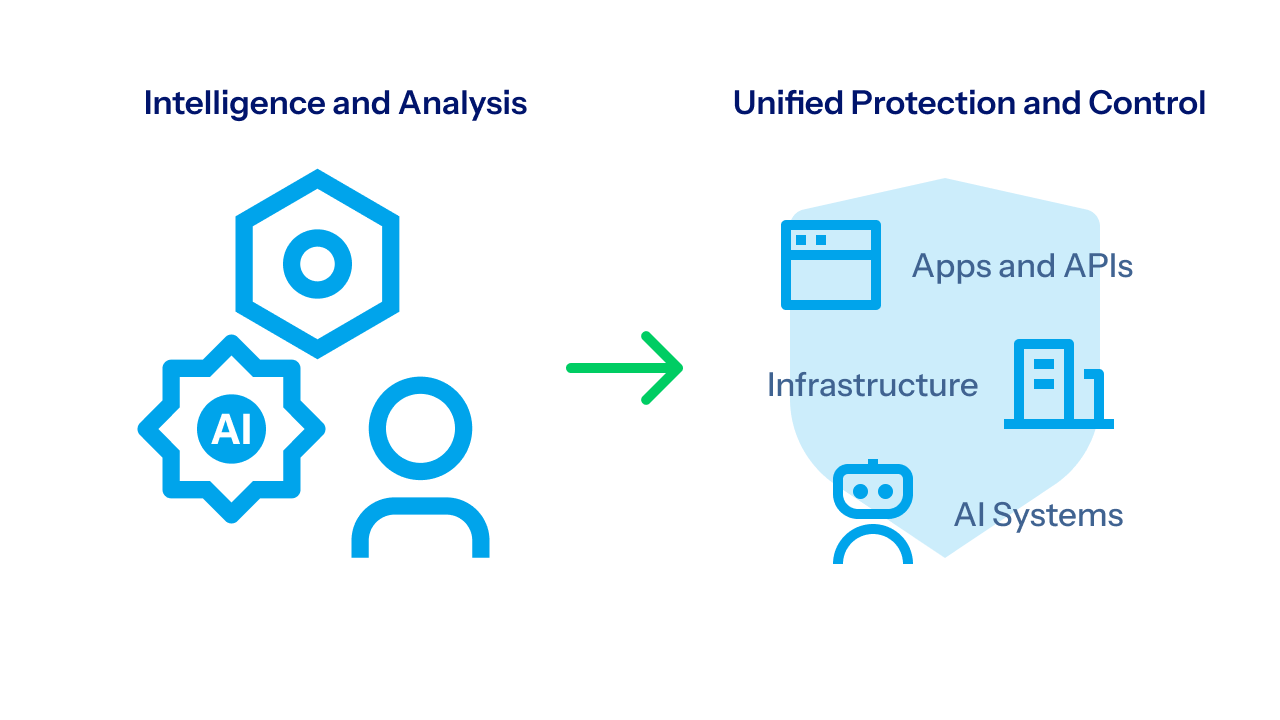
Reduce the attack surface with collective and behavioral intelligence that learns faster than attackers
AI-powered behavioral analysis and human security experts rapidly identify emerging attack TTPs, business logic abuse, API threats, and bot attacks. Apply these insights across applications, APIs, AI systems, user interactions, and infrastructure to proactively reduce exposure.
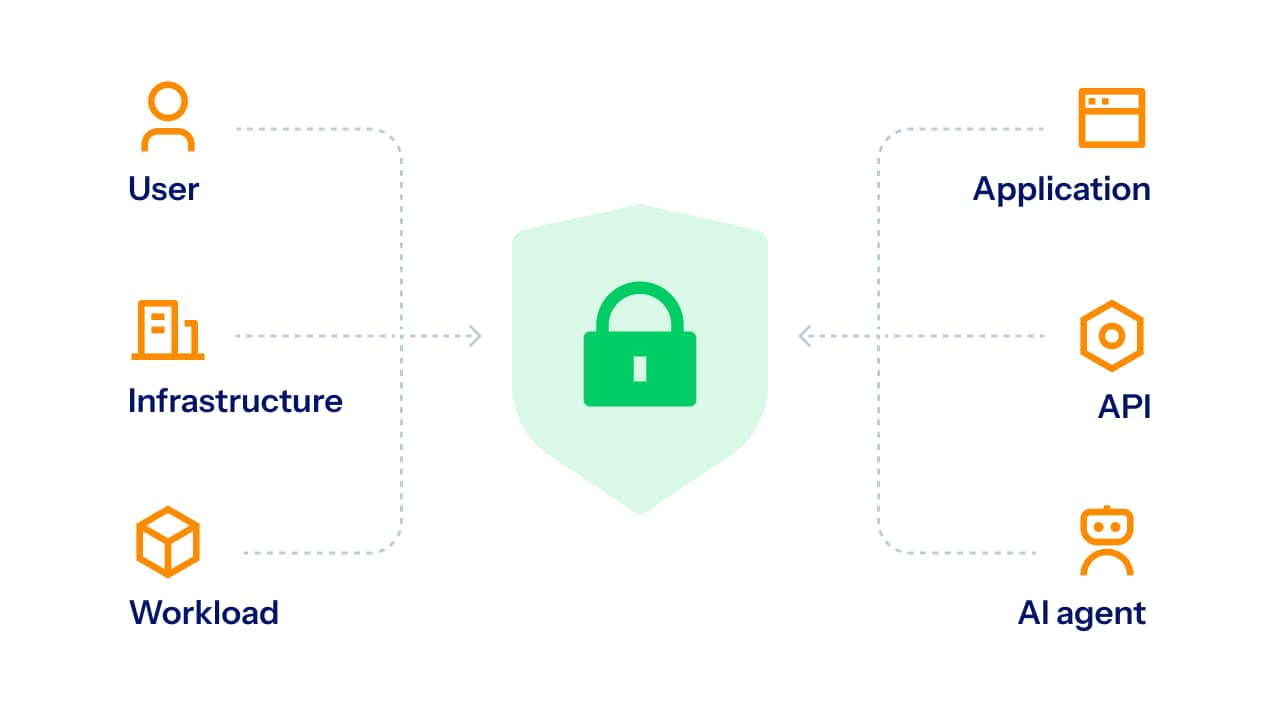
Limit lateral movement and secure every human and agentic interaction
Limit lateral movement and minimize the blast radius by implementing granular security controls throughout your distributed environment.
Enforce adaptive governance across users, applications, APIs, and AI agents by continuously validating intent, identity, and behavior.
Validate and enforce security controls as your AI environment rapidly changes and evolves
Ensure that security policies and controls adapt in real-time and remain effective in an evolving AI-driven environment. Fragmented security can leave you vulnerable to advanced AI-powered attacks. Akamai helps verify controls, identify unintentional policy drift, and quickly remediate gaps in your security posture.
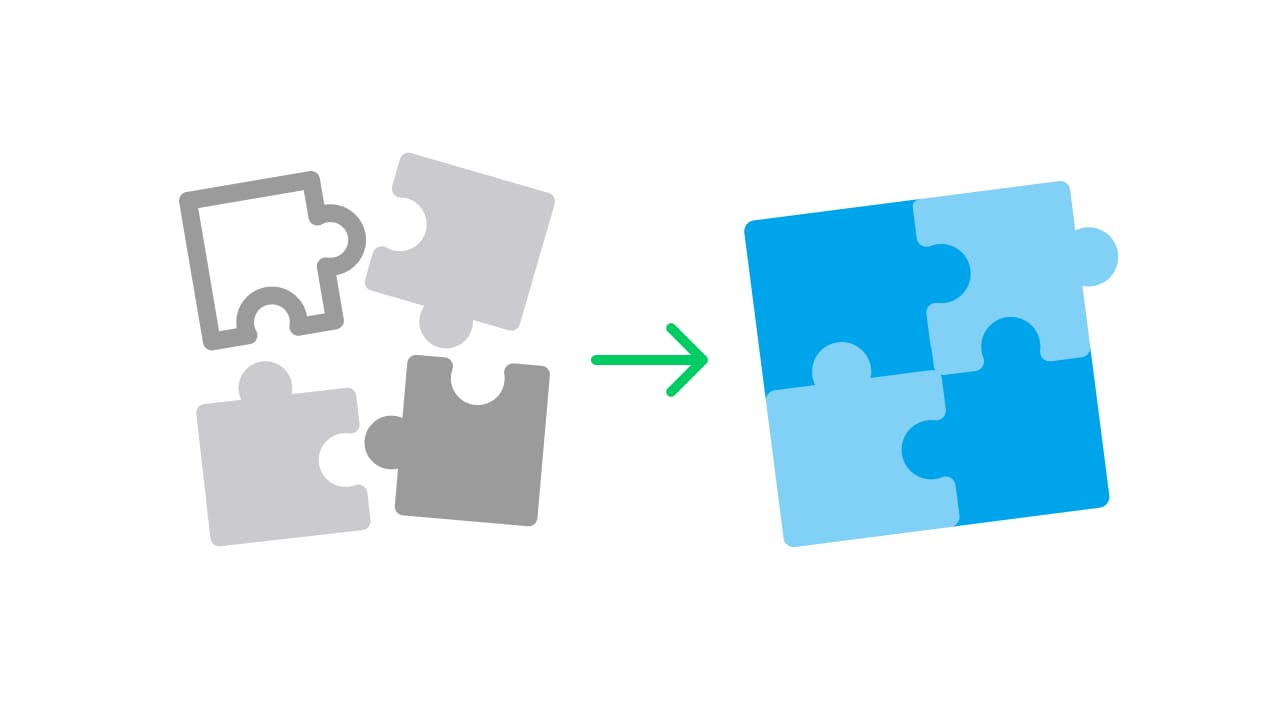
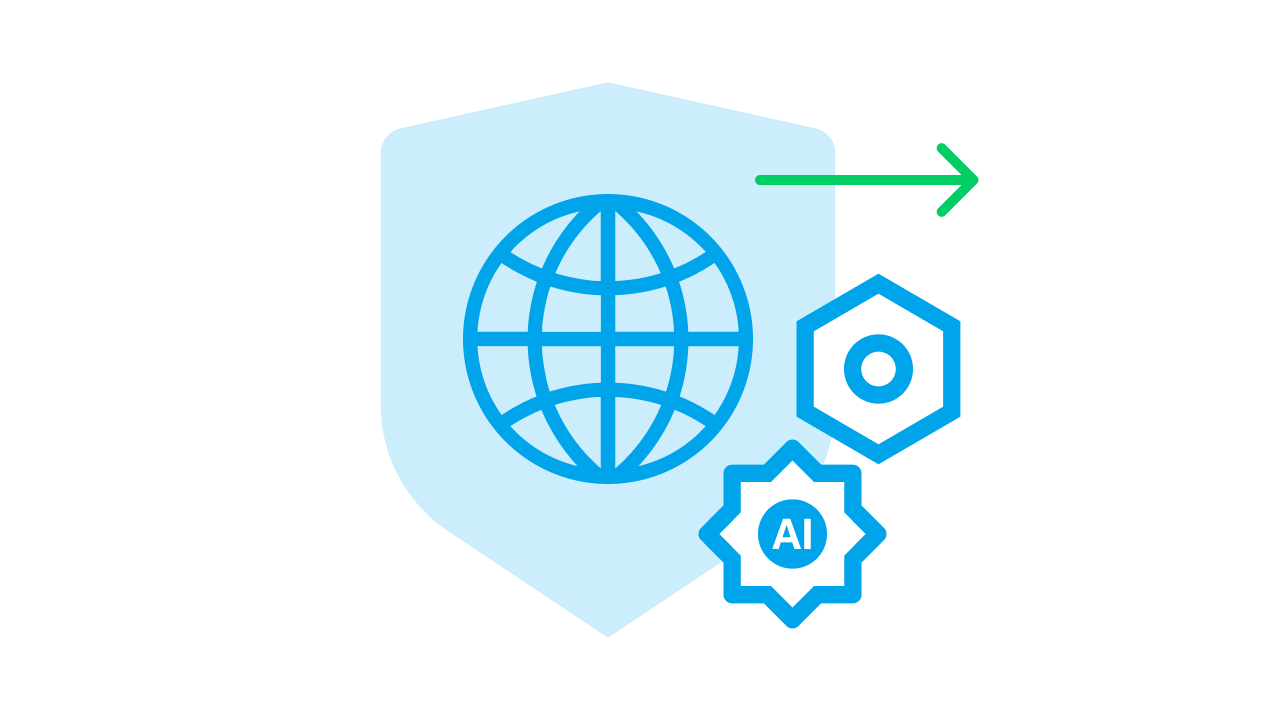
Build resilience by reducing exposure, containing attacks, and maintaining effective controls as AI-driven work evolves
Prevention remains essential, but it is no longer enough. Organizations must assume some attacks will succeed — and design security to adapt, contain disruption, recover quickly, and minimize business impact. Akamai’s distributed scale, intelligence, automation, and solutions portfolio provide the foundation for cyber resilience in the AI era.
How AI security works
Secure AI interactions, applications, APIs, and critical infrastructure against automated threats
Akamai’s AI security solutions, supported by a global edge platform and real-time threat intelligence, help you:
- Govern user and agentic AI interactions
- Protect your business-critical applications, APIs, and enterprise AI models
- Build resilient infrastructure that powers your AI workloads and minimizes lateral impact
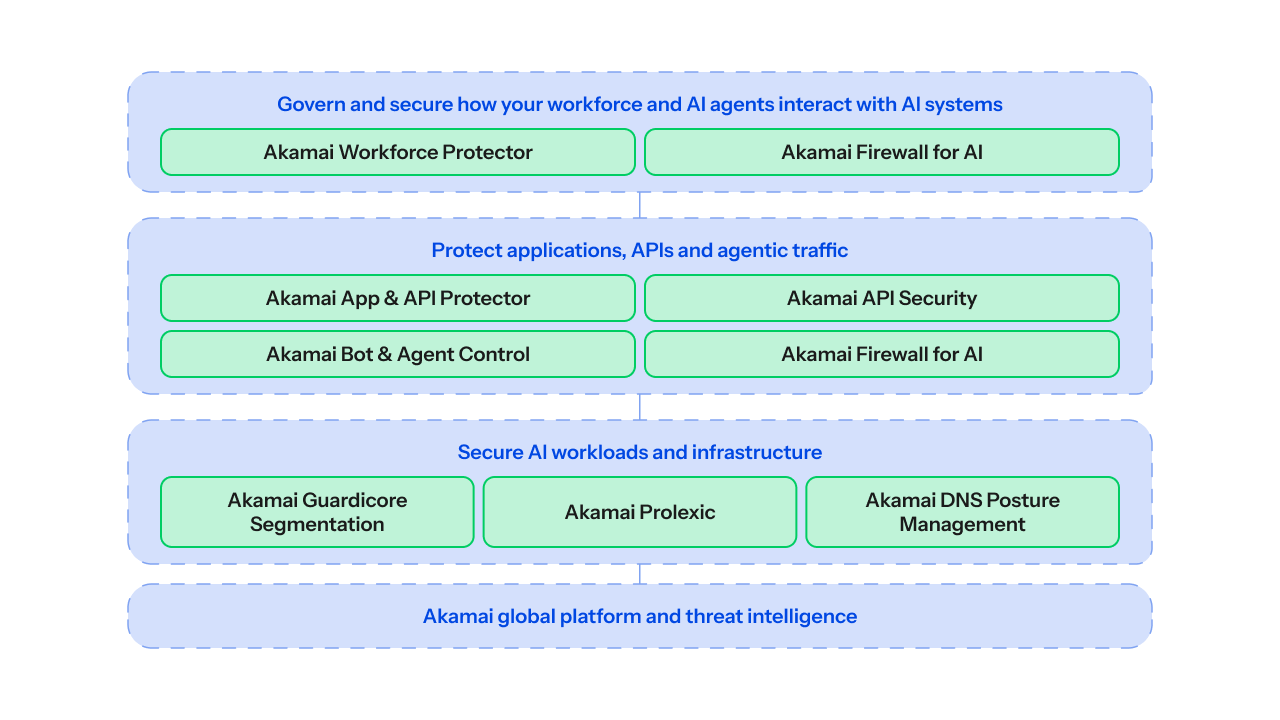
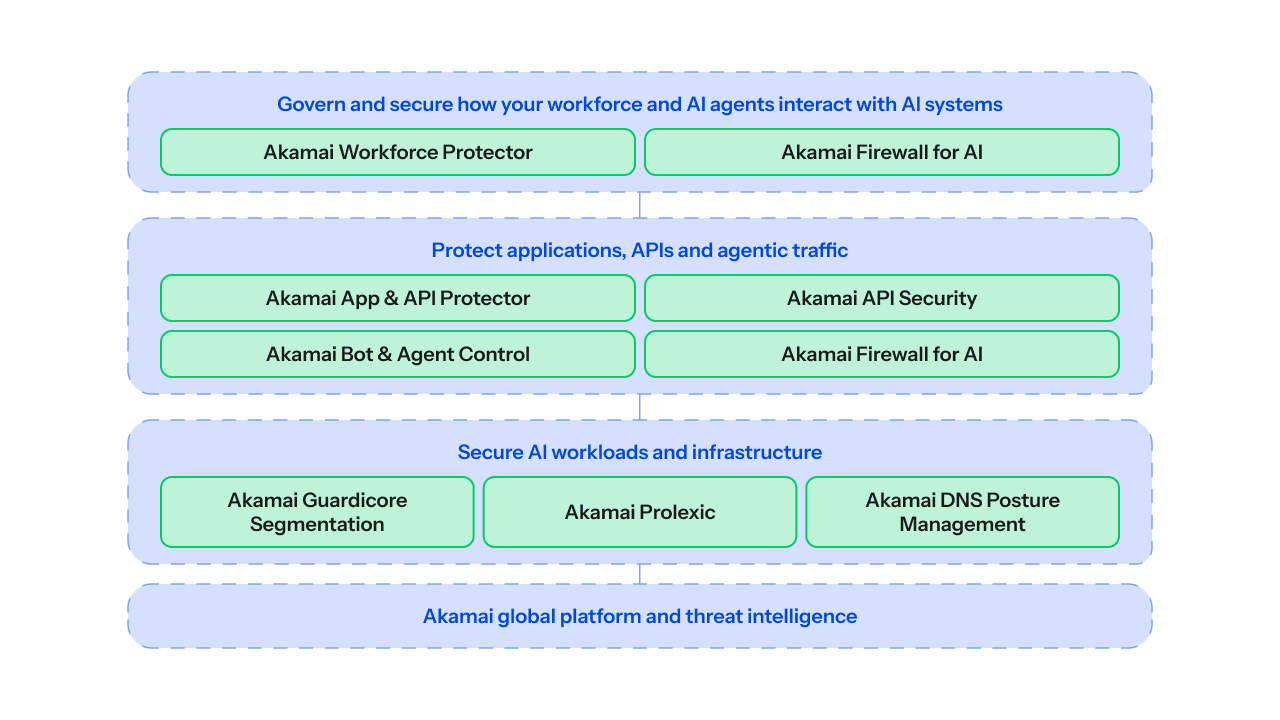
Explore Akamai solutions to govern and protect your AI interactions, workloads, apps, and infrastructure
AI-powered attacks can discover, weaponize, and exploit vulnerabilities in minutes. Akamai helps customers protect business operations from these threats. We provide a comprehensive solution set, real-time adaptive intelligence, and human experts to prevent and contain attacks.
Secure your network from lateral movement and limit the blast radius
Drive operational resilience and protect your enterprise applications, hybrid networks, and critical data with Zero Trust controls that limit lateral movement and minimize business disruption.
Use microsegmentation to reduce the blast radius of compromised systems and prevent threats from spreading across your environment. Enforce minimal required permissions and validate trust boundaries for human users as well as agentic interactions.
Secure applications, APIs, and AI applications
Discover and reduce risk across applications, APIs, and AI applications with visibility, testing, and adaptive protection.
Use AI-powered detections, edge protections, and rapid virtual patching to reduce exposure while security teams investigate and remediate threats.
Protect critical infrastructure from AI-powered attacks
Strengthen the security posture of your distributed and hybrid infrastructure with intelligent protection that detects risks and security gaps, and enforces consistent policies on-prem, in the cloud, and at the edge.
If your DNS goes down, your online presence goes down. Monitor DNS activity, identify misconfigurations, and protect multicloud DNS environments while defending against faster, more adaptive AI-powered DDoS attacks.
Stop bots, agents, and automated abuse
Identify and manage requests from users, bots, scripts, headless browsers, and AI-driven agents before abuse escalates.
Detect malicious automation, protect digital experiences, and reduce the impact of automated attacks with intelligent controls that adapt to evolving threats.
Protect your enterprise AI systems from inbound attacks and prevent sensitive data exposure
Enterprise AI systems often contain valuable proprietary knowledge and sensitive datasets, making them prime targets for attackers.
Secure your AI systems by applying guardrails to the inbound and outbound interactions.
Prevent prompt injections, jailbreaking, policy violations, sensitive data exposure, and unsafe model behavior.
Secure human and agentic AI interactions
While AI-powered systems are enablers for innovation, they also introduce a new risk surface for enterprises.
Control prompts, responses, agent actions, and data exchanges across AI systems, SaaS, web, and desktop applications with real-time visibility, centralized policy management, cloud intelligence, and adaptive enforcement at the interaction layer.

Frequently Asked Questions (FAQ)
Frequently Asked Questions (FAQ)
CISOs and enterprise security leaders should approach AI with governed adoption rather than unrestricted experimentation or an outright prohibition. This requires establishing enterprise-wide policies that define approved AI tools and use cases, enforce Zero Trust controls on how sensitive data is accessed by AI agents or AI-powered software, ensure that enterprise AI models are secured from malicious prompt poisoning, and align controls with the potential business and regulatory impact of each use case.
There are several areas which can be exploited by AI-powered attacks, including:
- Inadequately protected attack surfaces. For example, unintentional policy drift and inadequate protections for APIs, DNS, applications, and network subnets can be exposed to AI-powered exploitation.
- Inadequate segmentation and Zero Trust policies that allow AI agents to operate at maximum privileges by invoking APIs, retrieving sensitive data, or executing code. Additionally, these policies cannot limit lateral movement of AI-enabled attackers if and when they breach an organization’s network.
- Use of unauthorized shadow AI by employees.
AI systems are not an attack vector by themselves. They leave no signature and often operate as a reasoning layer that accelerates the discovery of latent vulnerabilities and create adaptive attacks. No security solution provider can claim to prevent all AI-powered cyberattacks.
However, Akamai offers a comprehensive set of AI security solutions that help organizations proactively discover vulnerabilities, reduce their exposure, limit lateral movement, govern and secure agentic interactions, and adopt a robust security posture. Akamai’s global scale, distributed edge capacity, real-time adaptive intelligence, and global team of human security experts offer customers the most effective security against AI-enabled threats.
Akamai helps enterprises secure their AI systems from inbound attacks and prevent sensitive data exposure by providing a dedicated LLM firewall. Akamai's solution actively defends against prompt injection, jailbreaks, and leakage of sensitive or personally identifiable information. The solution also provides audit trails and the model governance required to maintain compliance and align with industry frameworks.
An effective AI security solution should provide visibility into where AI is being used, protect AI applications and APIs, control access to models and data, detect malicious or abnormal activity, and prevent AI systems from taking unauthorized actions.
AI security solutions integrate with an organization’s existing security architecture instead of creating an isolated control plane. The solutions must be model agnostic and must protect the entire digital estate surface, including hybrid environments and on-prem systems.
Finally, the highest impact AI security solutions are supported by a global distributed infrastructure that collects intelligence at the edge in real time, can enforce security at the edge in real time, and combine human security expertise to complement automated signals.
Resources

Prepare your defenses for AI-driven risk
Advanced AI capabilities can accelerate discovery, probing, and exploitation by threat actors before teams can react. Talk to Akamai about how to:
- Identify exposed applications, APIs, and attack paths
- Contain lateral movement and reduce the blast radius
- Stop bots, agents, and automated reconnaissance
- Protect applications and APIs while remediation is underway
- Strengthen layered defenses for AI-accelerated threats