





Akamai acquires LayerX, delivering end-to-end security and real-time AI usage control to any browser. Get details

The Grim SessionReaper (CVE-2025-54236) Comes to Collect for Halloween

Akamai SIG is a global team of world-class researchers, engineers, strategists, and data scientists with a broad range of expertise and security disciplines. Our data sources include the enormous Akamai Cloud, open sources, collaboration with third parties, and dark web intelligence. We have also developed our own algorithms and tools that help us deliver our research and keep Akamai security solutions up to date.

Share

Executive summary

  • Akamai security researchers have observed activity in the wild of the critical improper input vulnerability in Magento dubbed SessionReaper (CVE-2025-54236).

  • The flaw was originally made known on September 9, 2025, in a publication by Adobe that included an emergency patch. On October 22, 2025, an exploit proof of concept (POC) was made public, sparking a dramatic increase in activity.  

  • Magento’s ubiquity and history of critical vulnerabilities make it an attractive target for threat actors. 

  • Given the widespread use of Magento and the critical nature of this vulnerability, organizations should apply the patches provided by Adobe as soon as possible

  • Akamai Adaptive Security Engine, our web application firewall (WAF), has been mitigating exploit attempts by default.

What is SessionReaper?

Published as CVE-2025-54236, SessionReaper is the name given to the latest critical vulnerability present in the widely used ecommerce platform Magento (now known as Adobe Commerce). The issue is described as an improper input validation vulnerability that can be abused to achieve session takeover.

However, as public POC’s have demonstrated, successful exploitation of SessionReaper can also result in unauthenticated remote code execution.

Observed attack traffic

Attackers have taken notice since the POC became public. Over the course of 48 hours, starting on October 22, 2025, more than 300 exploitation attempts were made against over 130 different hosts. These exploit attempts originated from 11 different IPs.

Akamai security researchers observed multiple payloads used in exploit attempts (Figure 1). The most damaging payloads are web shells designed to allow a threat actor to gain persistent access to the web server.

Akamai security researchers observed multiple payloads used in exploit attempts (Figure 1). Fig. 1: SessionReaper web shell payloads

Additionally, classic phpinfo and echo probes, a common attacker reconnaissance measure, were observed (Figure 2).

Additionally, classic phpinfo and echo probes, a common attacker reconnaissance measure, were observed (Figure 2). Fig. 2: SessionReaper phpinfo and echo probes

Mitigating with Akamai App & API Protector

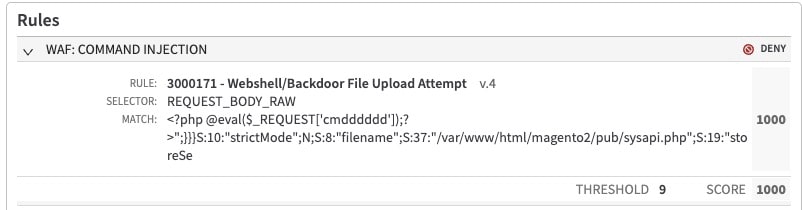
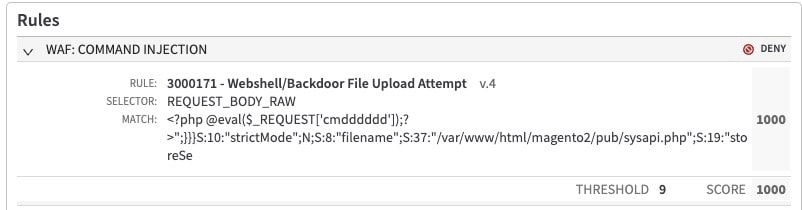
The current SessionReaper exploit attempts are mitigated by existing Adaptive Security Engine rules, including those that detect PHP web shell upload attempts (Figure 3).

The current SessionReaper exploit attempts are mitigated by existing Adaptive Security Engine rules, including those that detect PHP web shell upload attempts (Figure 3). Fig. 3: Adaptive Security Engine rule 3000171 detecting a SessionReaper web shell upload attempt

The Akamai Security Intelligence Group will continue to monitor the situation closely and update protections for our customers as needed.

Summary

Akamai App & API Protector has thus far been mitigating these attack attempts against our security customers. However, the most effective defense will always be to promptly apply the patches provided by the vendor. Given the severity of this issue, any patches should be applied as soon as possible.

The Akamai Security Intelligence Group will continue to monitor, report on, and create mitigations for threats such as these for both our customers and the security community at large. To keep up with more breaking news from the Akamai Security Intelligence Group, check out our research home page and follow us on social media.

Akamai SIG is a global team of world-class researchers, engineers, strategists, and data scientists with a broad range of expertise and security disciplines. Our data sources include the enormous Akamai Cloud, open sources, collaboration with third parties, and dark web intelligence. We have also developed our own algorithms and tools that help us deliver our research and keep Akamai security solutions up to date.

Tags

Share

Related Blog Posts

Cyber Security
Take Cover: Securing Games Truly Is a Battle Royale
July 31, 2024
Security threats in games are at an all-time high. See the statistics and learn what you should be looking out for as a security professional in games.
Security Research
Why (and How) APIs and Web Applications Are Under Siege
July 30, 2024
Read a summary of the latest SOTI report, which tackles the security risks in web applications and APIs, and the infrastructure that powers them
Cyber Security
The Year in Review 2024: Today’s Insights, Tomorrow’s Outlook
December 03, 2024
Six Akamai cyber experts reflect on the notable trends and events of 2024 and give their informed perspective on what to expect in 2025.