Since we initially launched Distributed Compute Regions in 2024, some of our largest customers have leveraged these smaller cloud computing sites to bring applications as close to end users as possible, especially during surges in app usage. Now, distributed regions are even better with Virtual Private Cloud (VPC) capabilities, allowing customers to place their performance-sensitive instances in distributed regions behind a private network.
A VPC is an isolated network that enables cloud resources to privately communicate with each other, and selectively gate access to the public internet or other private networks. VPCs are critical for protecting an application’s cloud resources from unwanted traffic and reducing the application’s surface area for potential DDoS attacks.
Distributed Application Reference Architecture
The following diagram shows how a customer can deploy additional compute resources near end users to optimize application performance while maintaining their primary cloud infrastructure in one of Akamai Cloud’s core regions.
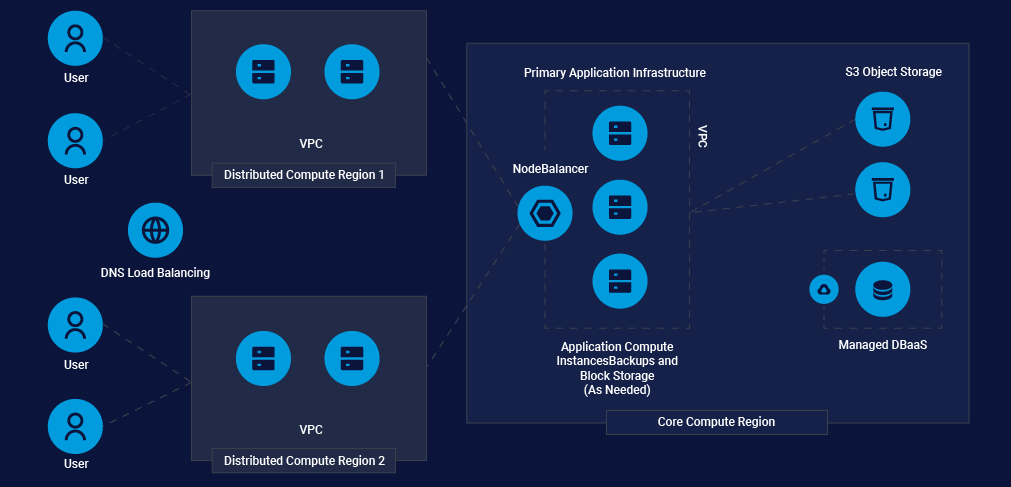
The workflow above outlines how application traffic and infrastructure can be distributed between a core region and one or more distributed regions using VPC:
- Dedicated compute instances ready to serve the client (likely including a containerized front-end) are deployed in one or multiple distributed regions close to end users.
- Stateful infrastructure including the database, storage, backend microservices, and backups are located in the core compute region, or what you might call your “home region”.
- End users’ requests are filtered by the DNS load balancer or global traffic manager and routed to the correct region based on the configuration. Instead of accessing one of multiple instances’ IP addresses, the end user’s connection only accesses the VPC’s IP.
- If any data for the user is required, this is requested from the core region database and cached locally for use during the user’s session.
- Each session runs at the distributed region and if any updates are made (such as to a user profile or statistics data in gaming), then the database in the core region is updated.
Learn more about the capabilities of distributed compute regions. Due to the limited capacity in these sites, access is restricted to qualified customers. If you are a new or current customer interested in deploying in these regions, contact our sales team.

Tags