Akamai to acquire LayerX to enforce AI usage control on any browser. Get details

Your Origin Server Might Be Your Most Expensive Decision

Matt Butcher headshot

Jun 08, 2026

Matt Butcher

Matt Butcher headshot

Written by

Matt Butcher

Matt Butcher is Vice President of Product Management at Akamai and a pioneering open source contributor. He has helped create projects including Helm, Spin, SpinKube, CNAB, Krustlet, Brigade, and the Open Application Model, and has contributed to more than 200 open source projects.

Share

Key takeaways

  • Standard cloud optimization projects often overlook a major budget drain caused by origin-centric architecture, introducing severe hidden costs like compounding cloud egress fees, idle autoscaling capacity, and heavy engineering overhead.

  • Fragmenting an architecture across multiple single-purpose vendors creates expensive seams and boundaries that degrade application performance, increase engineering complexity, and increase cross-vendor transit fees.

  • Akamai Functions resolves these widespread inefficiencies by shifting high-frequency tasks — such as personalization, token validation, and bot misdirection — directly to a smarter, more connected edge network to eliminate unnecessary origin round trips.

  • By operating seamlessly alongside Akamai’s integrated CDN, cloud, and security stacks, this unified infrastructure approach effectively removes cross-vendor boundaries, slashes egress fees, and reduces developer friction.

  • Transitioning to this smarter edge model delivers the ultimate bottom-line benefits of optimized latency, a vastly simplified architecture, and significantly lowered operational costs.

Your team just finished a cloud cost optimization sprint. You right-sized instances. You killed zombie resources. You renegotiated reserve capacity. And your bill went down 15% and everyone celebrated. 

But you missed an entire hidden category of costs: your architecture. Even well-planned architectural decisions can be the source of high costs: egress fees, origin load from work that didn't need to be centralized, autoscaling overhead for traffic that could have been handled at the edge, and the integration costs of piecing together a stack of single-purpose vendors. 

These costs are often hidden — and they’re often the most expensive in your stack.

Eliminate the costs of the architectural decisions 

In a previous blog post, we wrote about how the internet's front door (the edge network) has become a smarter, more connected place. We wrote about how that front door can now be the place where real application logic runs. And how, with Akamai's almost 4,400 points of presence across more than 130 countries, integrating that front door with Akamai's CDN, security stack, cloud, and AI inference layers creates a faster, continuous edge network.

This shift in the capabilities of the front door is not just about better performance — it’s also about costs. Because you pay for every decision sent back to a centralized region and for every layer-to-layer hop between vendors. 

With Akamai Functions and its smarter, more connected edge, these costs can disappear. 

How Akamai Functions can help

Let's look at two examples of these costs: the cost of the round trip and the cost of the seams. We'll see why these architectural decisions are so expensive, and how Akamai Functions can help.

The cost of the round trip

When your edge sends a decision to the origin, the costs accrue in three places: egress, capacity, and engineering hours.

The costs of egress 

The easiest cost to recognize is egress. Every byte that leaves a centralized cloud region comes with a well-known cost (Table).


US$ per GB

Additional costs

Amazon  Web Services

$0.09 (first 10 TB / mo)

$0.045/GB across NAT gateway

Azure

$0.087


Google Cloud Platform

$0.12


Akamai Cloud

$0.005


Egress costs per vendor as of May 7, 2026


A September 2023 Gartner report showed that, at enterprise scale, these numbers compound to 10%–15% of typical cloud bills. For data intensive workloads, that share climbs to 30%–40% of the bill. 

The more decisions you make at the origin, the more responses have to travel back across the network, and the higher the cost. 

  • A personalization check that round trips to a region pays egress on the way back. 

  • A bot classification at the origin pays egress to deliver a response the front door could have generated for free. 

  • A redirect resolved at the origin pays egress to send a 301 across the network. 

The costs of capacity 

The next cost is the wasted overhead of reserving capacity you don't need. 

Autoscaling looks elastic on paper, but in practice the “just in time” scale up and scale down doesn’t really work. Viral posts, flash sales, AI crawler surges … by the time your scaling kicks in, the spike has already come and gone. 

As a result, teams leave servers running with unused capacity, conservative CPU thresholds, and minimum-instance counts. Kubernetes industry surveys consistently find 30%–65% of paid-for cluster resources sit idle, reserved for headroom that rarely gets used.

The costs of engineering

The final cost is the hardest to quantify: the engineering hours needed to manage an origin-centric architecture. This comes in two forms: a developer tax and an operator tax.

The developer tax is what your application engineers pay every day. They write code that has to be aware of the operational config: environment-specific behavior, region-specific endpoints, retry logic. They become YAML experts. And in many container and managed-runtime setups, every change has to make a round trip for testing.

The operator tax is what your platform team pays just to keep the system running. Multiregion deployments mean config drift, distributed debugging, and coordination overhead. You have to plan region-by-region rollouts, tune autoscalers, patch images, and keep cluster manifests in sync.

How Akamai Functions creates a smarter edge

Akamai Functions (with Akamai EdgeWorkers handling lightweight logic directly on CDN nodes) reduces — and in some cases eliminates — these centralized cloud costs.

Reduces egress costs

First, it shifts critical decision-making to the edge, where logic runs before a single byte of egress is ever billed at the origin. By using the front door to resolve high-frequency tasks such as global mass redirects, token validation, personalization, and bot misdirection, you can eliminate the compounding 6%–12% egress fees. 

Reduces capacity costs

Second, with Akamai Functions’s sub-millisecond cold starts and instantaneous run-to-completion, there is no need for a minimum-instance floor or idle resources. Akamai Functions is designed to scale rapidly with demand, without provisioning or cooldown periods. You don’t need to keep resources warm “just in case.” Instead, your architecture supports even the most extreme demands, with your bill scaling strictly with the work performed. 

Reduces engineering costs

Finally, Akamai Functions removes both the developer tax and the operator tax. Instead of planning region-by-region rollouts, tuning autoscalers, and patching images, your team can deploy everywhere with a single command. And instead of architecting around container constraints and becoming YAML experts, your developer team can create, debug, and polish code locally with three simple commands.

The cost of the seams 

The above round trip costs, though often hidden, are understood. The costs of the seams, however, often aren't. 

Even when teams successfully move work to the edge, the boundaries between vendors and components (your edge vendor, CDN, bot management, cloud, AI inference) are themselves expensive. This is the cost of the seams. 

When your edge runs on Provider A, your CDN runs on Provider B, your bot management on Provider C, your cloud on a hyperscaler, and your inference on yet another platform, every request that traverses that stack pays in multiple ways: 

  • Cross-vendor egress at every hop. The win from moving to the edge evaporates when the edge has to call back to another vendor's origin. 

  • Engineering hours. API gateways, message queues, retry logic, sync layers, and observability that has to span vendors: None of this shows up cleanly on the cloud bill, but all of it causes engineering hours. 

  • Latency. Every time a request leaves one network for another, it traverses the public internet at the slowest layer's pace. Sub–50 millisecond personalization stops being sub–-50 milliseconds when the request has to hop to a different vendor's network. 

How Akamai Functions creates a more connected edge

Akamai Functions (with EdgeWorkers) can eliminate all three of the seam costs. Akamai Functions runs on the same network as Akamai Cloud, Akamai's CDN, and Akamai’s security stack (including Akamai Bot Manager).

Using Akamai Functions, a single request can hit the front door, get classified by Bot Manager, hand off to a function for content rewriting or token validation, fetch from Akamai Cloud storage (if core compute is needed), and call inference on local GPUs — all without leaving the network. 

You see no cross-vendor egress, no additional infrastructure to maintain, and the request doesn't leave Akamai's network. 

Using a variety of specialized vendors at the edge fragments your architecture (and increases your bill). But Akamai Functions becomes the glue that runs code on the same network as your CDN, your bot management tool, your cloud, and your AI inference. 

This creates not just a smarter edge, but one that's more connected.

A real-world example of a smarter, more connected edge

So, what does this look like in the real world?

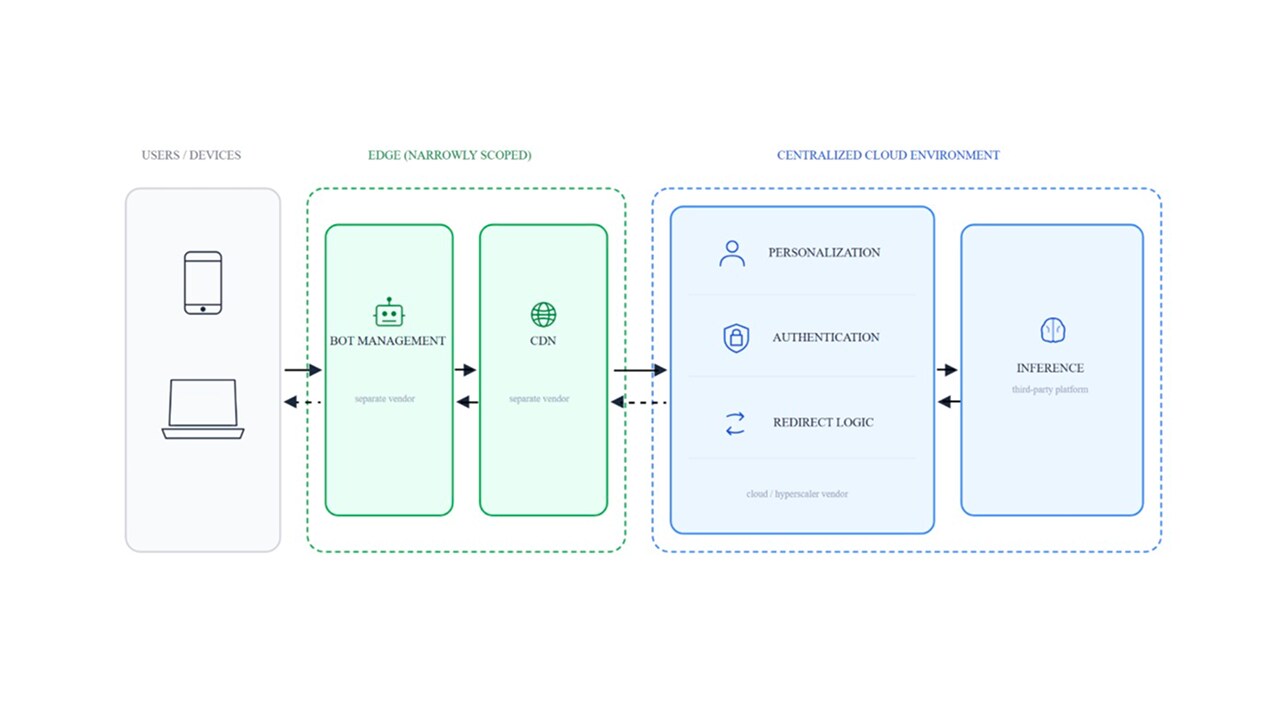
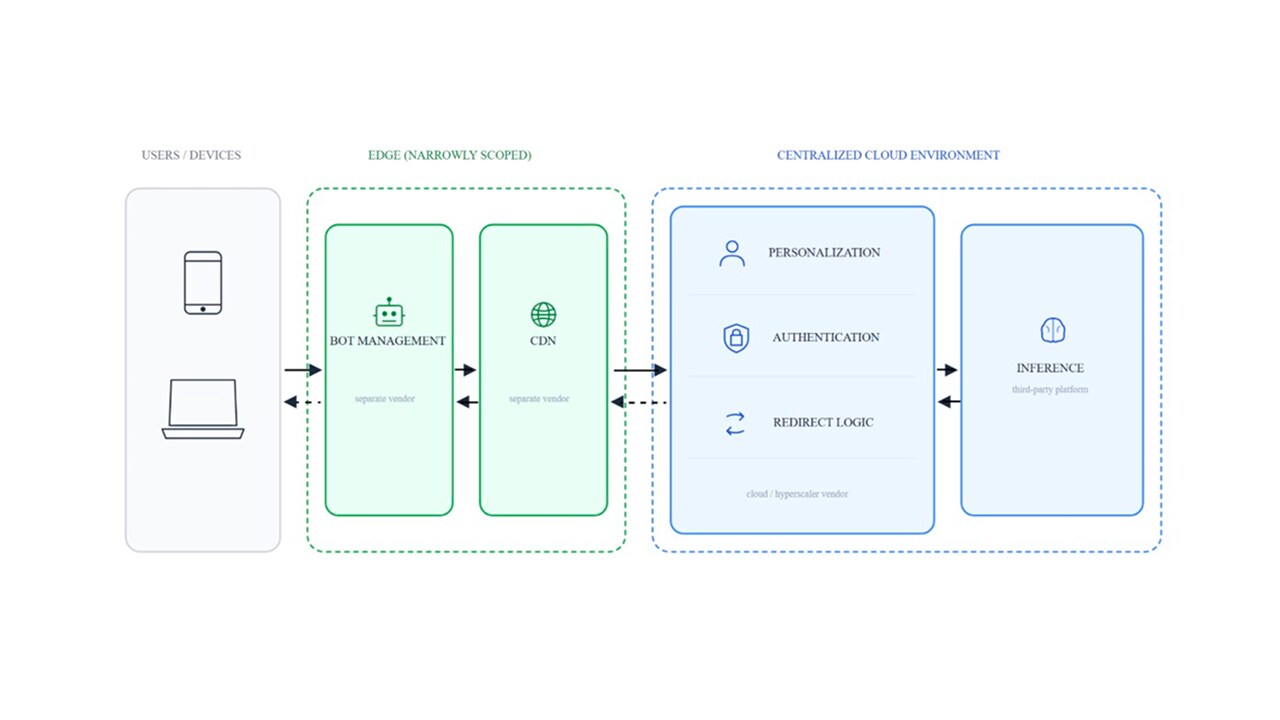
Let's look at a typical medium-sized ecommerce company that runs personalization, authentication, and redirect logic at the origin. Bot management is a separate vendor in front of the CDN, which is in front of a hyperscaler region, which calls a third-party inference platform for product recommendations (Figure). Every page load fires the entire chain.

ot management is a separate vendor in front of the CDN, which is in front of a hyperscaler region, which calls a third-party inference platform for product recommendations (Figure). A typical narrowly scoped — and expensive — edge with multiple vendors

In this scenario: 

  • Each request pays egress to ship a personalized payload back across the network. At a few hundred terabytes a month, the egress alone is six figures per year. 

  • A viral post spikes the cluster to peak capacity. The spike only lasts an hour,  but the costs to keep resources ready for that event are permanent. 

  • Recommendations cross three networks per request: CDN to the origin, origin to inference vendor, and inference back to the origin. Each hop pays egress. Each hop adds latency and costs. 

  • The platform team spends weeks each quarter coordinating multiregion rollouts and keeping the integrations among vendors aligned. 

But what happens if the company moves the work to a smarter, more connected front door? The architecture compresses, and the costs drop.

  • Personalization, auth, and redirects resolve at the edge with Akamai Functions: the round trip drops from 200 ms to 40 ms

  • When core compute is genuinely required, the call goes to Akamai Cloud on the same network with no cross-vendor egress. 

  • Recommendations run on the NVIDIA AI Grid at the edge instead of making a round trip to a third party. Inference costs fall by up to 86%.

  • Bot Manager hands suspect traffic to a function for rewriting before the origin ever sees it. 

  • Deployment can be done with a single command. 

  • There are no per-region rollouts, no YAML, no integration glue among five vendors. 

The results are improved latency, better architecture, and lower costs.

Akamai Functions is a smarter, more connected edge

The front door is where the early decisions are made. A smarter edge reduces the round trip time, making those decisions faster and cheaper. A connected edge reduces the seams. With both, you stop doing work you don't need to do.

Learn more

Ready to see how your edge can be smarter and more connected? View the Functions Quick Start Guide in TechDocs.

Matt Butcher headshot

Jun 08, 2026

Matt Butcher

Matt Butcher headshot

Written by

Matt Butcher

Matt Butcher is Vice President of Product Management at Akamai and a pioneering open source contributor. He has helped create projects including Helm, Spin, SpinKube, CNAB, Krustlet, Brigade, and the Open Application Model, and has contributed to more than 200 open source projects.

Tags

Share

Related Blog Posts

Cloud
Optimize AI Inference: Real-Time NodeBalancers Metrics for AI Workloads
June 03, 2026
Learn how to use Akamai Cloud Pulse to track granular telemetry for traffic, sessions, and back-end health — and find out how these metrics prevent bottlenecks.
Cloud
AI: Edge Is All You Need
October 28, 2025
Learn how Akamai Inference Cloud builds on the distributed architecture work we pioneered nearly 30 years ago to expand AI inference to the edge.
Cloud
Powering and Protecting Online Privacy: iCloud Private Relay and Information for Akamai Customers
March 02, 2022
See how Apple worked with Akamai to launch iCloud Private Relay. Learn about the service and how it can be best leveraged for Akamai customers.