Key takeaways
- Traditional centralized cloud architectures introduce a significant “personalization latency tax” due to multiple cross-region network round trips for identity, segment, and inference lookups.
- Moving application logic to the network edge with Akamai Functions reduces processing latency to less than 40 milliseconds, directly protecting and recapturing digital revenue.
- Deploying personalization elements, security treatments, and AI models on a single edge native platform eliminates public internet hops and cross-vendor egress fees.
Every time a retail app makes a personalization decision, it adds latency to the user experience. Identity lookups, segment queries, recommendation inference, content assembly: Each one can be a network hop and a round trip to a centralized region somewhere far from the user.
This “personalization latency” has a dollar cost that can be measured. Akamai's research shows that just a 100 millisecond delay can cause a 7% conversion drop, and that 53% of mobile shoppers will abandon a site that takes longer than 3 seconds to load.
For a retailer, these numbers represent real revenue lost as a result of personalization. Most retail teams are good at measuring the upside of personalization, but few measure the latency tax that personalization brings.
In a previous post, we argued for moving real application logic to the front door — the edge network every request already crosses on its way to the origin. Retail personalization is a perfect use case to test that argument.
What is the personalization latency tax?
Loading a single personalized page usually triggers four decisions on the server:
- Who is this? (Identity resolution)
- What bucket are they in? (Segment lookup)
- What should they see? (Inference call)
- Which images, prices, and inventory should be rendered? (Content assembly)
In a centralized cloud architecture, each of those decisions requires a round trip to a primary region and 50 to 100 milliseconds of latency. Stack all four decisions and the time to first byte (TTFB), the time before the page even starts rendering, becomes a quarter of a second or more. Akamai's benchmarks put the typical personalization round trip at 200 milliseconds in a centralized setup.
How to avoid paying the hidden latency tax
Moving these same decisions to the edge with Akamai Functions can drop the latency to just 40 milliseconds, with inference costs falling by up to 86%. This can result in a true lift in retail conversion, where just a 0.1-second improvement in mobile site speed improves conversion by 8.4% and average order value by 9.2%.
Examples of retail personalization
Let’s look at three examples of retail personalization:
- Geo-aware proximity personalization
- LLM-driven product guidance
- A combined personalization stack at the front door
We’ll describe how each example is typically designed in a centralized architecture, examine the benefits of moving to the more connected edge with Akamai Functions, and provide example reference architecture to help you get started.
Geo-aware proximity personalization
It’s a common use case: A shopper opens your app just outside one of your stores and you want to personalize the shopper’s experience to the location. Your app does all the right things: It shows what's stocked inside that specific store, sends the user to the right department, and surfaces regional pricing. All these decisions are personalized, and all have to happen before the user sees the first screen.
The centralized architecture
In a centralized setup, each of those decisions is its own service. Geolocation lives in one database. Inventory lives in another. Pricing rules live in a third. Bot detection sits in front as a separate vendor. The function orchestrating the page makes a round trip to each of them, and every shopper in every market experiences all these round trips as a slow app.
The Akamai Functions solution
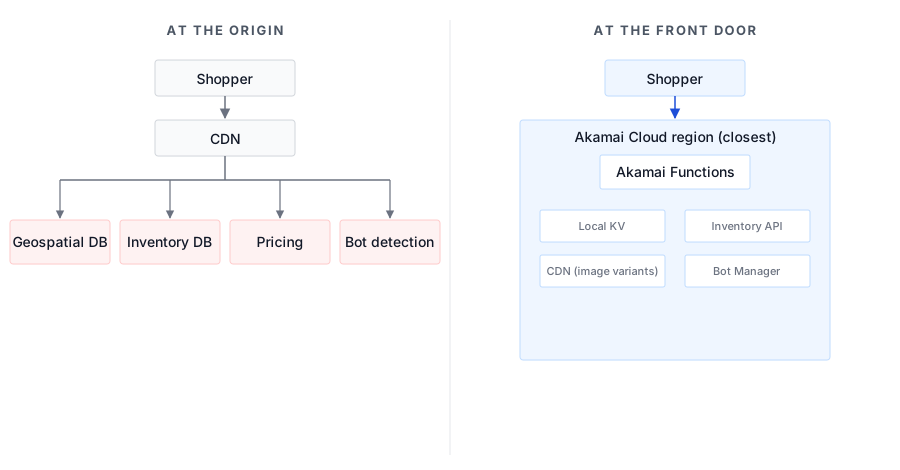
By moving to Akamai Functions, you can effectively remove this latency tax. The spatial logic ships as a small Wasm binary that lives on the edge and reads from a local key-value (KV) store housed at every Akamai Cloud region. There's no external geospatial database to maintain, and lookups never leave the region.
That same function calls inventory APIs that are delivered and protected by Akamai App & API Protector, serving store-specific images and regional pricing variants, all on-network and connected to Akamai’s content delivery network (CDN) edge. Security treatments such as Akamai Bot Manager blocks and manages inventory and price scrapers before they touch the API.
Everything lives in the same Akamai Cloud region, with Akamai Functions as the glue.
Demo
This geospatial demo shows a working geoproximity reference app that moves all spatial logic to the edge, keeps all state in a KV store, and uses geohash prefix math to avoid scans entirely. In this example, the reference app ingests 17,980 U.S. public libraries and exposes an API that answers the following questions in just 2 to 4 milliseconds of compute time:
- Am I inside a library right now? Which one, and which section am I in?
- What are the other nearest libraries to this location?
- Given I'm at this position, what's my coordinate on the branch floor plan?
- What contextual content should we show for the section I'm standing in?
The reference app can be adapted by retailers for in-store routing, regional pricing, and inventory-aware shopping.
LLM-driven product guidance
In another popular use case, a shopper asks your AI assistant for a recommendation on a product — in this case, running shoes. The assistant combines the user input (weekly mileage, previous tries, preferences) with the actual contents of the catalog, takes into account what's in stock (in the shopper’s size), and analyzes all the gathered information based on product performance and reviews.
The centralized architecture
In a centralized setup, the app calls a third-party large language model (LLM) API that lives across the public internet (and imposes latency). The catalog query goes to a separate vendor for retrieval-augmented generation (RAG). And the inventory check goes to the origin.
The bill compounds in three ways:
- Latency
- Egress
- Per-token vendor charges
The Akamai Functions solution
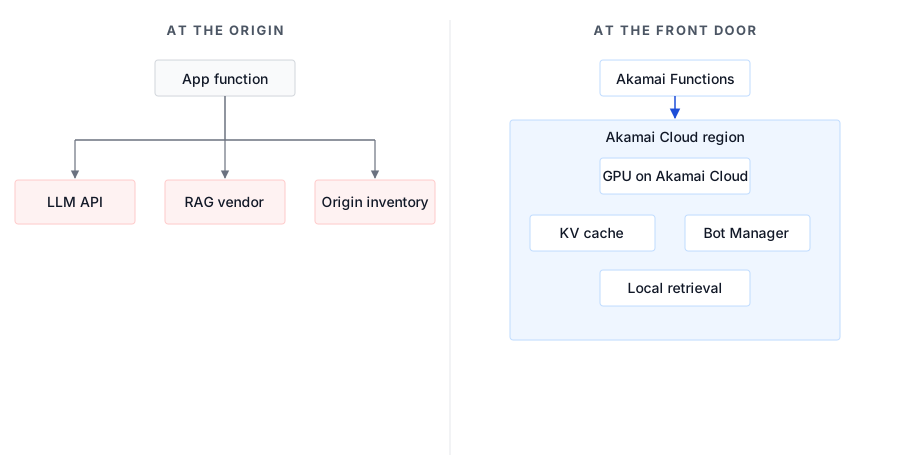
Instead, with Akamai Functions running at the front door, the model runs on a GPU-equipped Akamai Cloud instance on the same network as the function that’s calling it. There's no public internet hop to the model, no third-party LLM charges per token, and no cross-vendor egress on the response. KV-cached responses are served directly from the edge, and repeat queries against the same prompt never reach the GPU.
The function also pulls retrieval context — all still from the same network. Product catalog, customer history, and pricing all sit close to the function and model. With that information, the model matches its recommendation to actual stock and actual customer behavior.
Bot Manager also sits inline on the same Akamai network. AI assistants are a common target for scrapers who harvest prompts, exhaust token budgets, or pull completions for model training. But Bot Manager screens that traffic before the function ever calls the model, so the GPU only spends cycles on actual customers.
Demo
The FC AkaDevs LLM chatbot is a reference model for running an AI assistant on Akamai Cloud (instead of behind a third-party API). The sample implementation shows how to build and deploy an LLM-powered chatbot that runs truly serverless and globally distributed on Akamai Functions, with no per-token charges to an LLM vendor, no cross-vendor egress on the response, and no public internet hop in the middle of the request. Cached answers serve from the edge.
A combined personalization stack at the front door
In our final use case, a user clicks on a search ad, email, or referral, and lands on your personalized product detail page. The page has to know who they are, what segment they're in, what to recommend, and what variants of the page to render, all before giving a response.
The centralized architecture
In the centralized setup, each of these pieces of information is its own cross-region call. Identity goes to one service, segment to another, the recommendation engine to a third, and the inventory and pricing services to yet another.
By the time the page assembles, the personalization latency tax has already eaten a meaningful share of the conversion-rate budget.
The Akamai Functions solution
With Akamai Functions, every decision happens on the same Akamai network with the function serving as the glue. Identity resolves at the edge. Segment lookups read from local KV. Recommendations are inferred against a vector database co-located in the same Akamai Cloud region as the calling function. Image variants are served from edge cache.
The CDN, the security stack, the inference layer, and the data services all participate in the same request without ever crossing a vendor seam.
Demo
This demo showcases a full retail personalization stack deployed on a single network. Identity, segment, recommendation, inventory, image variants, and bot screening all run on Akamai. As a result, the architecture creates a personalization stack with no seams between vendors and minimal latency.
Akamai Functions is the smarter, more connected front door
Personalization in retail comes with a tax that most retail teams have been paying for years. But with Akamai Functions, teams can eliminate that tax, improve conversion, and take advantage of a smarter, more connected front door.
Ready to see what your edge could be doing? View the Functions Quick Start Guide in TechDocs.

Tags