





© 2026 Akamai Technologies
The recent discovery of the PHP2Shell vulnerabilities (CVE-2026-109618 and CVE-2026-109619) serves as a stark reminder of the limitations of a perimeter-only security approach. These critical remote code execution (RCE) flaws in the core PHP Zend Engine allow attackers to achieve arbitrary code execution by exploiting memory corruption during multipart form parsing and fatal error handling.
Once RCE is achieved, a PHP server could become a foothold for familiar postexploitation activity. For example, an attacker may attempt to establish command and control (C2), harvest credentials or cloud metadata, download additional tooling, or pivot toward internal systems.
Postexploitation activity can use communication paths that were not part of the original inbound attack, including outbound connections and east-west traffic. Network controls that lack workload or process context may make it difficult to distinguish required application communication from an attacker using the compromised server as a foothold.
While an enterprise web application firewall (WAF) provides critical, frontline protection by inspecting and blocking malicious HTTP requests at the edge, comprehensive enterprise resilience relies on a defense-in-depth strategy that embraces an “assume breach” posture.
The first opportunity to reduce risk is in the application request path.
Akamai App & API Protector inspects HTTP/S traffic before it reaches the vulnerable application. For PHP2Shell, we deployed Rapid Rule 3000991 in Adaptive Security Engine globally in Alert mode by public disclosure. After validation and tuning, the Akamai-managed action moved to Deny in less than four hours. Existing command injection protections also mitigated identified weaponized payloads.
That inspection layer matters because the vulnerable PHP server may still need to remain reachable over HTTP/S while teams test and deploy the vendor patch. Blocking legitimate web traffic entirely may not be operationally possible.
But inspection has an architectural boundary. App & API Protector protects application and API traffic routed through it; it does not govern unrelated internal or east-west communication from a workload that has already been compromised.
This is where microsegmentation provides the complementary layer.
Blocking exploitation and containing compromise solve different parts of the problem. If a workload is compromised, Akamai Guardicore Segmentation can reduce the network paths available for C2, credential access, and lateral movement.
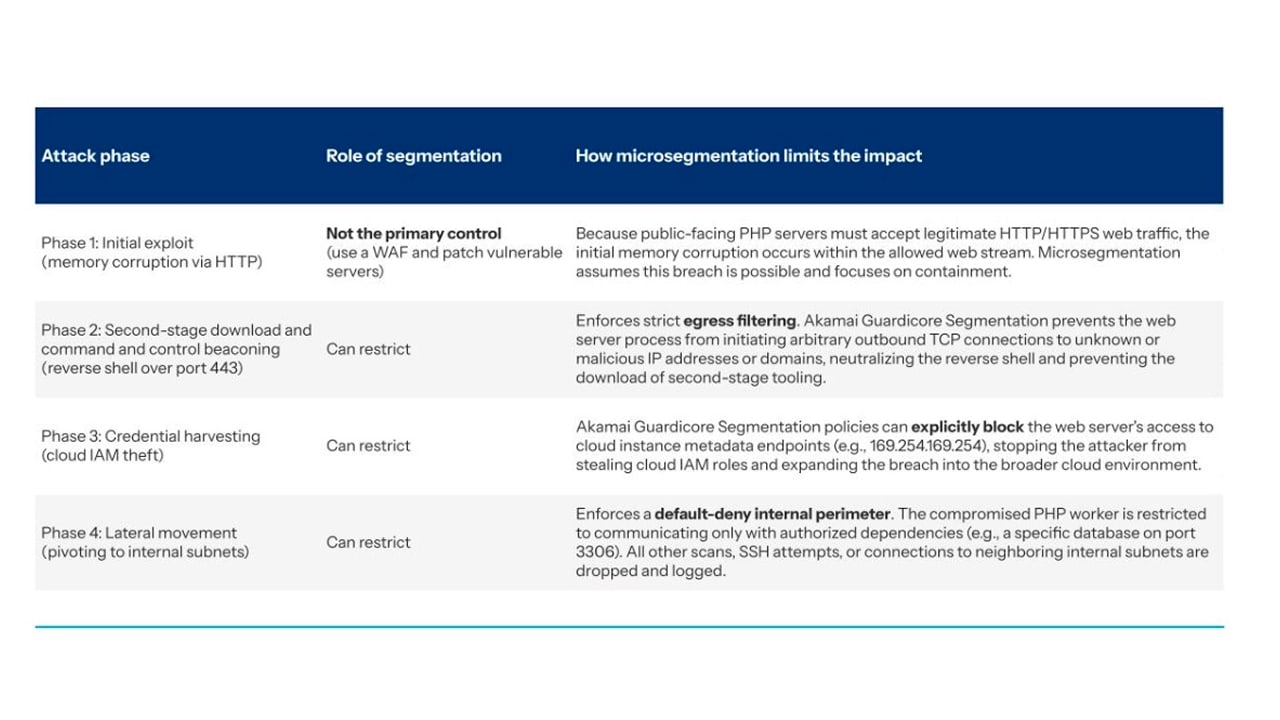
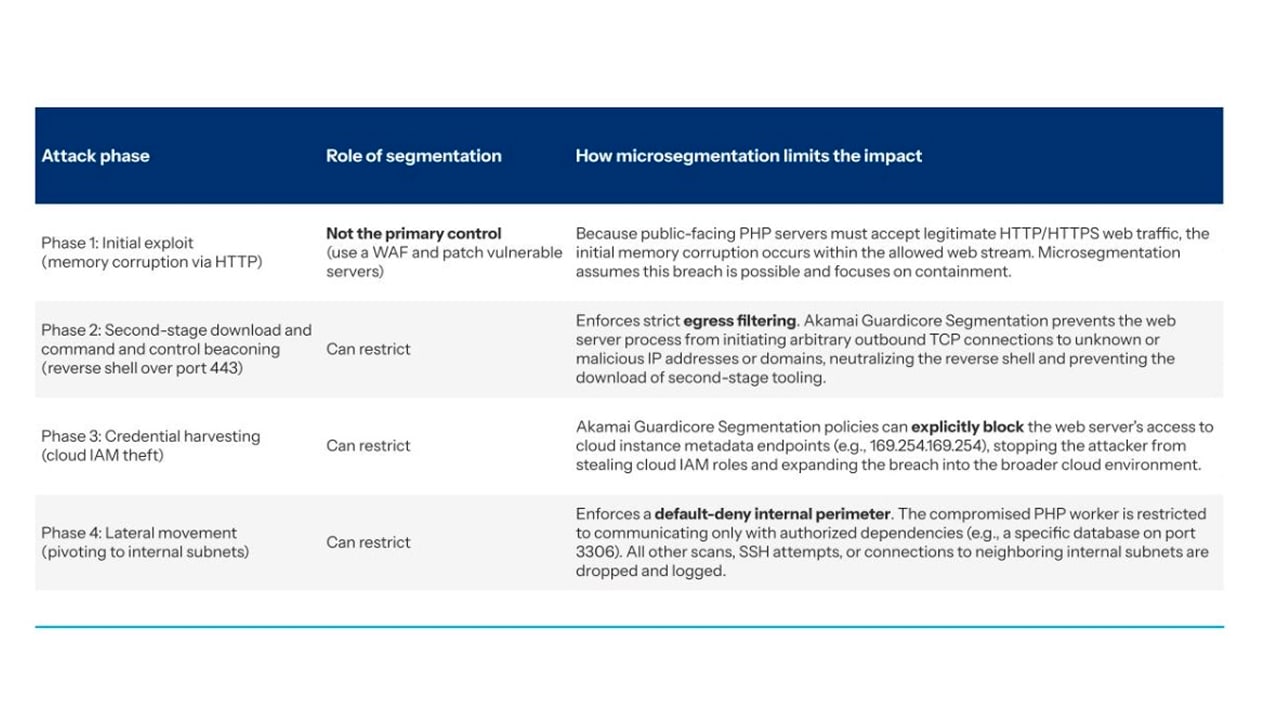
Instead of relying on broad IP rules, microsegmentation dictates exactly which processes can communicate with specific internal and external resources. The table shows how Akamai Guardicore Segmentation could mitigate the lifecycle of a potential PHP2Shell attack.
PHP2Shell demonstrates why organizations cannot rely on patching alone to close the exposure window. Upgrading to a fixed PHP release is the complete remediation, but critical systems may remain vulnerable while teams validate and deploy that patch.
A multilayered virtual patching strategy helps reduce risk during that period. App & API Protector provides inspection-based protection for the HTTP/S traffic that must remain open, while Akamai Guardicore Segmentation provides reachability-based controls that reduce unnecessary paths to and from vulnerable workloads and limit blast radius if compromise occurs.
The two controls address different questions:
Can the exploit reach the vulnerable application?
If the workload is compromised, where can the attacker go next?
Neither control replaces the vendor patch. Together, they give security teams additional ways to reduce exposure before, during, and after patching.
Close what you can. Inspect what you can’t.

© 2026 Akamai Technologies