Akamai acquires LayerX, delivering end-to-end security and real-time AI usage control to any browser. Get details
Background

API Security for Government Services: Protecting Citizen-Facing Applications

July 30, 2026 by Joe Henry

Share

Key takeaways

Government APIs are prime targets for nation-states and advanced threat actors that are seeking long-term access to permanent personally identifiable information (PII) rather than transient financial data.

Legacy debt and high availability demands make securing public sector endpoints unique — agencies must wrap modern APIs around legacy back ends without taking critical civic services offline.

Traditional firewalls miss modern API threats like Broken Object Level Authorization (BOLA), business logic abuse, and untracked “shadow” or “zombie” APIs, which mimic legitimate user activity at scale.

Security visibility must expand to “detect shadow everything” — including emerging AI agents, Model Context Protocol (MCP) servers, and internal service-to-service (east-west) traffic.

Comprehensive API defense requires continuous automated discovery, strict Zero Trust architecture (e.g., sender-constrained tokens, Know Your Agent policies), AI-driven behavioral analytics, and shift-left security testing.

Today’s public sector is quietly leading a revolution in digital experience. Far from the rigid, legacy systems of the past, your agency is now at the forefront of modern web design and technical standardization. From seamless tax filings to intuitive healthcare portals, civic technology is setting new benchmarks for accessibility, responsive design, and unified user interfaces that rival — and often exceed — those in the private sector. Application programming interfaces (APIs) enable this digital transformation by supporting real-time data sharing and secure cross-agency integration.

This commitment to design excellence means that public sector platforms are establishing the gold standard for interconnected infrastructure. Standardizing these digital touchpoints improves usability and builds a scalable ecosystem for citizens. To protect these systems, organizations must integrate API security directly into core system architecture from the initial design phase. Safeguarding these systems is the vital foundation that ensures public innovation remains secure, resilient, and trusted as digital governance continues to evolve.

Why government APIs are unique targets

Cybercriminals view government endpoints differently than corporate ones. While cybercriminals target ecommerce APIs for financial data, public sector APIs attract persistent advanced threat actors and nation-state attackers seeking long-term access.

  • The ultimate PII vault: Government databases contain criticalPII: Social Security numbers, tax histories, medical records, and biometric data. This information doesn't expire like a credit card; it can be used for identity theft and espionage for decades.
  • The legacy debt dilemma: Public agencies rarely have the luxury of building systems from scratch. More often than not, developers are tasked with wrapping modern APIs around legacy systems. If not secured correctly, this is the digital equivalent of putting a biometric smart lock on a cardboard door.
  • The mandate of absolute availability: If an online shoe retailer suffers an API distributed denial-of-service (DDoS) attack, shoppers get frustrated and go elsewhere. If a government API handling unemployment benefits or emergency dispatch services fails, critical public services are disrupted, and community stability and operational continuity are affected. Government apps cannot simply be taken offline during a suspected exploit.

Common vulnerabilities and vector types in public sector APIs

Traditional firewalls and legacy web application firewalls (WAFs) look for known malicious signatures. But modern API attacks don't usually look like traditional hacks; they look like legitimate user behavior manipulated at scale.

  • BOLA: BOLA remains one of the most persistent and critical API vulnerabilities. It occurs when an API endpoint accepts a user-supplied identifier (like an account ID) to fetch data but fails to validate if the logged-in user actually has permission to view that specific data. A hacker can simply manipulate the numbers in a URL query string to systematically extract thousands of citizen records.
  • Business logic abuse: In this type of attack, threat actors exploit the design of the API rather than a bug in the code. For example, a malicious bot might abuse a public voter registration lookup API, systematically querying names and addresses to scrape an entire state's voter registry. To a traditional WAF, each individual request looks like a normal citizen checking their status. At scale, it’s a massive data exfiltration event.
  • Shadow and zombie APIs: Government agencies are vast, bureaucratic entities with high developer turnover. Over time, testing environments are forgotten, and older versions of APIs are left running in the background. These shadow APIs (untracked endpoints) and zombie APIs (outdated, unpatched endpoints) give attackers an unmonitored path straight into the network. An emerging dimension of this challenge involves the expanding scope of what can be a shadow element. Your organization must now work to detect “shadow everything,” including not just forgotten APIs, but also the emerging AI agents and MCP servers (model servers) that use them, adding layers of untracked infrastructure.

The blueprint for public sector API defense

Securing citizen-facing applications requires moving beyond minimum regulatory compliance to adopt a proactive, identity-centric architecture. Aligning with frameworks like NIST SP 800-228 provides a concrete roadmap that includes:

  • Continuous API discovery
  • Enforce Zero Trust at the API level
  • Implement strict rate limiting and behavioral analytics
  • Control identity and access for autonomous agents
  • Understand agent-to-agent interactions (east-west)
  • Shift-left security for civic tech

Continuous API discovery

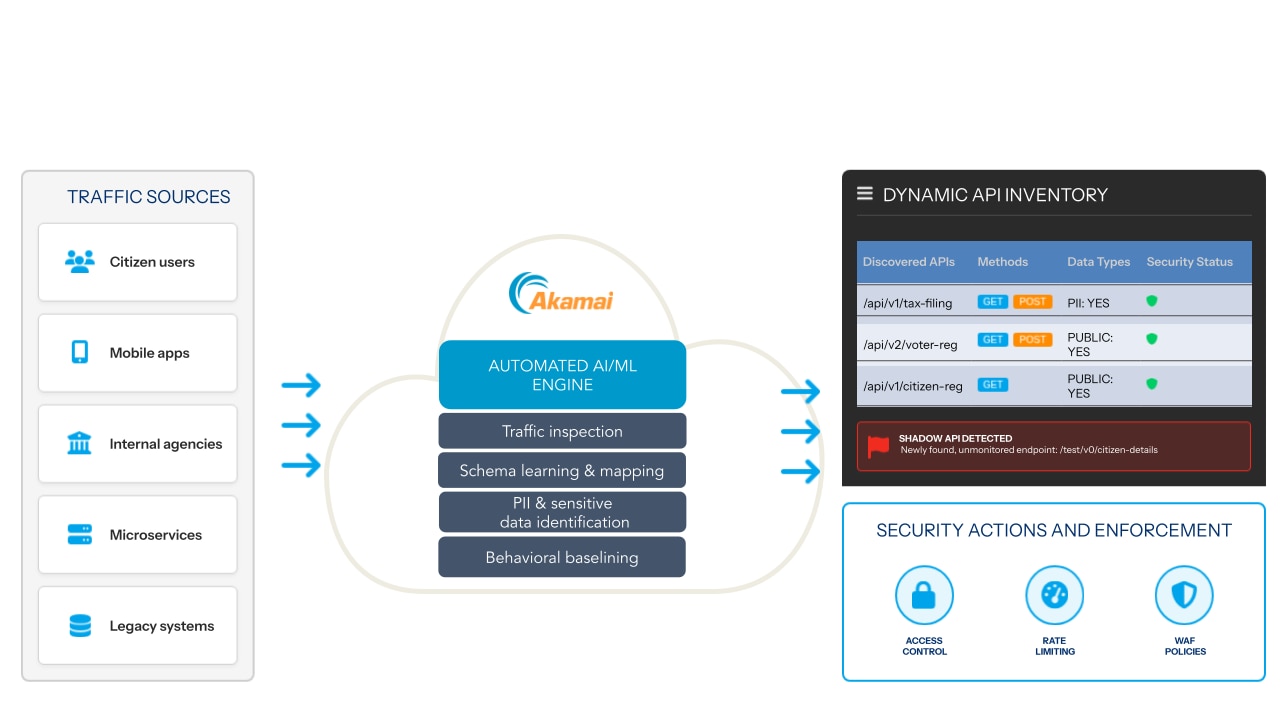
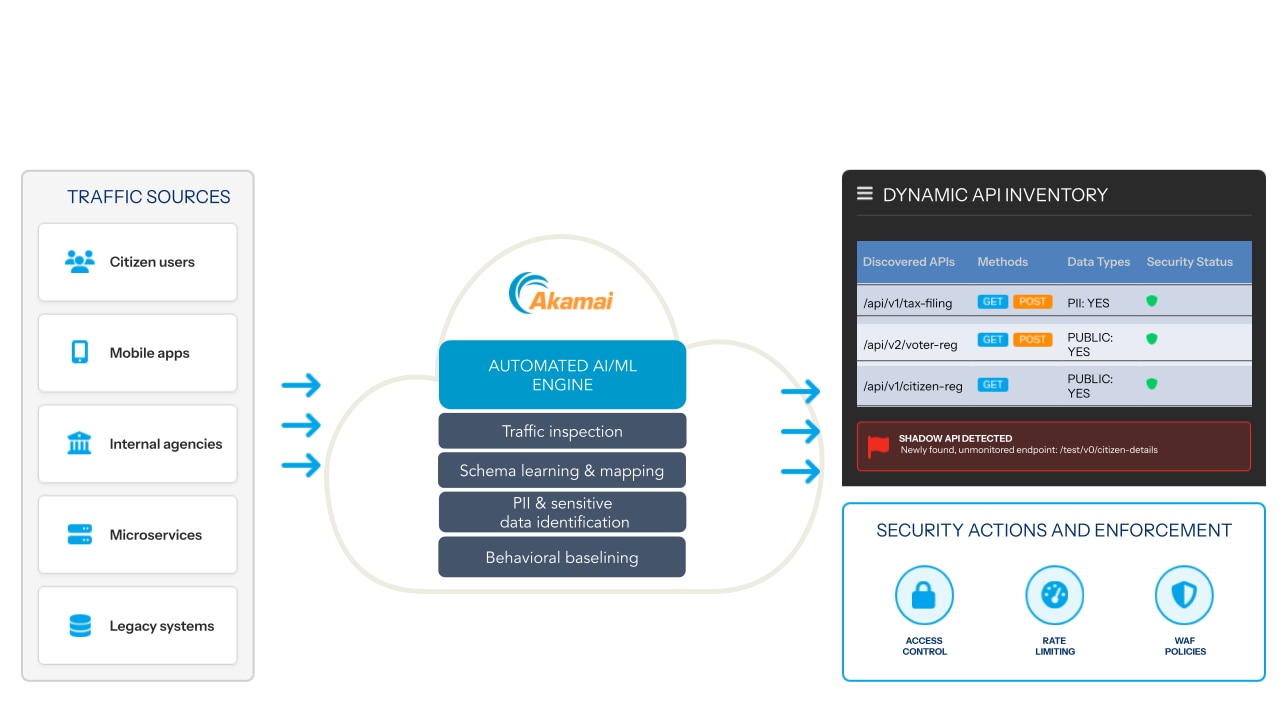
You cannot protect what you don't know exists. Move away from manual API inventories (which are outdated the moment they are written) and deploy automated, continuous discovery tools. These tools scan network traffic to map out every active endpoint to identify exactly what data is flowing where — and expose shadow APIs before hackers find them (Figure 1).

These tools scan network traffic to map out every active endpoint to identify exactly what data is flowing where — and expose shadow APIs before hackers find them (Figure 1).
Fig. 1: Reference architecture: Automated API discovery and traffic flow
These tools scan network traffic to map out every active endpoint to identify exactly what data is flowing where — and expose shadow APIs before hackers find them (Figure 1).

Enforce Zero Trust at the API level 

The perimeter defense model is no longer sufficient on its own. Although securing the perimeter (north-south traffic) is a necessary foundational step, just because a request comes from inside a government network doesn't mean it’s safe.

  • Never trust, always verify: Every single API call must be authenticated, authorized, and inspected.
  • Upgrade your tokens: Shift from standard, easily interceptable bearer tokens to sender-constrained tokens and cryptographic proofs of identity to ensure the entity making the request is exactly who they claim to be.

Implement strict rate limiting and behavioral analytics 

To thwart business logic abuse and automated scraping, your organization should implement intelligent rate limiting. Furthermore, integrating AI-driven behavioral analytics allows systems to baseline “normal” citizen behavior. If an API key suddenly requests 5,000 records in three minutes at 3 AM, the system can flag and block the anomaly instantly. This is crucial for tracking data exposure across all flows, especially sensitive data like PII.

Control identity and access for autonomous agents 

As government services begin to deploy autonomous AI agents to interact with citizens or other systems via APIs, identity must be extended to these digital entities. This requires a robust Know Your Agent (KYA) policy, ensuring that each agent has defined, verifiable, and cryptographic permissions, much like any human user.

Understand agent-to-agent interactions (east-west) 

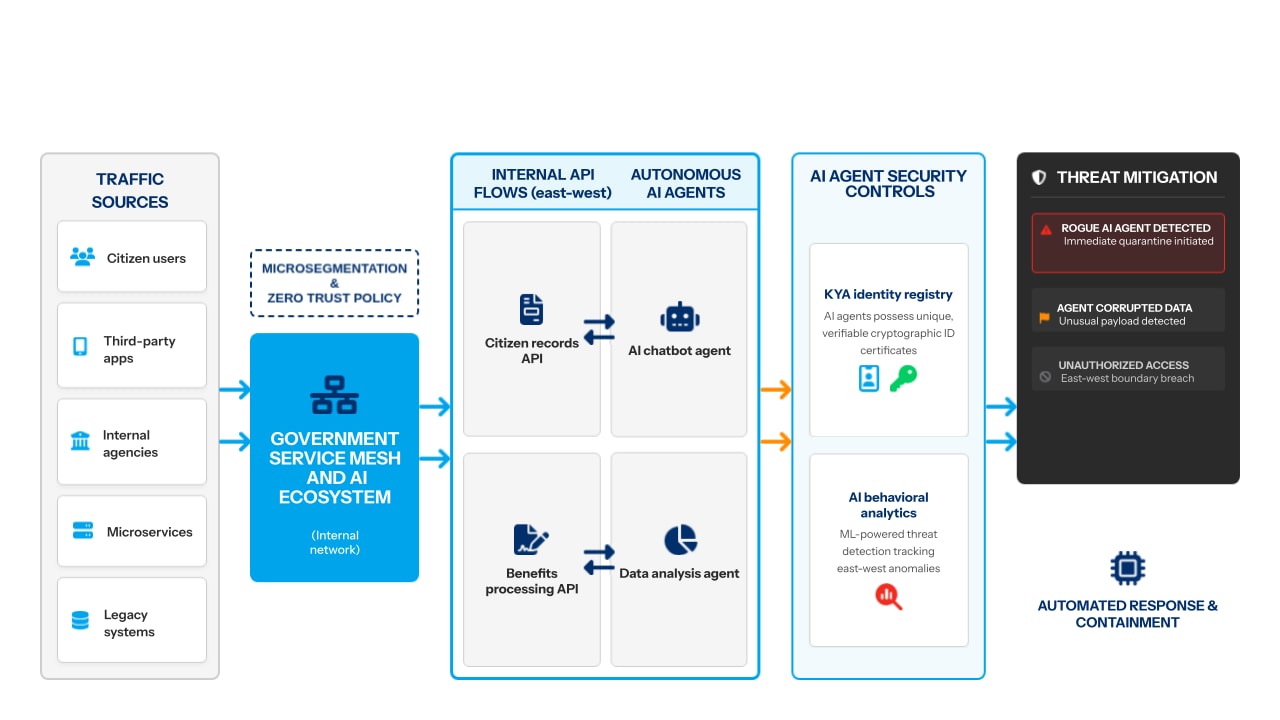
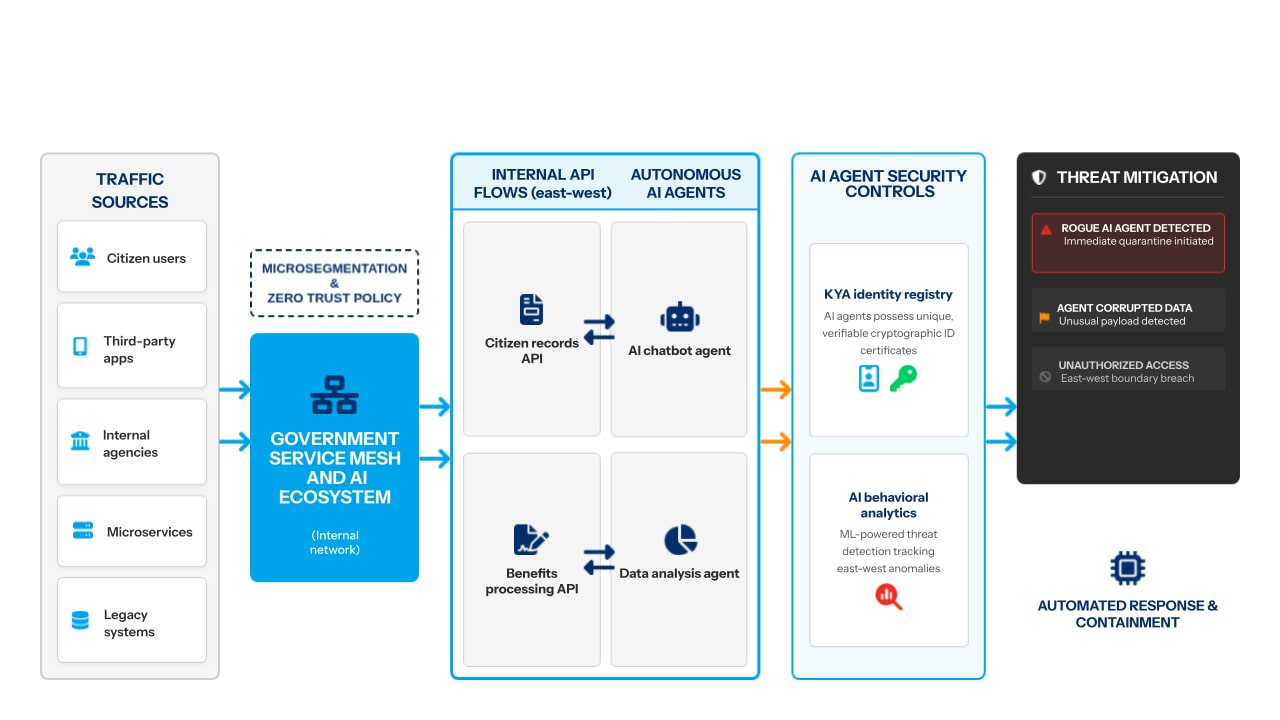
A key area of focus in API security is east-west traffic; that is, the internal interactions between different services and, increasingly, among autonomous AI agents. You must gain visibility into these internal chatter patterns to detect risks like rogue agents or agents that are processing corrupted, “polluted context” data from external APIs (Figure 2).

You must gain visibility into these internal chatter patterns to detect risks like rogue agents or agents that are processing corrupted, “polluted context” data from external APIs (Figure 2).
Fig. 2: Reference architecture: East-west traffic and AI agent security
You must gain visibility into these internal chatter patterns to detect risks like rogue agents or agents that are processing corrupted, “polluted context” data from external APIs (Figure 2).

Shift-left security for civic tech 

Security testing cannot be delayed until the end of a deployment cycle. Government agencies must require internal developers and third-party vendors to integrate automated API security testing early into CI/CD pipelines (shift-left security). Vulnerabilities must be caught and remediated in the code repository, long before they hit production.

Securing the future of digital governance

As public sector modernization accelerates, the reliance on APIs will only grow, especially with the introduction of AI-powered agentic systems. Embracing digital transformation shouldn't mean compromising citizen privacy.

By treating API security as a core pillar of national infrastructure rather than as an isolated IT problem, government agencies can deliver the seamless, modern digital services that citizens expect — while fiercely safeguarding the data those agencies have been entrusted to protect.

About the Author(s)

Joe Henry

Joe Henry

Joseph Henry has spent his career securing critical infrastructure — starting with 16 years supporting the U.S. Army and the FAA on networking, cybersecurity, and data center builds. 


Today, Joseph is a Solutions Engineer at Akamai, where he focuses on security for U.S. federal agencies and Dow. He works with customers to protect their apps and APIs, simplify their security architecture, and fit Akamai's capabilities into the environments they already run.