Akamai to acquire LayerX to enforce AI usage control on any browser. Get details

What is an API?

What is an API(Application Programming Interface)?

API is an abbreviation of application programming interface, a set of rules, protocols, and definitions that allow different software components or programs to communicate with each other and share data.

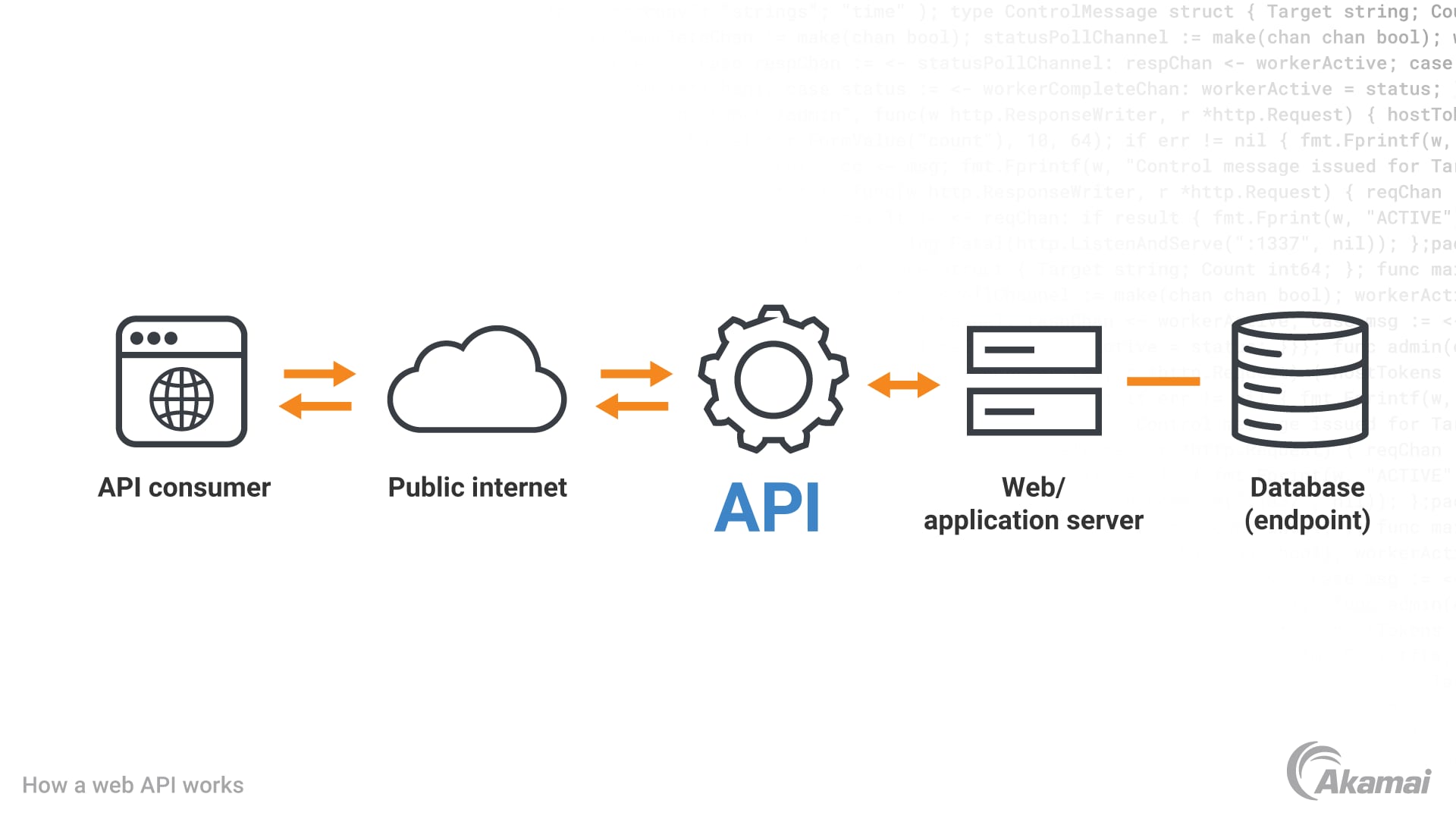
APIs determine how one application can access the data or functions offered by another software program. In a traditional client-server model, APIs act as the bridge between the front-end (client) and the backend (server), enabling secure and structured communication between different systems. For example, to include weather information on a website, programmers may use an API to communicate with a site that provides real-time weather reports rather than needing to build their own program to collect and interpret weather data. In today’s digital world, APIs are involved in almost every action you take and transaction you make online, including making a mobile payment or browsing an ecommerce site.

You can think of an API somewhat like a takeout menu that lets you order different meals at any time without having to prepare the food yourself. When you’re building an application or website, you can use APIs to pull data without having to build and manage your own database, or offer fingerprint authentication without having to create your own authentication software. APIs use a request-response model of communication, in which a client sends a request or API call to an API that processes the request and returns a response. Understanding how APIs work is essential for beginners learning software development, since APIs define how requests are structured, how data validation occurs, and how responses are returned. APIs typically use standard data formats like JSON (JavaScript Object Notation) or XML (eXtensible Markup Language) to exchange data.

What are examples of API use cases?

APIs allow software development teams to integrate applications created in different programming languages – such as Java or Python – and to make data and functions easily available between applications. For example, a rideshare application might use a maps API to incorporate mapping functions from another application that let users view the location of the arriving driver. APIs are important for managing multiple social media accounts from one dashboard, integrating CRM (customer relationship management) platforms with marketing automation tools, or for connecting Internet of Things (IoT) devices like smart watches, digital assistants, and smart home appliances. Stockbrokers rely on applications that use APIs to access real-time information about financial markets and stock prices, and smartphone apps use APIs to capture photos and videos from the built-in camera. APIs may also enable organizations to take advantage of cloud-based solutions for a DNS firewall or DNS proxy.

More broadly, APIs connect modern digital ecosystems, enabling microservices architecture environments to communicate efficiently while supporting scalability and performance across distributed systems.

What are the types of APIs?

There are many kinds of APIs:

  • Web APIs are used for building web and mobile applications and are accessed over the web using standard protocols such as HTTP.
  • Library APIs allow programmers to access libraries of code that can provide specific functionality as they build new applications.
  • Operating system APIs make it possible for software to interact with an underlying operating system.
  • Open APIs, or public APIs, are created by third-party developers and enable anyone to access and use a website or app.
  • Partner APIs allow communication between systems within companies and business partners that have a distinct relationship.
  • Private APIs (also called internal APIs) enable users within a company to move data between teams or to connect various internal apps and systems.
  • Composite APIs combine several APIs from multiple servers or sources to build a unified connection to a single system.
  • Web service APIs are interfaces between web browsers and web servers.
  • Cloud APIs allow cloud applications to communicate with one another.
  • Remote APIs enable applications running on different machines to interact by communicating remotely.
  • WebSocket APIs support real-time, two-way communication between clients and servers, which is especially useful for chat applications, live dashboards, and financial trading platforms.


What is an API architecture or protocol?

APIs may be built with different API protocols , architectural styles, and design frameworks. Effective API design ensures consistency, security, scalability, and ease of integration across different systems.

  • REST APIs, or APIs built on Representational State Transfer architecture, can scale easily and transfer data securely by managing requests through HTTP and by relying on statelessness, where no client content is stored on servers between requests.
  • SOAP, or Simple Object Access Protocol, makes it easier for apps in different environments or apps written in different languages to share data. SOAP APIs determine how data can be transmitted across networks, how messages can be sent, and what messages should include.
  • RPC APIs use the Remote Procedure Call (RPC) model to allow a program to execute procedures on a remote system as if they were local function calls.
  • GraphQL is an open-source query language that minimizes the number of round trips between clients and servers, which can be helpful for applications that run on slow or unreliable connections. GraphQL APIs allow clients to get the data they need by engaging a single API endpoint, rather than chaining multiple requests together.
  • Webhooks are involved in implementing event-driven architectures, where requests are automatically sent as a response to event-based triggers.
  • Frameworks such as Spring (Java), Django (Python), and Express (Node.js) are commonly used to build and manage APIs throughout their lifecycle — from development and testing to deployment, monitoring, and retirement.

What are the benefits of APIs?

For many companies, APIs are business-critical assets that help to digitize processes, enable automation, accelerate workflows, connect people and applications, and innovate new products and services. APIs can help deliver exceptional customer experiences and enhance operational agility. Because APIs enable modular development within a microservices architecture, they also improve scalability, allowing organizations to scale individual services independently without affecting the entire application.

What is an API gateway?

An API gateway is an application that receives requests, processes them, delivers them to the appropriate server, and returns data back to the user or application that requested it. API gateways provide a centralized point for managing, securing, and optimizing API calls/requests and responses. API gateways may also handle authentication, enforce rate limiting, validate requests, manage API keys, and monitor traffic to prevent abuse.

What are threats to APIs?

APIs are attractive to attackers because they often contain the keys to valuable information. When not adequately secured, APIs can potentially expose a great deal of sensitive data. Hackers often look to target APIs that are built and deployed without sufficient security measures, as well as legacy APIs that are not regularly updated. Malicious actors may use APIs to gain access to sensitive data, to disrupt services, or to hijack systems. Common API security risks are weak authentication controls, exposed API keys, poor input validation, and misconfigured API protocols.

What is API sprawl?

As digital technologies like cloud computing and microservices continue to expand, the rapid growth of applications has resulted in API sprawl — where the number of APIs is increasing exponentially, and inconsistencies in design and API documentation standards make API management more difficult. API sprawl makes it more difficult for security teams to properly implement and manage security policies, resulting in greater risk to the organization.

What is API discovery?

API discovery is the process of identifying and cataloging all the APIs within an organization’s digital footprint along with their associated endpoints, functions, and data structures. API discovery is essential to avoiding redundancy, identifying security risk, documenting APIs, and ensuring integration and interoperability.

What is API security?

API security practices involve discovering and tracking all APIs within a digital ecosystem, identifying vulnerabilities that exist within each API, leveraging existing security solutions, and establishing a blanket set of security policies that govern and protect all APIs. API protection solutions may include API testing, a web application firewall, encryption, Zero Trust architecture, behavioral analytics, solutions for API gateway security, OpenAPI security, and managed threat hunting. A comprehensive API security strategy also considers the full API lifecycle — from design and development to deployment, monitoring, and decommissioning — ensuring that APIs remain secure as applications evolve.

Frequently Asked Questions

APIs work using a client-server model in which a client application sends a structured request to an API endpoint, and the application programming interface (API) processes the request and returns a response. The API defines the set of rules for request formatting, authentication, validation, and response structure — typically using data formats such as JSON or XML. This standardized communication enables different software systems to exchange data securely and efficiently.


 

An API key is a unique identifier used to authenticate requests made to an application programming interface (API). API keys help control access, track usage, and enforce rate limits for client applications. If an API key is exposed or improperly secured, attackers may use it to gain unauthorized access to the API.


The main difference between REST and SOAP APIs is that REST is lightweight and flexible, while SOAP is protocol-driven and highly standardized. REST APIs use standard HTTP methods and are commonly used for web and mobile applications. SOAP APIs rely on a strict messaging protocol with built-in standards for security, transactions, and error handling, making them suitable for enterprise environments that require formal contracts and compliance.

API integration is the process of connecting two or more software applications through their application programming interfaces (APIs) so they can share data and functionality. API integration enables organizations to automate workflows, synchronize data across systems such as CRM platforms and payment processing tools, and improve operational efficiency.


The API lifecycle refers to the stages an application programming interface (API) goes through, including design, development, testing, deployment, monitoring, versioning, and retirement. Proper API lifecycle management ensures performance, security, governance, and compatibility as applications evolve.


The difference between public and private APIs is based on who can access them. Public APIs are available to external developers and third parties to encourage innovation and ecosystem growth. Private APIs, also known as internal APIs, are used within an organization to connect internal systems and services and are not exposed to external users.

An API endpoint is a specific URL where an application programming interface (API) receives client requests and sends responses. Each API endpoint represents a particular resource, service, or function within the system and defines how clients interact with that API.

The purpose of an API (application programming interface) is to enable different software systems to communicate and share data in a standardized way. APIs allow developers to reuse functionality, integrate applications, automate workflows, and build scalable digital services without exposing underlying system code.

Why customers choose Akamai

Akamai is the cybersecurity and cloud computing company that powers and protects business online. Our market-leading security solutions, superior threat intelligence, and global operations team provide defense in depth to safeguard enterprise data and applications everywhere. Akamai’s full-stack cloud computing solutions deliver performance and affordability on the world’s most distributed platform. Global enterprises trust Akamai to provide the industry-leading reliability, scale, and expertise they need to grow their business with confidence.

Related Blog Posts

What Is DNSSEC, and How Does It Work?
Read how DNSSEC enhances security by adding cryptographic signatures to DNS records, ensuring data is securely transmitted over Internet Protocol (IP) networks.
Anatomy of a SYN-ACK Attack
Learn how the TCP SYN-ACK attack vector reflection works, why it’s uncommon, and concerns it raises for security.
Why (and How) APIs and Web Applications Are Under Siege
Read a summary of the latest SOTI report, which tackles the security risks in web applications and APIs, and the infrastructure that powers them

Related Customer Stories

Explore all Akamai Security Solutions

Start your free trial and see what a difference having the world’s largest and most trusted cloud delivery platform can make.