Executive summary
- Akamai Media Services Live 4 (MSL4) will be discontinued on December 31, 2026.
- The upgraded Akamai Media Services Live 5 (MSL5), powered by Harmonic, is currently in general availability (GA).
- Simple migration is available via Akamai Control Center.
- Customers can benefit from an improved user experience, enhanced performance, and increased scalability.
Akamai is excited to announce the launch of Media Services Live 5 (MSL5) general availability. We partnered with Harmonic for the upgraded MSL5 to offer cutting-edge live origin features and to help customers migrate from MSL4 to MSL5. With this enhancement, customers can benefit from an improved user experience, enhanced performance, and increased scalability.
Current MSL4 customers can migrate to MSL5 throughout the remainder of 2025 and 2026. Akamai will discontinue Media Services Live 4 in December 2026.
Powering the most-watched streaming events
Akamai has a long-standing partnership with Harmonic, an industry-leading provider of video processing and delivery technologies for many of the world's largest media companies. Harmonic's cloud native live-streaming platform powers MSL5 (Figure).
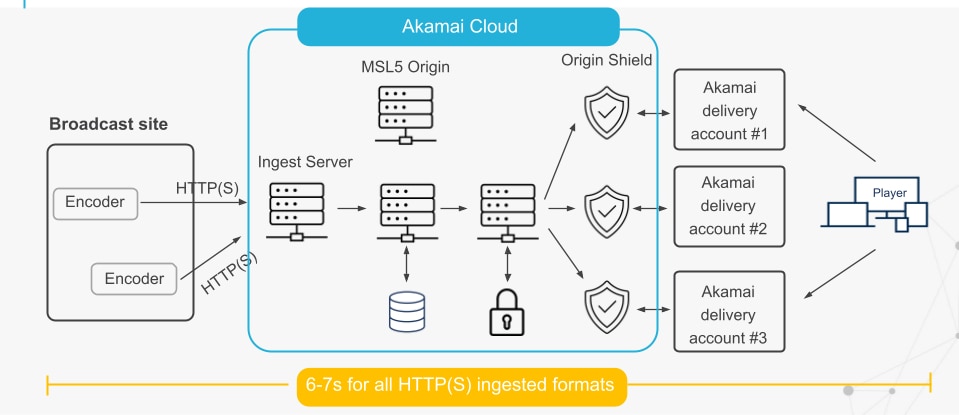 MSL5 — purpose-built for live streaming on Akamai Cloud
This technology was validated on some of the most-watched streaming events to date, including the NFL Network Exclusive Games and the Paris 2024 Olympic Games. It provides Akamai with the reliable, highly scalable, and cost-effective solution necessary to better serve you and help maintain your competitive edge in the industry.
Improve performance, insights, and administration
The Akamai edge network integrates natively with MSL5, allowing existing MSL4 customers to upgrade to MSL5 in minutes and quickly take advantage of the platform's many improvements.
MSL5 users will benefit from:
- Improved performance
- Faster time to first byte (TTFB) with MSL5 than MSL4
- Faster onboarding, greater scalability
- Near–real-time stream provisioning (5 seconds)
- Sliding DVR Windows support up to 12 hours (vs. 30 minutes with MSL4)
- Higher aggregate maximum bitrate: 100 Mbps for primary stream (vs. 75 Mbps for MSL4), 200 Mbps for primary and backup streams
- User experience insights
- More intuitive user interfaces with powerful metrics displays and system status overview
- Event monitoring support
- Logs management and access to ingest logs
- Efficient administration
- Simple event creation and management
- New features planned in 2026
- Low-latency HTTP live streaming
- Live over-the-top (OTT) transcoding
- Server-side ad insertion
How to learn more
You can learn more about MSL5, powered by Harmonic, by reading our product brief.
See Akamai TechDocs for more details, including a two-minute video tutorial on how to migrate. Please note that the existing MSL4 streams will be deactivated on the Akamai portal on or soon after December 31, 2026.
Reach out to your Akamai Account Team to add MSL5 to your contract and begin migration.

Tags