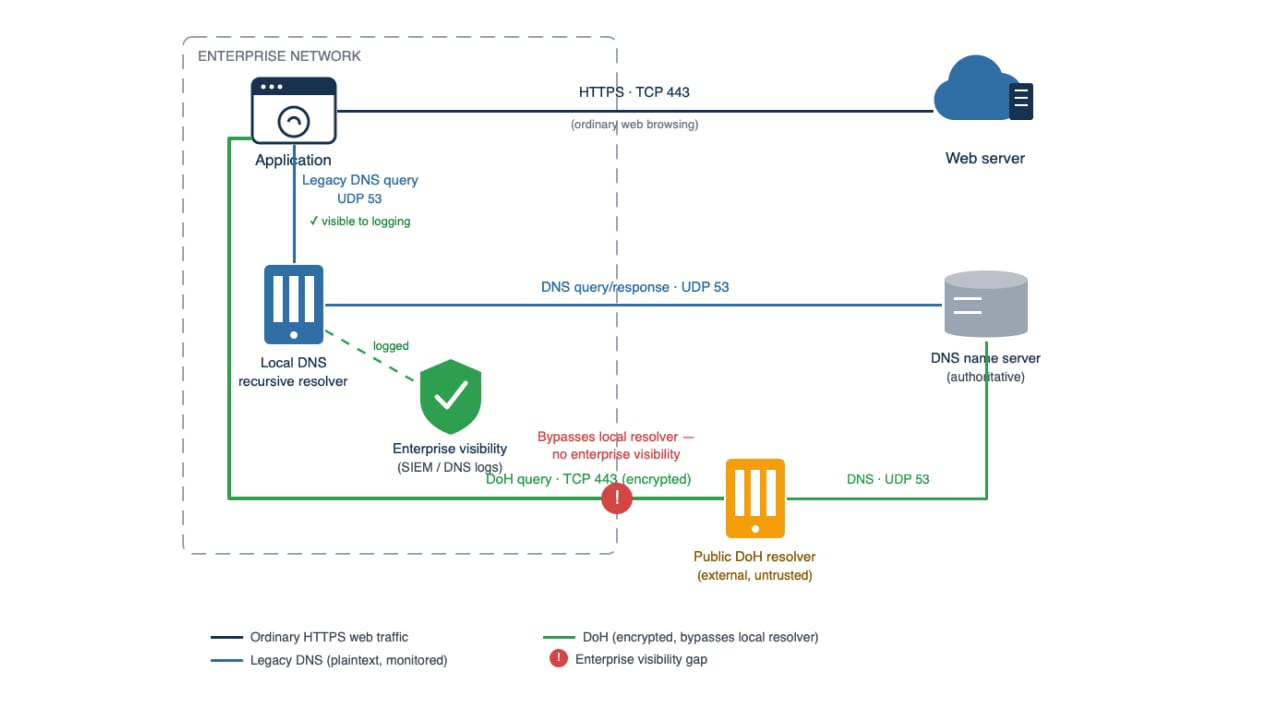
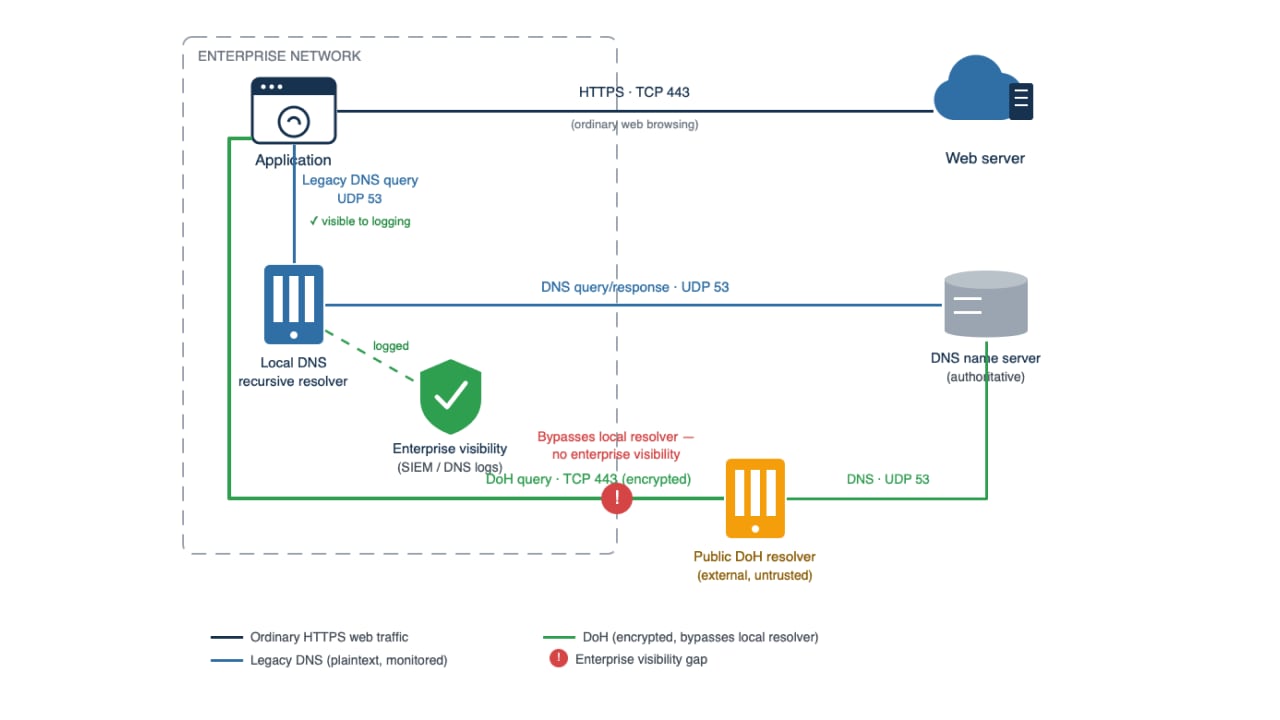
Much of the DoH abuse story isn’t about sophisticated malware, it’s about control drift in environments that are unmanaged, partially managed, or inconsistently enforced. On fully managed browsers, IT can usually disable browser-selected DoH or force approved resolvers; the real problem appears when applications bypass the system resolver, devices roam outside enterprise control, or policy is incomplete.
Encrypted DNS to third-party resolvers means that:
Internal DNS filters, RPZ rules, and custom blocklists are ignored.
DNS logs in your SIEM no longer reflect reality — users are resolving domains you never see.
Content filtering and compliance controls fail silently, potentially exposing your organization to regulatory violations or data breaches.
Attackers typically abuse DoH in one of two ways: malware ships its own DoH client (or uses standard HTTP libraries) to talk directly to an external endpoint, or — in more serious browser-compromise cases — a malicious extension abuses the browser’s privileged network access. Either way, once outbound HTTPS is allowed, they’ve quietly stepped outside your DNS control plane.
Exploiting secure-by-default client behavior
As Windows 11, major browsers, and mobile platforms increasingly default to encrypted DNS — sometimes auto-upgrading to DoH/DoT when they detect a capable resolver — adversaries can simply ride along.
If an environment doesn’t explicitly control where DoH is allowed to go, malware can piggyback on the same resolvers the OS or browser already uses and blend into legitimate traffic. Features meant to protect users from ISP snooping become a free, stealthy layer for adversaries inside enterprises that haven’t modernized their DNS architecture.
This is increasingly policy, not just technology: NIST’s SP 800-81r3 notes that the U.S. government now requires Federal Civilian Executive Branch (FCEB) agencies’ DNS infrastructure to use encrypted DNS wherever technically supported — a sign that encrypted-by-default DNS is becoming a baseline expectation. This makes “just block DoH” an even less viable strategy.
Organizations that don’t adapt risk operating with incomplete intelligence: They may be unaware of which domains their endpoints are resolving, which users are bypassing content policy, and which systems may already be talking to attacker infrastructure.