

Background

Is Your Cloud Infrastructure Running in the Right Place?

November 17, 2026 by Danielle Cook

Share

When we commissioned Forrester Consulting for our latest research — Right Workload. Wrong Place. — we had a question: Are enterprises able to run their applications where they need to, or is their cloud infrastructure limiting their choices?

We’ve spent years talking about cloud in terms of capacity, scalability, and cost. All those things still matter, but where an application runs is becoming just as important, particularly as more applications require real-time responses.

Think about what an enterprise needs to support today. There are traditional applications running on CPUs, AI models that require GPUs, data that may need to stay in a particular location, and lightweight functions that can run close to an end user. Some workloads benefit from being centralized, while others perform better when compute is close to the people or systems using it.

The challenge for infrastructure teams is figuring out how to support all these requirements without making their environments even more complicated. We wanted to understand how organizations are approaching these decisions, what challenges they’re running into, and whether they have the flexibility to move workloads when requirements change.

So, we commissioned Forrester Consulting to survey 528 enterprise infrastructure decision-makers across North America, Europe, and Asia-Pacific.

In this blog post, I’ll explore some of what we learned.

More applications need to respond in real time

One of the things that stood out in the research was how much of the enterprise application portfolio is now real time or interactive.

  • 41% of respondents cite the distance between data storage and processing as a cause of response-time issues.

  • 76% of respondents say more than a quarter of their applications are real time or interactive, and 78% say that share has increased over the past two years.

It’s more than AI here; these workloads include APIs, personalization engines, service-to-service communication, video processing, and other applications that organizations have been running for years. What they have in common is that someone, or something, is waiting for a response.

If you’re shopping online, you expect recommendations to appear as the page loads. If you're using a voice assistant, you expect it to respond without an awkward pause. And if an application depends on multiple services to complete a request, delays between those services can affect the overall response time. Our research found that:

  • Only 16% of organizations consistently meet the response-time targets for their most business-critical interactive workloads.

When Forrester asked what was causing these performance issues, two of the most common answers were the location of data relative to where it's processed and the physical distance between users and compute.

These are architectural challenges. Adding more capacity in an existing cloud region isn't necessarily going to help if the application needs to communicate with data or users thousands of miles away.

Enterprises want more choice in where they run compute

We also wanted to understand whether organizations were running workloads in their preferred locations or simply working within the constraints of their current infrastructure. The research results showed:

  • 55% of respondents cite operational complexity as a barrier to running compute in their ideal locations.

  • 75% of respondents said they would run compute in more locations if they weren’t limited by provider capabilities, budgets, or operational complexity.

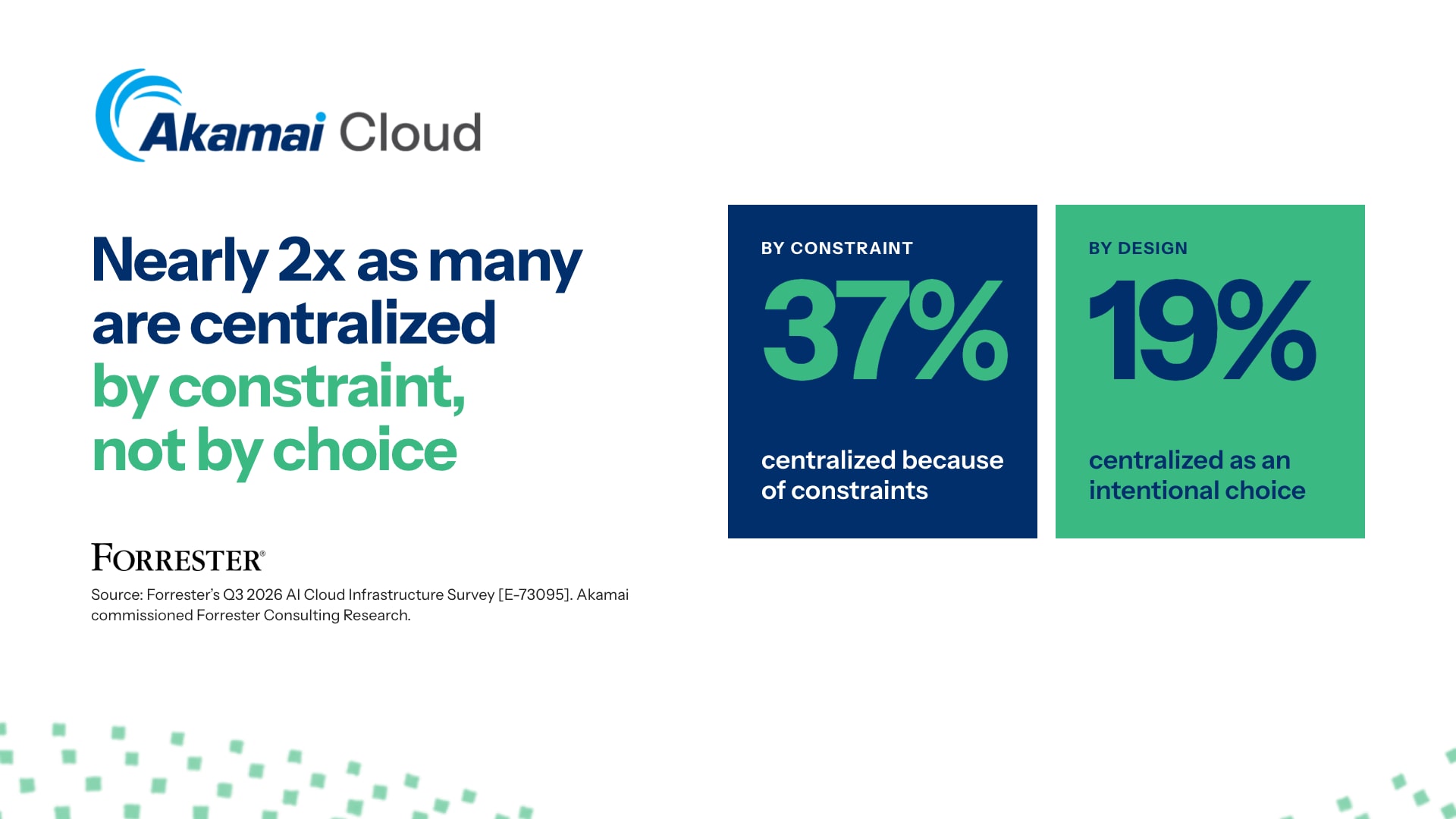
  • 37% described their infrastructure as centralized because of constraints, compared with just 19% who said centralization was an intentional architectural decision.

Nearly 2x as many are centralized by constraint, not by choice.

That doesn’t mean every organization needs to run applications in dozens of locations. There are plenty of good reasons to centralize workloads, particularly when you’re dealing with large datasets, specialized hardware, or applications that don't have strict latency requirements. But organizations should be able to make that decision based on what the application needs.

Once a workload is deployed, changing its location can be difficult. 

  • Nearly 80% of respondents to the survey said relocating a production workload takes days or longer. 

  • 50% said they had kept workloads in locations they knew weren’t ideal because moving them would be too expensive or complicated. 

This means that teams can end up designing around the limitations of their infrastructure rather than designing for the needs of their applications. 

And that has a business impact. The research found that organizations are increasing infrastructure spending, accepting lower performance for some users, and delaying launches to compensate for performance issues.

You can get more details on this in the full report, particularly regarding the costs of moving data and the operational challenges of managing workloads across locations.

What does a continuum of compute actually look like?

At Akamai, we’ve been looking at how we can give organizations more flexibility in the types of compute they use and where they run it.

Depending on the application, that might mean:

  • Centralized GPUs for fine-tuning and hosting models that require significant compute capacity

  • GPUs across geographic regions to serve inference workloads closer to users and data

  • CPUs in regional cloud locations to run traditional applications and support AI workloads

  • Functions at the edge to process requests and run application logic closer to users

All these are different requirements, and most enterprises will need some combination of them, often within the same application.

This is how we think about a continuum of compute, with infrastructure that spans from core cloud regions to the edge. Organizations can run different parts of an application where they make the most sense, while managing them on the same cloud platform.

Of course, compute location is only part of the decision. Organizations also need to consider where their data lives, how applications communicate, and the cost of moving information between environments. 

  • 80% of respondents experience unexpected data transfer costs at least occasionally.

Moving compute closer to a user may improve response times, but if that application constantly needs to retrieve data from another region, the benefits could be limited.

Building and operating applications across environments

There‘s also the question of how easily teams can build and operate applications across these environments. Open technologies such as Kubernetes, open-weight models, and OpenAI-compatible APIs give organizations more flexibility in how they deploy and manage workloads, without tying every component to a proprietary service.

The goal is to give teams the infrastructure and tools to make those architectural decisions based on their applications’ requirements.

AI is making cloud architecture more complicated

I recently wrote about how every application now lives in an AI ecosystem. In that blog post, I looked at how applications are increasingly connected to AI, even when they aren’t what we’d traditionally consider AI applications.

An application might contain AI, connect to an AI service, feed data into a model, or provide the infrastructure that supports an AI workload.

For example, an enterprise might have a customer-facing application running on CPUs that calls an AI model hosted on GPUs. That model may need to retrieve information from a database, access an API, or interact with another service before returning a response.

Now, add agents into that environment. An agent might call a model, access data, execute code, and interact with other services to complete a task. Each of those interactions introduces additional infrastructure requirements, and they may not all need to run in the same location.

The GPUs hosting the model might be in a core cloud region, while inference and agent workloads run closer to users and data. Functions at the edge can handle parts of the interaction, and the surrounding application continues to rely on CPUs, networking, and storage.

And all this needs to happen quickly enough that the customer doesn't notice the complexity behind the scenes.

Securing the AI ecosystem

We also need to think about security. As applications become more connected and agents start interacting with systems on our behalf, organizations need to understand and control the traffic moving between users, applications, models, and agents. That understanding and control includes inspecting human, bot, and agent traffic, enforcing controls closer to where interactions happen, and isolating workloads appropriately.

These requirements make the location of compute, data, and security controls increasingly important.

In my previous post, I also discussed data gravity, which describes how large or important datasets become difficult and expensive to move. Sometimes bringing compute closer to the data makes more sense than moving the data to the compute.

These challenges existed before AI. What's changing is how frequently applications need to communicate across different services, compute types, and locations.

And enterprises still have all their existing workloads to support alongside these new requirements.

Building for the applications you have and the ones you'll need

One of the reasons we commissioned this research from Forrester Consulting was to better understand whether existing cloud architectures are giving enterprises the flexibility they need. There is still work to be done. 

Organizations are running more interactive workloads and struggling to meet response-time targets, and are often unable to move applications to better locations without significant effort or expense.

As AI becomes more integrated into enterprise applications, these challenges will become increasingly important. Organizations need to support existing applications while introducing new capabilities such as model inference and agents, often with different requirements for compute, performance, and security.

A cloud platform that supports the full AI stack

At Akamai, we’re building a cloud platform that supports the full AI stack, with infrastructure spanning from core regions to the edge. Teams can fine-tune and host models on dedicated GPU infrastructure, serve inference and run agents closer to users and data, and manage application interactions and security across the platform.

We’re also focused on open technologies and extending the cloud environments customers already use, so organizations have more choice in how they build and deploy applications.

The right location today might not be the right location tomorrow

The Forrester Consulting research reinforces why this flexibility matters. Applications evolve, customer expectations change, and the right location for a workload today might not be the right location tomorrow.

Organizations need the ability to make those decisions without being limited by where their cloud provider happens to offer compute.

Learn more

Download Right Workload. Wrong Place. to explore what 528 enterprise infrastructure leaders told Forrester about workload placement, performance, data movement costs, and the challenges of moving compute where it's needed.

FAQ

A continuum of compute is an infrastructure design spanning core cloud regions to distributed edge points of presence. It allows teams to deploy workloads — ranging from heavy GPU model fine-tuning to low-latency edge functions — where they perform best without being forced into a single centralized environment.

AI inference and autonomous agents require real-time execution close to end users and data sources. Centralized data centers introduce physical latency and high data egress costs when moving queries and embeddings back and forth across regions.

Akamai Cloud provides distributed GPUs and CPUs alongside global edge execution, enabling enterprises to serve model inference, run agents, and enforce Zero Trust security close to users without vendor lock-in.

FAQ

About the author

Danielle Cook author image

Danielle Cook

Danielle Cook has been a driving force in the cloud native industry since 2016, helping organizations adopt enterprise-ready technologies while communicating their business value. She co-authored and maintains the CNCF Cloud Native Maturity Model, co-chairs the CNCF Cartografos Working Group, and co-authored Admiral Bash’s Island Adventure. A CNCF Ambassador and founder of KubeCrash, a virtual bi-annual meeting, she champions open source and community-driven activism.

Tags