The way people watch live sports is changing, with fans increasingly seeking high-quality streams of local games, niche sporting events, and hard-to-access matches. This shift is reshaping how venues and broadcasters approach live streaming, demanding more reliable and flexible solutions to meet growing expectations.
Smaller sporting events in more remote locations or regions otherwise underserved by cloud providers traditionally faced significant barriers to live streaming. Live video streaming requires access to a network with low jitter and reliable connectivity to avoid packet loss and consistent bandwidth. Though many areas of the globe are making significant progress in terms of expanding internet access, this level of connectivity isn’t available everywhere, making expensive satellite transmission services the only serviceable alternative.
To address this challenge, some specialized platforms are highlighting smaller and niche tournaments by leveraging the Akamai network to contribute high-quality streams of these events - bringing live content from remote locations to populous cities seamlessly.
Akamai’s Distributed Compute Regions provide highly distributed, cost-effective compute resources in edge locations with fast, reliable network connectivity and consistent round-trip time (RTT) across regions, which can come in handy especially for use cases like contribution, transcoding or packaging.
How Effective are Akamai’s Distributed Compute Regions for Contribution?
As live streaming from remote locations becomes more feasible with solutions like Akamai’s Distributed Compute Regions, ensuring your infrastructure’s reliability is crucial, especially for high-stakes events.
In certain situations, the remote camera feed needs to be transmitted across the internet to a studio for further processing. In order to have consistent, efficient and low latency contribution, Akamai’s Distributed Compute Regions come into play.
To demonstrate these regions’ ability to handle these demanding scenarios, I conducted extensive tests across a range of challenging conditions, from regions with limited connectivity to geographically dispersed venues.
These tests were designed to rigorously assess the performance of our distributed regions by simulating real-world streaming scenarios through two distinct architectures, so you can see the difference for yourself.
The table below outlines the different streaming routes, protocols, and networks used during testing to evaluate the performance of Akamai’s Distributed Compute Regions. I tested using both Secure Reliable Transport (SRT) and Zixi protocols, which are commonly used for video contribution. SRT optimizes performance by minimizing packet loss and jitter, while Zixi adds advanced error correction and bandwidth management features. These protocols were evaluated across Akamai's Distributed Compute Regions and transport via Akamai network.
| Route | Protocol |
| Chicago to Santiago | SRT & Zixi |
| Santiago to Los Angeles | SRT & Zixi |
Test Scenario
To evaluate the performance of live streaming across these network routes, I created a series of tests measuring key metrics: round-trip time (RTT), network jitter, packet drops, and health score (a proprietary metric by Zixi). These tests ran continuously for 48 hours, and results were averaged across one-minute intervals to give a comprehensive view of performance under real-world conditions.
Chicago to Santiago over Akamai’s Distributed Compute Regions:
The first route I tested was from Chicago to Santiago.
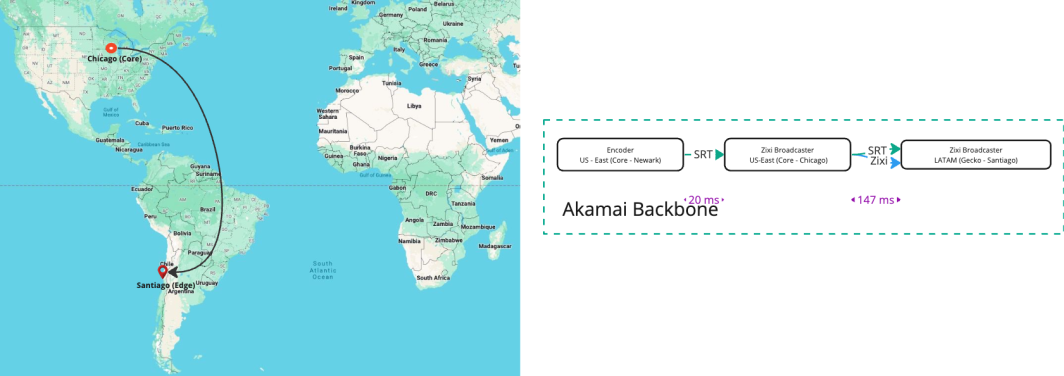
Results
- RTT: 147 ms
- Packet Drops: less than 0.01%
- Jitter: 1ms
- Health Score: 100
As you can see from the results, Akamai’s distributed regions provide low latency results for long-distance traffic between North and South America. With near-zero packet loss and minimal jitter, the stream achieved a perfect Health Score of 100.
Santiago to Los Angeles over Akamai’s Distributed Compute Regions:
The next test I set up measured the route from Santiago to Los Angeles.
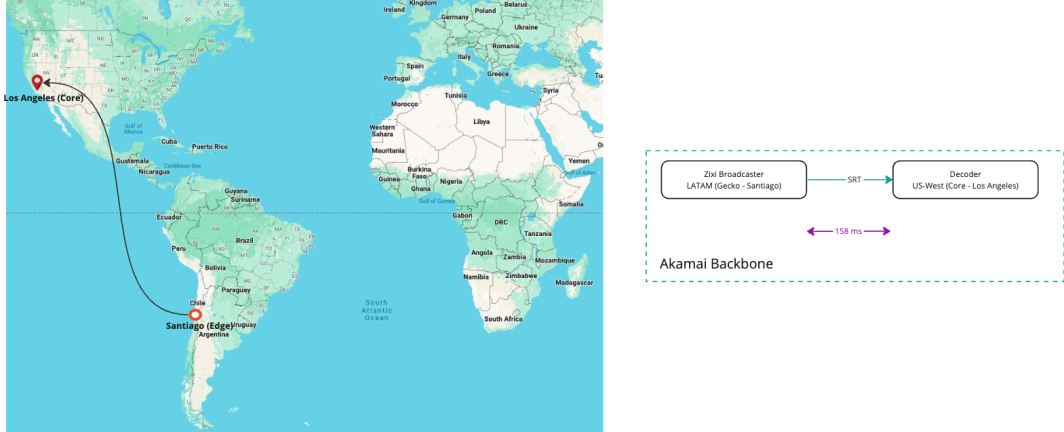
Results
- RTT: 158 ms
- Packet Drops: less than 0.01%
- Jitter: 2ms
- Health Score: 100
Similarly, this test showed how Akamai’s Distributed Compute Regions kept latency low while preserving stream quality. Despite covering a significant geographical distance, Akamai ensured steady data flow without packet loss, delivering a flawless Health Score of 100.
Test Summary
The results - low jitter, consistent round trip time, and negligible packet drop highlight the power of Akamai’s Distributed Compute Regions and the power of Akamai’s backbone covering difficult-to-reach regions. The Akamai network helped in achieving reliability for the live stream. Here is the summary of test results for both tests.
| Origin | Destination | Protocol | RTT | Packet Drop | Jitter |
| ORD (Chicago) | SCL (Santiago) | SRT & Zixi | 253 ms | Less than 0.01% | 1 ms |
| SCL (Santiago) | LAX (Los Angeles) | SRT & Zixi | 295 ms to 305 ms | Less than 0.01% | 1 ms |
The Akamai Advantage
The ability of Akamai’s Distributed Compute Regions to contribute live streams with low latency, minimal jitter, and nearly flawless packet transmission—across even the most far-flung regions—speaks for itself. With the low latency guarantee from remote camera feed locations and the feeds fed into further processing such as transcoding and paired with Akamai’s content delivery network, you have the ability to achieve low latency or ultra low latency use cases for live streaming.
Akamai’s vast network makes streaming from anywhere a reality without sacrificing quality. This kind of reliability isn’t just about meeting the needs of today’s sports fans—who expect a flawless experience no matter where the game is played—but also about empowering businesses to expand their live-streaming reach without the baggage of outdated, expensive tech.
By leveraging Akamai's infrastructure for the entire streaming media workflow, customers get access to Akamai Connected Cloud which includes our content delivery network (CDN) which offers the ability to deliver high-quality streams at scale. This integrated approach streamlines the video pipeline and ensures secure, low latency live streaming.
To get started with Akamai’s Distributed Compute Regions, read more about it here, sign up for updates, or contact sales to see how you can deploy low latency live streaming from even the most remote locations.

Tags