In the world of digital video, the media player is often overlooked among the many steps of preparation, storage, and delivery. Yet it's one of the most critical components in the streaming experience. It's the last mile between your content and your audience.
Whether your viewers are watching on a smart TV, mobile device, or game console, the player is responsible for rendering video, managing playback quality, handling ads, and collecting analytics. In short: If the player fails, the experience fails.
Think of the media player as the conductor of a complex orchestra. It coordinates:
Playback: Decoding and rendering video streams in real time
Content protection: Enforcing digital rights management (DRM) policies to secure premium content
Advertising: Managing ad insertion workflows like server-side ad insertion (SSAI) and client-side ad insertion (CSAI)
Analytics: Capturing performance, engagement, and monetization data
User experience: Ensuring smooth navigation, responsiveness, and quality
Yet most media workflows rely on fragmented solutions — separate software development kits (SDKs) for each platform, third-party analytics integrations, and custom ad logic. This leads to inconsistent data, longer development cycles, and higher operational costs.
Introducing AMP2
That's why Akamai, in partnership with Bitmovin, is introducing Akamai Adaptive Media Player 2 (AMP2) — a next-generation media player designed to simplify development, unify analytics, and enhance viewer experiences across every platform, ensuring audiences can view your content on any device, anywhere.
AMP2 reimagines the media player's role by embedding intelligence directly into the SDK. AMP2 offers:
- Multiplatform SDKs: Covering web, mobile, smart TVs, and consoles
- Built-in analytics: Real-time insights into playback, audience behavior, and ad performance
- Advanced features: Multiview streaming, server-guided ad insertion (SGAI), and error diagnostics
- Streamlined development: With support for React Native and Flutter, and robust documentation
By consolidating playback, analytics, and monetization into a single player, AMP2 eliminates the need for multiple vendor relationships, accelerates time to market, and provides the operational flexibility and metrics that operations and developers need.
Why AMP2 is a game changer
AMP2 isn't just a technical upgrade — it's a rethinking of media players based on what is critical to video providers today, including:
Reach: Ensure that the complex, ever-evolving ecosystem of devices doesn't prevent users from enjoying an optimal experience while consuming your content
Observability: Get the real-time data you need to identify and resolve issues that impact user streams or monetization; combine content delivery network (CDN) logging for the ultimate operational visibility
Simplicity: Allow developers to focus on functionality, not maintenance, with automated testing and upgrades and support for common cross-platform frameworks.
User experience and monetization: Enjoy enhanced capabilities like multistream viewing, DRM, low-latency, and monetization support for SSAI, CSAI, and SGAI
Stay tuned
Existing AMP customers will receive communication from their account teams. This will include timelines, options, information, and support to facilitate a smooth transition.
The figure shows a comparison of the original AMP and the next-generation AMP2.
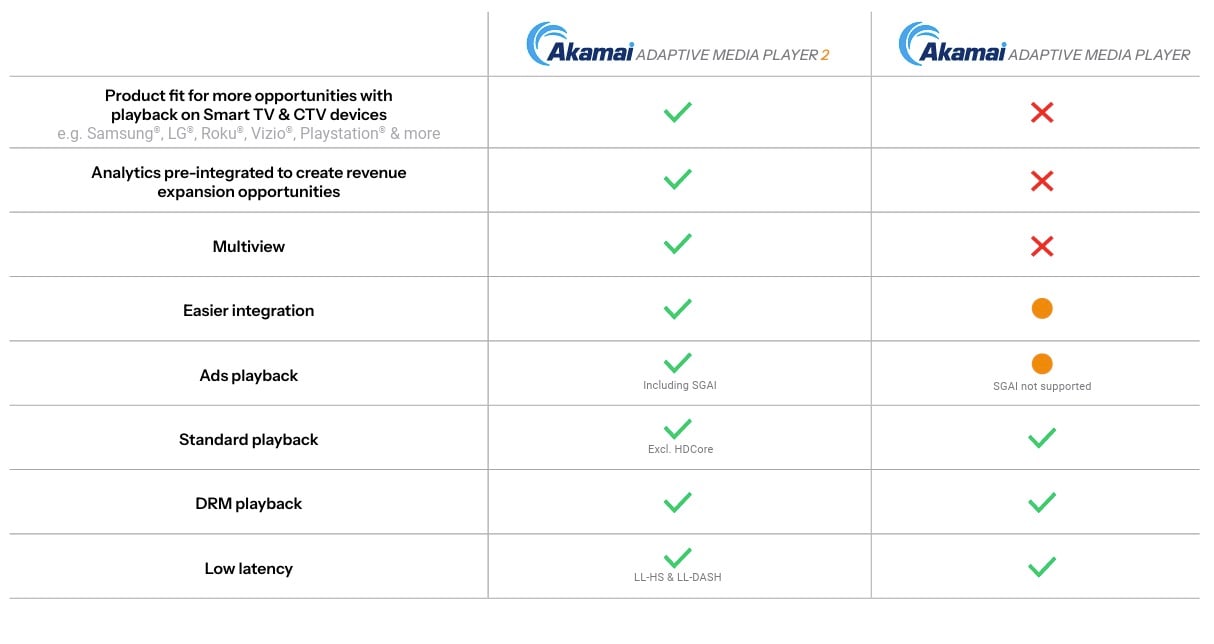 Comparison chart of AMP and AMP2
Whether you're building a new video app or optimizing an existing platform, AMP2 will give you the tools to deliver high-quality playback with complete control.

Tags