Security leaders are increasingly adopting a simple mindset: Assume breach.
Attackers today move quickly once inside a network, using automation and artificial intelligence (AI)-assisted techniques to discover systems, escalate privileges, and spread laterally across environments. Stopping every intrusion is no longer realistic. What matters most is containing attacks before they become enterprise-wide incidents.
That’s why microsegmentation is a critical control for modern security programs.
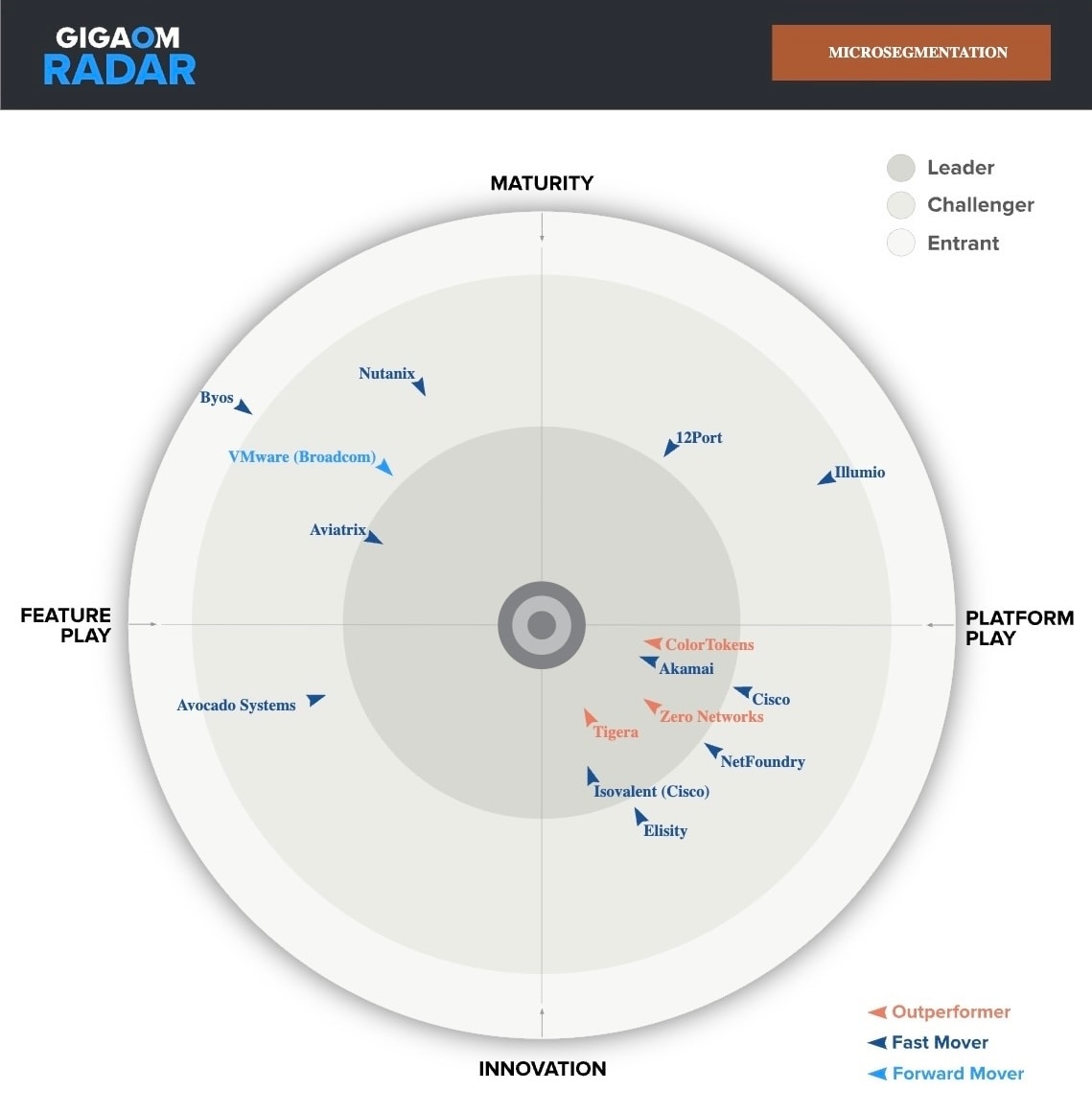
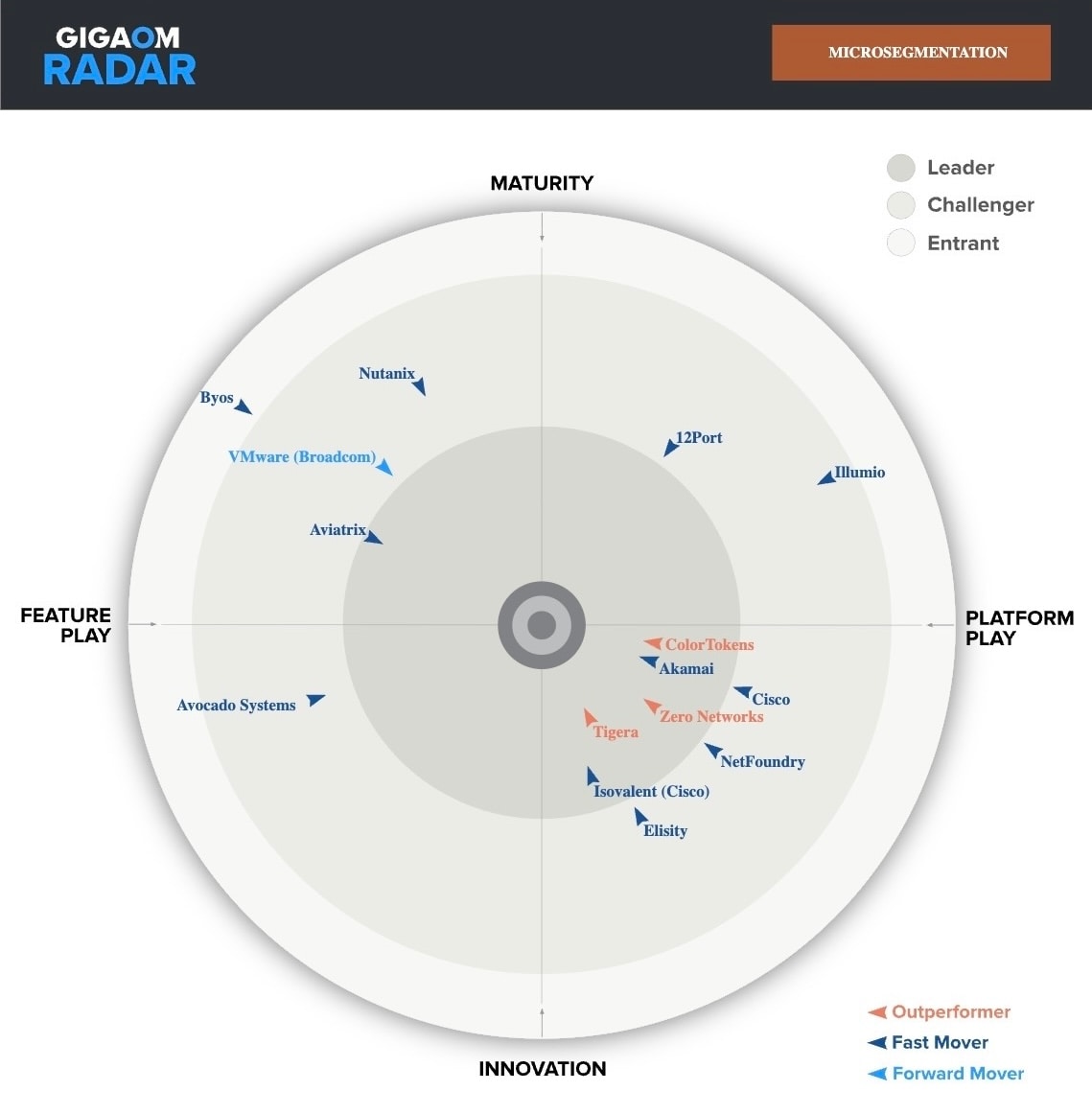
Industry analysts are increasingly recognizing this shift as well, which is why we are thrilled that in the 2026 GigaOm Radar for Microsegmentation report, Akamai Guardicore Segmentation has been recognized as a Leader and Fast Mover. Akamai is also positioned closest to the center of the Radar, reflecting our ability to balance strong execution along with a rapid pace of innovation.
Understanding the GigaOm Radar
The GigaOm Radar for Microsegmentation report evaluates vendors based on both the completeness of their platforms and their pace of innovation. Unlike quadrant-style analyst reports, the Radar shows how vendors balance mature capabilities with forward momentum, along with balancing a feature-forward approach versus taking a platform approach.
Vendors positioned closer to the center generally demonstrate stronger overall performance, while the direction of movement reflects the analysts’ view of each vendor’s innovation trajectory.
In the 2026 report, Akamai is positioned closest to the center and recognized as both a Leader and a Fast Mover, reflecting the maturity of our platform as well as the innovation driving its evolution. This placement reflects a broader shift in how organizations approach segmentation.
Balancing innovation with enterprise readiness
Being recognized as both a Leader and a Fast Mover reflects an important balance that we’re striking in the microsegmentation market. Security teams need platforms that can protect today’s complex environments while continuing to evolve alongside changing infrastructure and threat landscapes.
This balance requires mature capabilities for deploying microsegmentation across enterprise environments, along with ongoing innovation to address new operational and security challenges.
Microsegmentation platforms are expected to provide more than network policy enforcement; they must help security teams understand application communication, apply policy based on real behavior, and enforce controls consistently across hybrid environments.
Closest to the center: Delivering balanced platform strength
In the Radar visualization, vendors positioned closer to the center reflect stronger overall performance across the evaluation criteria.
Akamai’s placement closest to the center highlights the balanced strength of Akamai Guardicore Segmentation, combining mature microsegmentation capabilities with continued innovation.
The report also positions Akamai on the Platform Play side of the Radar, reflecting how microsegmentation has evolved beyond a stand-alone infrastructure control into a broader security capability.
By combining deep visibility into application communication with contextual signal ingestion, the platform gives security teams the insight needed to understand how systems interact across the environment. Policy controls support Zero Trust architectures then help organizations reduce risk while keeping security aligned with the pace of modern infrastructures.
Making microsegmentation work at enterprise scale
Despite its benefits, microsegmentation has historically been difficult to implement at scale.
Security teams often struggle to map application dependencies, design policies safely, and enforce controls without disrupting critical business operations. These challenges have caused many segmentation initiatives to stall before they reach meaningful enforcement.
Akamai Guardicore Segmentation approaches this problem by providing deep visibility into how applications communicate, along with tools that help translate observed behavior into easy-to-apply microsegmentation policy.
By understanding application communication at the process level, organizations can validate policies and move from visibility to enforcement more confidently and with less operational risk.
A foundation for modern Zero Trust security
As organizations implement Zero Trust architectures, enforcing least-privilege communication among systems becomes increasingly important.
Identity and access controls help manage who can access resources, but they do not limit how systems communicate once that access is granted. Microsegmentation helps address this challenge by restricting unnecessary east-west communication and limiting opportunities for lateral movement.
In this way, microsegmentation becomes a practical enforcement layer within a Zero Trust architecture. By combining deep visibility, policy controls, and safe enforcement across hybrid environments, platforms like Akamai Guardicore Segmentation help organizations reduce risk while keeping security aligned with the pace of modern infrastructure.
Looking ahead
The 2026 GigaOm Radar for Microsegmentation report reflects the growing importance of microsegmentation as organizations shift toward security architectures designed to contain attacks and continuously reduce risk.
As modern environments become more distributed and dynamic, security teams need microsegmentation platforms that combine deep visibility, intelligent policy control, and safe enforcement across hybrid infrastructure.
At Akamai, we remain focused on advancing Akamai Guardicore Segmentation to help organizations make microsegmentation practical at enterprise scale. Our goal is simple: Give security teams the tools they need to reduce lateral movement, strengthen Zero Trust architectures, and stay ahead of an evolving threat landscape. This latest report from GigaOm is a tremendous recognition of our efforts.
Learn more
Explore how Akamai Guardicore Segmentation helps organizations contain attacks and reduce risk across hybrid environments.
Tags