

Background

Deconstructing the Architecture of AI-Orchestrated Web Attacks

August 24, 2026 by Ryan Barnett

Share

Key takeaways

Cyberthreats have evolved into machine-scale attacks, creating an operational “speed gap” where AI systems generate functional exploits in less than 10 minutes — rendering multiday patch cycles ineffective.

Frontier large language models (LLMs) do not execute attacks directly; they act as orchestrators (“brains”) that perform complex code analysis while secondary tools like headless browsers (“hands”) carry out web requests.

Offensive workflows leverage protocols like Model Context Protocol (MCP) and multitool platforms to automate reconnaissance, probe vulnerabilities, and repeatedly execute exploits until they succeed.

AI-orchestrated attacks obfuscate their origin by spoofing standard User-Agent headers, preventing legacy web application firewalls (WAFs) from detecting malicious activity via static signatures.

Mitigating autonomous threat pipelines requires real-time behavioral analytics and automated defenses deployed directly at the edge to identify probing activity before weaponized payloads are delivered.

The era of industrialized exploitation

The landscape of web security has reached a critical inflection point, shifting from a battle of human keystrokes to an era of industrialized exploitation. Our research in the Akamai Security Intelligence Group (SIG) revealed a significant compression of traditional security remediation timelines. Although security teams have historically relied on multiday patch cycles to fix known vulnerabilities, automated machine-scale attacks now require immediate, real-time defenses. 

We call it the “speed gap” — the mathematical impossibility that human-led defense can keep pace with machine-scale offense. DARPA Challenge findings have demonstrated that AI systems can identify dozens of vulnerabilities in hours and generate functional exploits in less than 10 minutes. 

The architecture of an AI attack: Orchestrator vs. executor

A persistent technical misunderstanding among security stakeholders is that frontier LLMs perform attacks directly. In fact, they orchestrate automated systems that execute vulnerabilities rapidly at scale. And human-led remediation can still stretch into days or months … or longer. So, security teams face a clear operational imbalance. 

This is the architecture of a “decoupled orchestration” model. The LLM acts as the orchestrator (or brain) by developing the exploit, performing deep analysis of source code, identifying out-of-band (OOB) testing opportunities, and chain-linking logic flaws.

The executor (or hands) of the operation are the secondary tools — headless browsers, custom Python scripts, or existing frameworks — that execute the actual web requests. 

The LLM operates behind the attacker's API, decoupled from the TCP/TLS handshake, while the hands execute the web requests. 

The anatomy of AI-driven attack phases

The table outlines how attackers leverage AI across each phase of the attack lifecycle, alongside the corresponding technical defenses we use to detect and mitigate these advanced threats.


Attack phaseAI-driven actionAkamai technical defense

Reconnaissance

Autonomous agents use well known tools such as FFUF (Fuzz Faster You Fool) or headless browsers to map API logic and find hidden flaws.

Identifying known attack tool fingerprints and headless browser frameworks despite browser spoofing and evasion techniques


headless browsers to map API logic and find hidden flaws.

frameworks despite browser spoofing and evasion techniques

Vulnerability discovery

AI chains multiple low-severity bugs to create a full remote code execution (RCE) exploit.

Using behavioral analytics to detect abnormal probing patterns before the exploit is executed

Exploitation

New machine-speed generated exploits bypass static, signature-based defenses.

Shielding assets with adaptive, AI-powered defenses at the edge

Lateral movement

If a server is breached, the AI autonomously hunts for high-value network assets.

Constraining the blast radius to the vulnerable server via microsegmentation and edge controls

Breakdown of AI-driven attack phases, corresponding automated techniques, and Akamai’s adaptive technical defenses


By pairing autonomous threat logic with adaptive edge security, organizations can effectively contain and block sophisticated automated attacks before they cause severe impact.

The new offensive tool Belt: MCP and AI agents

The bridge between high-level reasoning and offensive execution is the Model Context Protocol (MCP). This protocol allows terminal-based AI assistants to drive security suites autonomously. A prime example is the Burp AI Agent, which integrates MCP tooling directly into the pen testing workflow.

By using automated capabilities like burp-scan, an AI assistant can independently operate security scanners. It uses a reasoning engine to evaluate 62 vulnerability classes — including injection, authentication, and cryptography — against a library of more than 200 payloads. Crucially for researchers, these tools now include sophisticated Privacy Modes (STRICT/BALANCED/OFF) to redact sensitive data, alongside passive analysis protocols that analyze traffic without sending a single probe.

The industrialization of automated capabilities

The industrialization of these capabilities is best seen in platforms like HexStrike AI. This tool integrates with more than 150 security utilities, allowing threat actors to achieve a significant adversarial advantage. By parallelizing automation, attackers can increase their exploitation yield — automatically retrying failed attempts until they succeed. 

We have observed threat actors using such tools to weaponize recently disclosed Citrix vulnerabilities within a single week of disclosure, effectively erasing the time defenders once had to test and deploy patches.

The visibility challenge: Why “User-Agent: LLM” doesn't exist

From a WAF perspective, identifying these attacks is an exercise in detecting shadows. In offensive AI scenarios, there is no “User-Agent: LLM” because the LLM is never the source sending the actual web traffic. 

Because of the decoupled orchestration model, the security provider sees the result of the AI’s intelligence (the web request) rather than the AI itself.

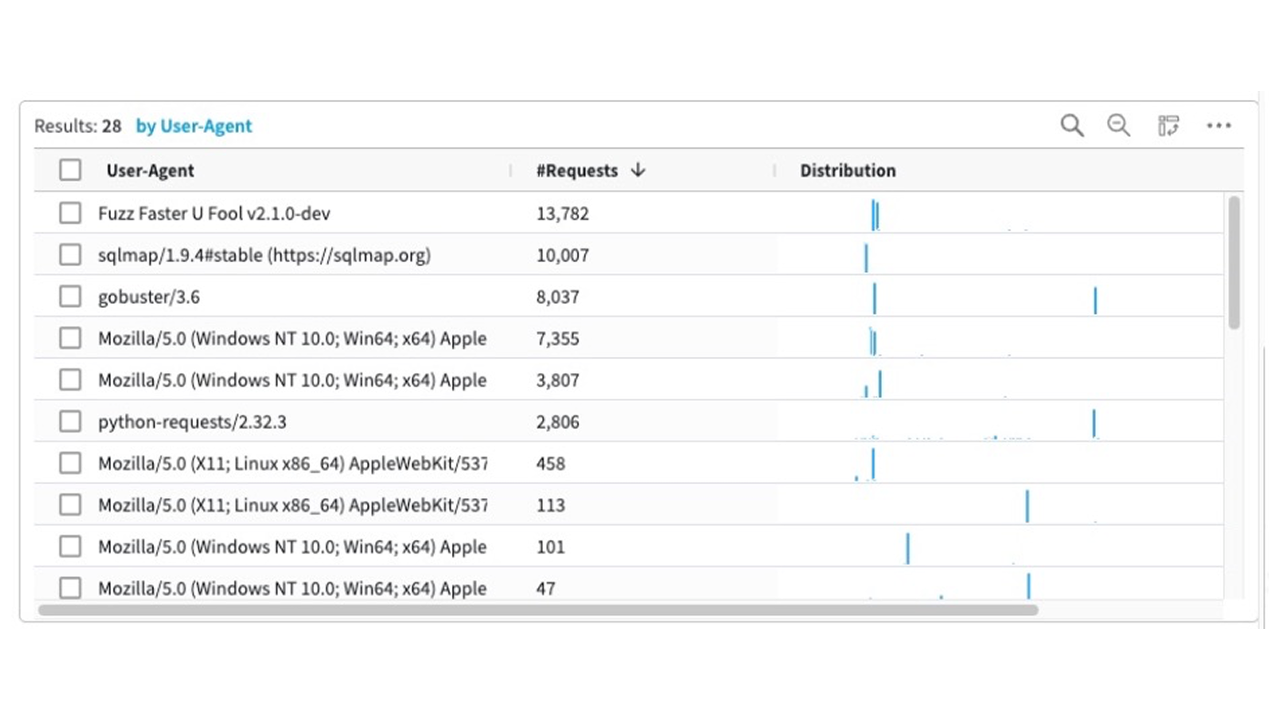
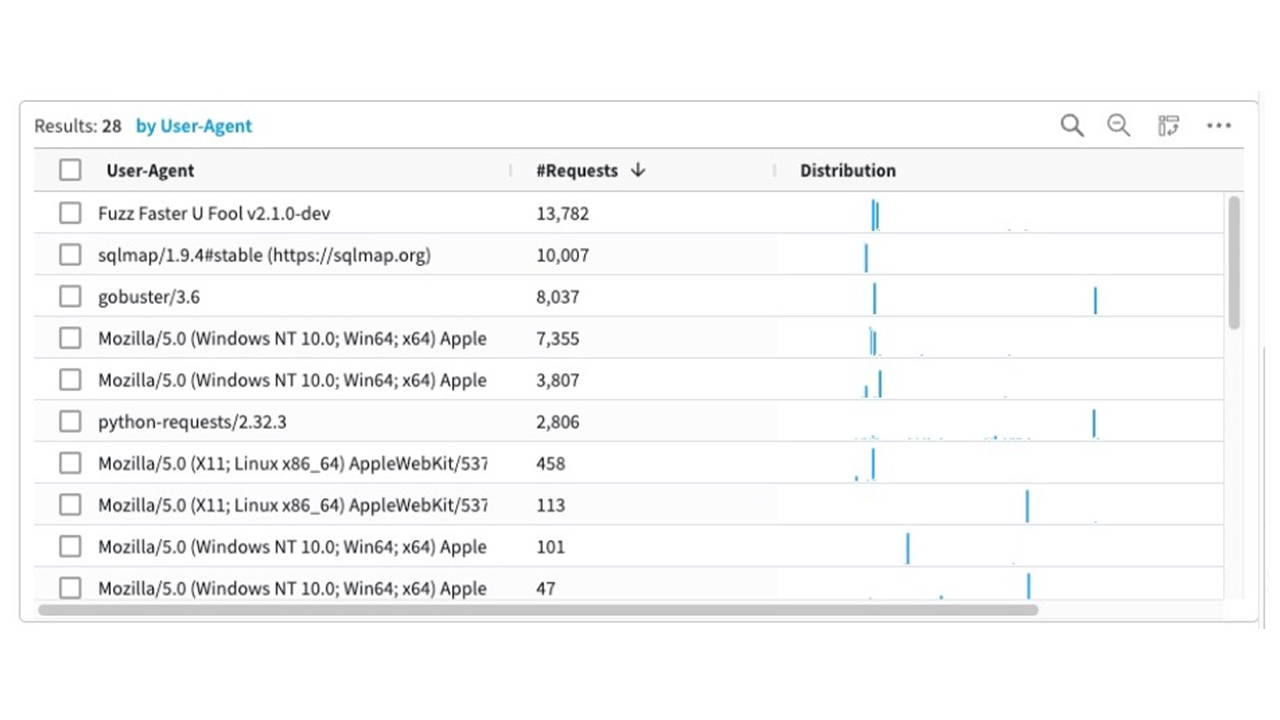
Offensive AI orchestrators can use secondary tools to spoof their identity — meaning traditional, static indicators are useless (Figure). The abstraction through headless browsers ensures that the WAF sees a standard-looking browser session, while the “brain” sits miles away, refining the attack logic in real-time based on the feedback it receives from the “hands.”

Offensive AI orchestrators can use secondary tools to spoof their identity — meaning traditional, static indicators are useless (Figure).
An offensive AI orchestrator uses secondary execution tools to spoof User-Agent headers and bypass static WAF rules
Offensive AI orchestrators can use secondary tools to spoof their identity — meaning traditional, static indicators are useless (Figure).

Closing the gap: The role of defensive AI at the edge

To counter machine-scale attacks, we must deploy machine-scale defense. Relying on human intervention in a 10-minute exploit window is a recipe for failure. At Akamai, we leverage behavioral telemetry from across our global edge platform to identify machine-speed probing that eludes traditional filters.

We use the Akamai Inference Cloud and our distributed edge to close the speed gap via three strategies:

  1. Identifying critical fault lines: We use behavioral analytics to detect the systematic mapping of API logic, identifying the “probing” phase before a weaponized payload is ever delivered.

  2. Preemptively defending AI speed: Our threat research teams use AI-driven insights to surface potential bypasses, updating WAF rules globally before an AI-orchestrated attack can find a foothold.

  3. Moving defense to the edge: By moving defense to the edge, we provide organizations with the ability to shield infrastructure instantly, ensuring that an AI-discovered bug tonight does not become a successful breach tomorrow.

Securing enterprise infrastructure at machine speed

The transition from human keystrokes to machine scale is complete. In today’s threat landscape, traditional reactive security is now a mathematically impossible winning strategy. When an orchestrator can iterate through thousands of evasive tactics in minutes, the defense must be equally autonomous and resilient.

The future of web security lies at the machine-scale edge. Organizations must move beyond the “patch and pray” model and adopt a proactive security posture that operates at the same velocity as the attackers. To secure the future of the modern enterprise, we must meet offensive AI at the edge.

About the Author(s)

Ryan Barnett

Ryan Barnett

Ryan Barnett is a Senior Threat Research Manager leading the Akamai App and API Protector security solution. In addition to his primary work at Akamai, he is also a WASC Board Member and OWASP Project Leader for: Web Hacking Incident Database (WHID) and Distributed Web Honeypots. Mr. Barnett is a frequent speaker at security industry conferences such as Black Hat and has authored two web security books: Preventing Web Attacks with Apache (Pearson) and The Web Application Defender's Cookbook: Battling Hackers and Defending Users (Wiley).