

Background

Attackers Aren’t Hacking Your Customers. They’re Impersonating You.

October 29, 2026 by Kimberly Gomez

Share

It’s not new to say fraud and abuse are threatening online businesses — those types of attacks are often accepted as the price of doing business in many industries. But the tactics are continuing to change and agentic AI is making deception more adaptive and persistent, which is giving attackers new ways to exploit customer trust in familiar brands. 

The abuse can take many forms: misused logos and brand impersonation; look-alike domains and spoofed portals; and scams that move across email, paid advertisements, social media, and other channels. 

Attackers continue to find innovative ways to target brands and customers. The evolution of these increasingly sophisticated attacker tactics that we’ve observed in the fraud and abuse ecosystem is unprecedented. 

3 key insights from the SOTI report

The latest State of the Internet/Security report — AI-Driven Digital Deception The Fraud and Abuse Report 2026 — breaks down what we've seen.  Three takeaways stood out:

  1. Account verification requests represent 40% of high- and critical-risk login traffic, indicating that attackers may be confirming active email accounts prior to executing credential stuffing attacks.

  2. Nearly 70% of the malicious domains that targeted enterprise networks between January and July 2026 impersonated high tech, financial services, and commerce, in that order of frequency.

  3. Online scams approximately doubled in volume and surpassed traditional phishing for the first time in Q1 2026, according to Akamai data. 

Logo abuse and impersonation

Attackers don’t need to be clever when an organization’s brand does the convincing for them. Oftentimes, a cloned logo and a decent login page are enough. 

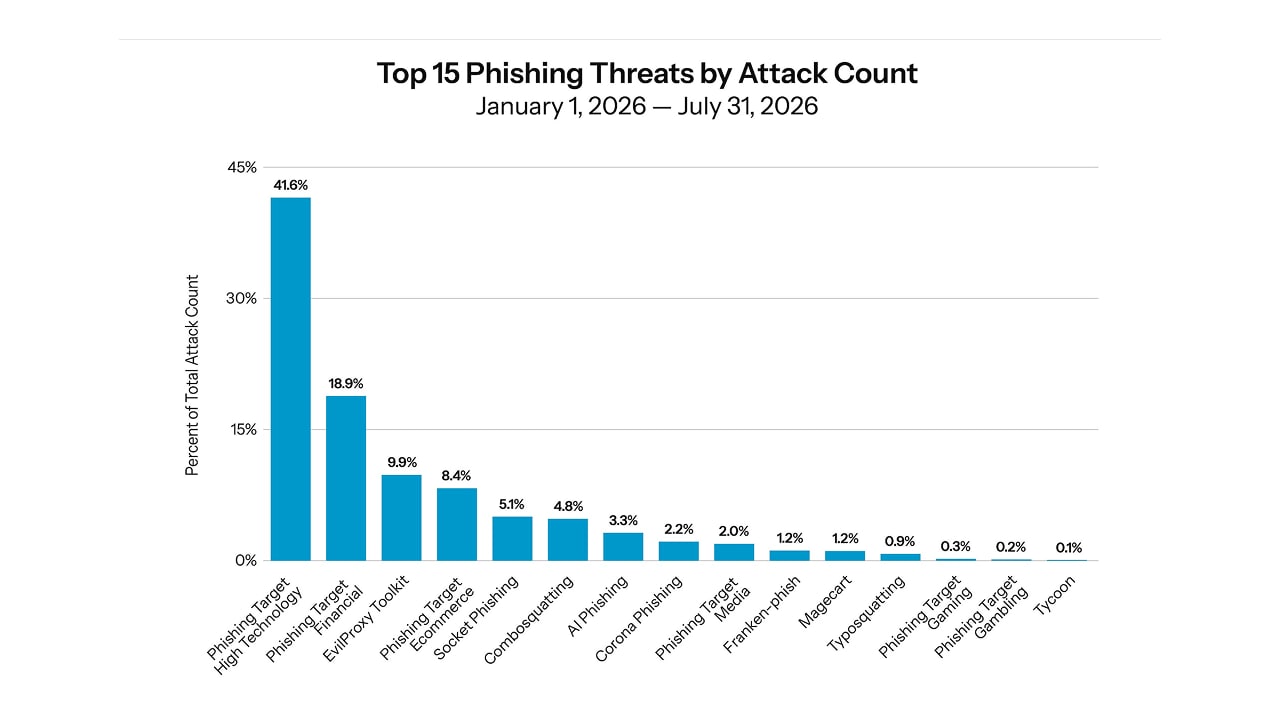
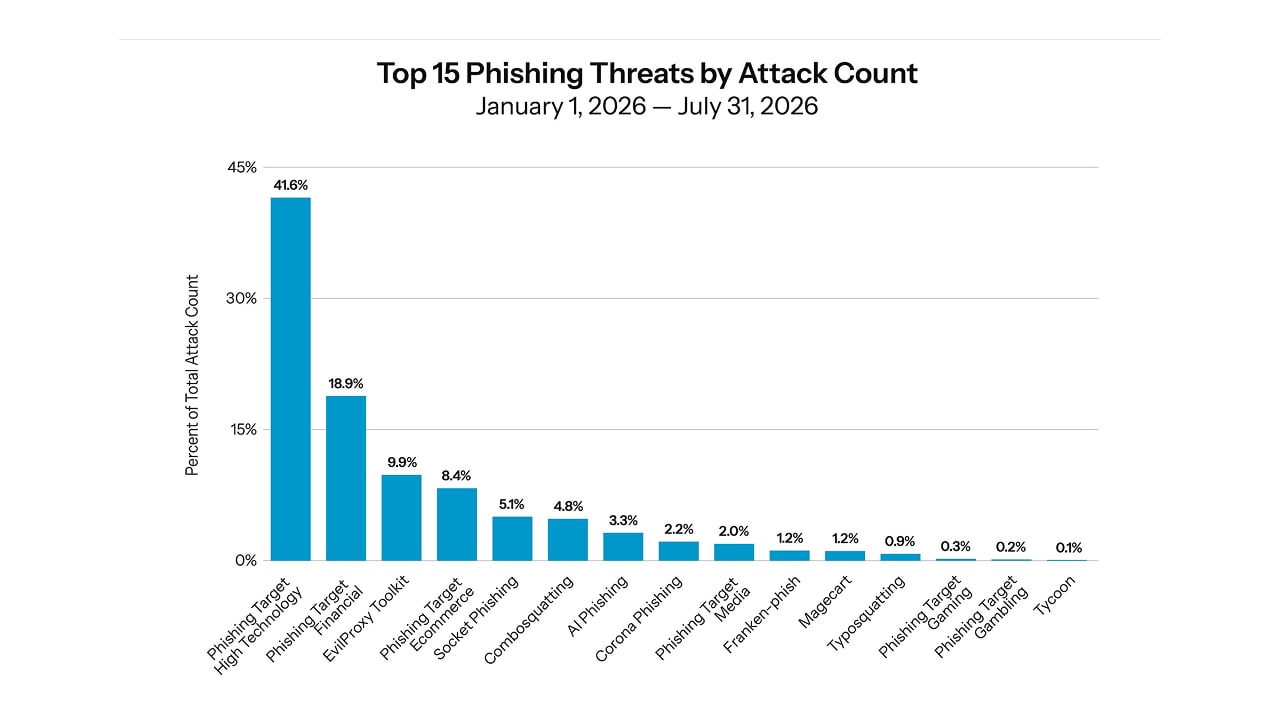
According to Akamai data from January through July 2026, nearly 70% of the malicious phishing domains observed impersonated brands in three industries: high technology (41.6%), financial services (18.9%), and commerce (8.4%; Figure 1). Attackers use cloned logos, counterfeit login pages, and messages that appear to come from legitimate organizations to make those phishing attempts more convincing. 

According to Akamai data from January through July 2026, nearly 70% of the malicious phishing domains observed impersonated brands in three industries: high technology (41.6%), financial services (18.9%), and commerce (8.4%; Figure 1).
Fig. 1: High technology, financial services, and commerce brands are among the top phishing threats with the highest attack count
According to Akamai data from January through July 2026, nearly 70% of the malicious phishing domains observed impersonated brands in three industries: high technology (41.6%), financial services (18.9%), and commerce (8.4%; Figure 1).

Generative AI (GenAI) can help attackers tailor phishing messages and produce them at scale. Attackers are also exploiting interest in AI tools themselves: AI phishing ranked seventh in our dataset and includes fake sites that impersonate platforms such as OpenAI’s ChatGPT to harvest employee credentials. 

Phishing as a service (PhaaS) further lowers the effort needed to launch and scale impersonation campaigns. The EvilProxy toolkit, which ranked third among the phishing threats in our dataset, accounted for almost 10% of attacks. It is a PhaaS platform that uses an adversary-in-the-middle approach to capture credentials and active session cookies during sign-in. The user can do everything right, even complete the multi-factor authentication prompt, and the attacker can still walk off with the session data.

As phishing kits scale and attackers rotate their infrastructure, defenders have less time to identify and disrupt campaigns. Blocking the reported domain feels productive, but it only addresses a moving target. Security teams must monitor for suspicious sign-ins and session activity that could indicate a compromised account.

Look-alike domains, spoofed portals, and the agentic web

Brand impersonation no longer stops at a convincing phishing email. Attackers can create look-alike domains and web portals that mimic a company’s storefront or employee login page, then use familiar layouts and checkout flows to persuade visitors to enter credentials, payment details, or other sensitive information. But not every deceptive interaction begins with a person visiting a fake site. 

The emergence of the agentic web and zero-click interactions has added another dimension to these challenges. Autonomous AI agents and large language models (LLMs) now act as intermediaries between users and online services, and cybercriminals are ready to take advantage. 

By exploiting these new ways of interacting online through synthetic identities and abuse of Model Context Protocol (MCP) endpoints, cybercriminals are creating emerging attack vectors like zero-click data exfiltration and automated business logic exploitation. In this environment, good bots, bad bots, and AI agents acting on a customer's behalf now all look very similar, and telling them apart is quickly becoming a core part of the security practitioner’s job.

When the fake storefront looks real

The threat from fake sites remains immediate. One campaign tied to a high-profile international sporting event shows how impersonation can work at scale. Our researchers identified dozens of spoofed ticketing and hospitality sites that shared back-end infrastructure and used near-identical checkout flows. Prominent “BUY NOW” prompts led visitors toward forms designed to collect payment card details, personal information, and identity documents.

A separate case shows how attackers also impersonate familiar commerce brands. Our researchers identified two Amazon-themed phishing domains that generated 640 DNS connection attempts across 181 customers.

These examples show how attackers can use familiar brands and purchase experiences to draw people to sites outside an organization’s control. Protecting customers means looking beyond the login page to look-alike domains and fraudulent purchase flows while also accounting for the separate risks introduced by automated interactions.

Multichannel scams

Fraudsters are using GenAI to create convincing lures in multiple languages and to adapt campaigns more quickly. Rather than relying on a single entry point, attackers spread these scams across social media, paid ads, counterfeit app stores, encrypted messaging, anonymous email, and pages that collect links to other sites, drawing potential victims through deceptive interactions across multiple channels.

Deconstructing the attack chain

Multichannel campaigns often begin with paid social ads or fraudulent recruitment posts that lure users. These posts may direct users to counterfeit app stores or malicious websites, where they are prompted to download harmful applications or submit sensitive credentials. 

Because these campaigns span multiple platforms and services, controls focused on any one platform may miss parts of the attack. A social media profile, for example, may direct users to an encrypted messaging app or a page that collects links to other sites. While the supporting infrastructure may be distributed globally, attackers tailor campaign content to local audiences, including their language, industry, and preferred payment methods.

Online scams and customer exploitation

As bots and autonomous agents interact with digital services alongside human customers, it becomes harder for organizations to distinguish legitimate activity from fraud. Attackers may use synthetic identities to create accounts or hijack automated agents to abuse systems designed for human users. These attacks can lead to financial losses and erode customer trust.

Account lifecycle risks

Fraud threats span every phase of the customer journey, from account creation and login to identity verification and payment processing. Attackers use automated credential stuffing and bot networks at each stage to identify active accounts and gain unauthorized access.

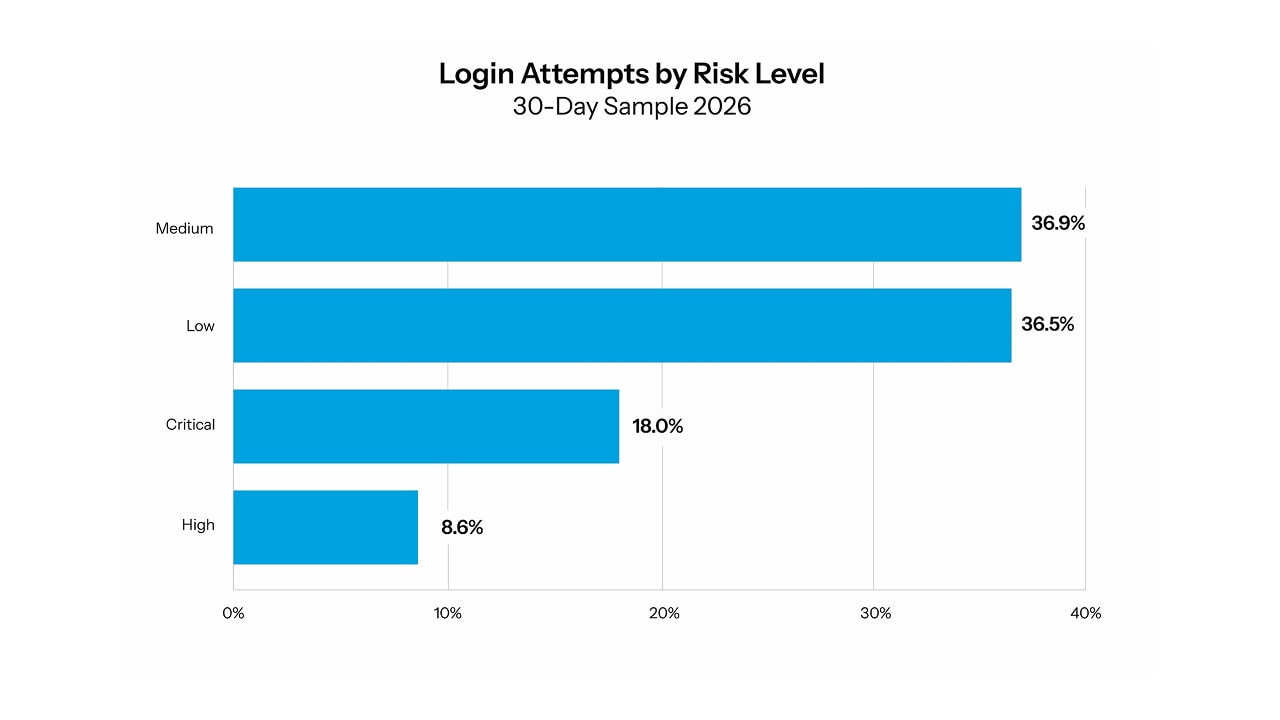
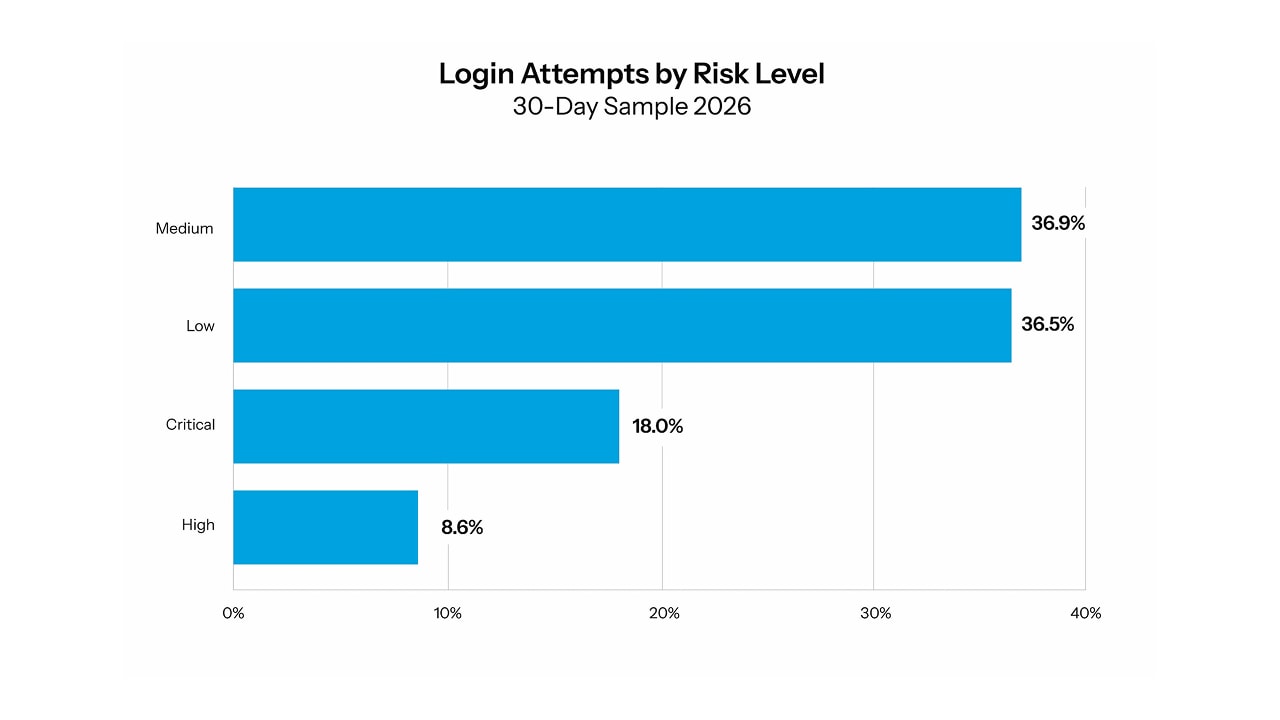
A 30-day sample of data from Akamai Account Protector showed that 26.6% of login attempts were at the high or critical risk level (Figure 2). Those levels indicate a likelihood of brute-force attacks and credential stuffing.

A 30-day sample of data from Akamai Account Protector showed that 26.6% of login attempts were at the high or critical risk level (Figure 2).
Fig. 2: More than 25% of all recorded login attempts are at the high or critical risk level
A 30-day sample of data from Akamai Account Protector showed that 26.6% of login attempts were at the high or critical risk level (Figure 2).

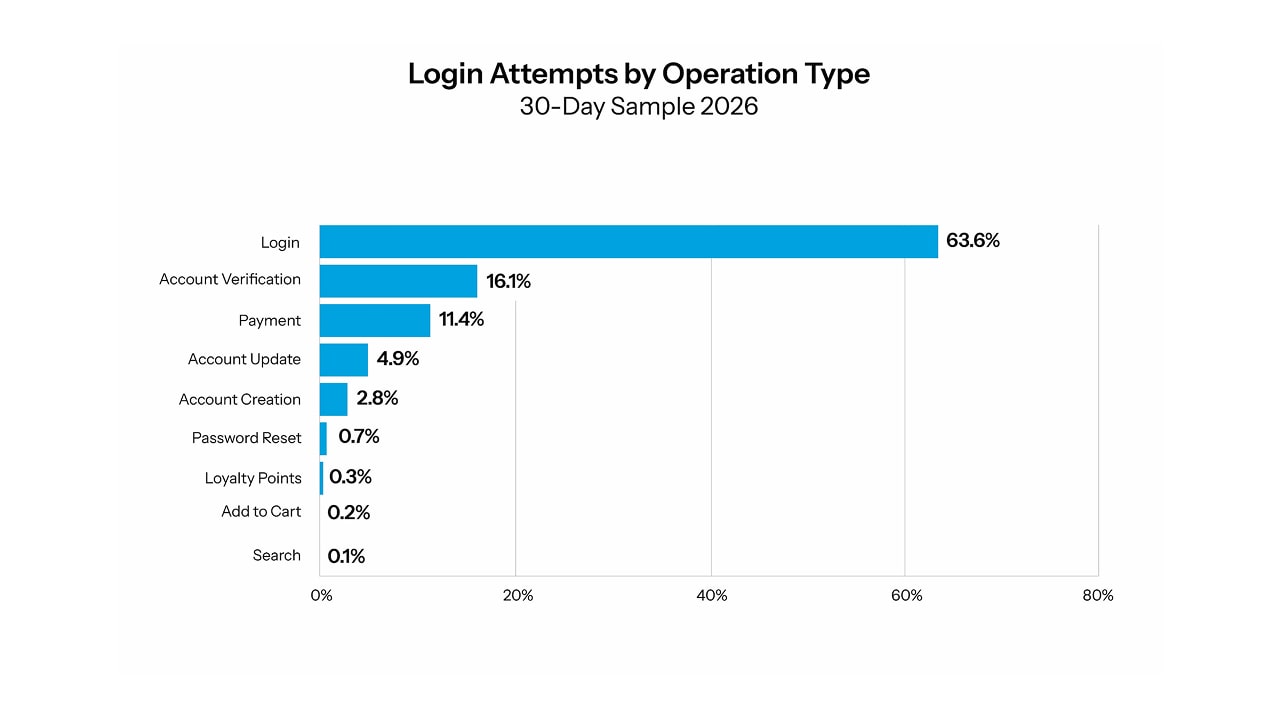
Organizations should monitor login activity closely because it can provide an early warning of account abuse. Also, the login phase is the most active stage of the account lifecycle and a common entry point for malicious bots. Standard login attempts represented the largest share of activity across all risk levels, followed by account verification requests (Figure 3).

Standard login attempts represented the largest share of activity across all risk levels, followed by account verification requests (Figure 3).
Fig. 3: Standard login attempts dominated the activity across all risk levels (63.6%)

Notably, account verification requests made up 40% of high- and critical-risk login traffic, which may indicate attempts to determine whether email addresses are associated with existing accounts.

Building a unified defense against AI-driven deception

Defending digital storefronts means looking beyond individual login or payment events. Organizations need visibility into suspicious activity across the entire customer journey, including automated interactions across all channels.

As AI-driven deception continues to accelerate attacks and blur the line between human and automated traffic, defenders need to move beyond reactive measures. Protecting your organization means breaking down the organizational silos, so teams can identify emerging scams before they undermine customer trust. 

While continuous signal monitoring and bot management are critical, technology alone is not enough. Bringing fraud, security, and digital teams together in a shared fraud fusion center creates the opportunity for real-time defense against fast-moving, cross-channel scams. 

The ultimate goal: Protecting customer trust

Your organization can't stop every attacker, but you can make sure that your customers never wonder whether the login page, the checkout, or the text message was really created by you. 

FAQ

Agentic AI and autonomous models allow attackers to adapt lures in real time, automate synthetic identity creation, and exploit MCP endpoints. Because AI agents can interact directly with web services on behalf of users, telling legitimate automation apart from malicious bots has become a major challenge for security teams.

Attackers constantly rotate their infrastructure and re-deploy automated phishing kits across new look-alike domains. Domain-blocking is inherently reactive; by the time a site is flagged, the infrastructure has often moved, making continuous session and sign-in monitoring essential.

Security teams must monitor account lifecycle activity for anomalies, particularly around account verification requests and login endpoints. Automated detection platforms identify credential stuffing traffic and high-risk logins early, preventing attackers from confirming active credentials before full account takeover attempts occur.

Fraudsters distribute campaigns across encrypted messaging, social ads, and spoofed domains, bypassing single-platform security measures. Establishing a unified defense through a central fraud fusion center enables cross-functional teams to correlate signals across the entire user experience, identifying fraudulent purchase flows before brand reputation and customer trust are compromised.

FAQ

About the author

Akamai wave logo

Kimberly Gomez

Kimberly Gomez is the Director of Security Research at Akamai, where she leads research teams to deliver comprehensive analyses and reports that help organizations stay one step ahead of cybercriminals. With more than a decade in cybersecurity and a background spanning print, broadcast, and online journalism, Kimberly is passionate about security storytelling — the kind that can help even your grandparents understand what's happening in the threat landscape.

When she's not tracking down the latest cyberthreats, you can find her buried in a book, planning her next adventure, or chasing her son through the theme parks of Orlando.