

Cortney Nickerson
Cortney Nickerson is a Principal Product Marketing Manager at Akamai.
Akamai Functions brings sub-millisecond start-up times to edge native serverless workloads, eliminating cold starts.
You pay for execution, not idle capacity, with no infrastructure to manage.
Every function runs in an isolated WebAssembly sandbox with per-application resource limits, providing production-grade protection for live workflows.
Akamai Functions runs alongside Akamai delivery and security, on portable WebAssembly and Spin.
Akamai Functions is an edge native serverless platform that runs fast WebAssembly (Wasm) functions across more than 4,350 edge locations in 130+ countries, reducing latency, egress costs, and infrastructure burden for modern applications and AI workloads.
Every millisecond between your customer and your application has a price. In centralized cloud regions, that price shows up as abandoned carts, buffering streams, slower page loads, and search rankings that slip. It also shows up on the invoice: regions you pay to keep warm, egress you pay to move data back and forth, and engineering hours spent managing infrastructure instead of building products and services.
Because Akamai Functions starts in less than a millisecond and executes close to every user, there are no servers, regions, or infrastructure to manage. Now generally available, Akamai Functions is SLA-backed, production ready, and accessible by Akamai Delivery customers through the contract they already have.
In this blog post, I’ll detail the effect that Akamai Functions can have on your risk posture — and on your bottom line.
Centralized serverless platforms create hidden costs through egress charges and 100- to 300-millisecond cold starts when your customers are globally distributed. Most platforms run in a handful of centralized cloud regions, forcing teams to choose between multiregion complexity, paying for idle capacity, or accepting the latency.
Teams usually respond in one of three ways, and each one costs the business:
Go multiregion. Latency improves, but so does complexity. Now you're paying for capacity in several regions and staffing the operations to keep them in sync.
Keep everything warm. Cold starts disappear, but you pay for compute that sits idle and unused most of the day.
Accept the latency. The bill stays flat, but conversion, engagement, and search visibility take the hit.
With Akamai Functions, these trade-offs are removed and you’re introduced to a new reality in which code deploys once, runs everywhere by default, starts instantly, and only costs you when it executes.
Akamai Functions delivers measurable value from the network edge to the bottom line in five ways:
Provides faster digital experiences that convert
Charges you for execution, not idle capacity
Ships faster with less overhead
Reduces operational and security risk
Consolidates vendors and keep your options open
Speed is revenue. Akamai Functions run on a Wasm runtime that starts in less than a millisecond, and Akamai routes each request to the fastest responding location.
Across the multitudes of Wasm executions Akamai handles daily, we routinely see edge native personalization drop page latencies from 200 milliseconds to 40, and redirects resolve in just 10 milliseconds. Your customers feel the difference, and so do your conversion rates.
You pay only when a function executes, not to keep servers or containers warm between requests. Because Wasm components are measured in kilobytes or a few megabytes, far more workloads fit on the same infrastructure. Moving logic like redirects, token checks, and bot responses to the edge also takes load and egress off your origin.
The result is a lower cost per request and fewer surprises on the bill.
Akamai Functions remove the work that slows teams down. There are no servers to provision, patch, or scale, and no regions to choose. One command deploys a function globally. Teams can start from a library of open source samples instead of a blank page.
The General Availability stage removes the procurement friction too. Akamai Delivery customers are entitled to Akamai Functions through their existing contract, with no ticket or approval step. Developers can write in the languages they already know, including JavaScript, Python, Rust, and Go, which widens your hiring pool and shortens ramp-up time.
Production workloads need guarantees. Akamai Functions is SLA-backed and held to the same operational standard as every Akamai production service.
Each function runs in an isolated Wasm sandbox with no access to files, network, or environment variables unless you grant it. Per-application resource limits stop a runaway function before it affects other workloads or your budget.
Akamai Functions sit alongside the delivery, security, storage, and compute services many enterprises already run on Akamai. You can bind a function to a property directly in Property Manager, protect it with Akamai App & API Protector, and pair it with Akamai Bot Manager or Managed Databases. Fewer vendors means fewer contracts and fewer integrations — and one place to manage edge logic.
Consolidation doesn't mean lock-in. Akamai Functions is built on open Wasm and WASI standards and on Spin, a Cloud Native Computing Foundation project. The same component runs on a laptop, in your own Kubernetes cluster with SpinKube, or on Akamai. That keeps your exit costs low and your architecture flexible.
Akamai EdgeWorkers runs JavaScript at the edge and is built for lightweight CDN logic: redirects, header rewrites, routing and simple personalization. Akamai Functions and EdgeWorkers are complementary; Akamai Functions takes edge compute a step further.
With Akamai Functions you can:
Use more languages. Write in JavaScript, Python, Rust, Go, and other languages that compile to Wasm, not JavaScript alone
Apply broader application logic. Run APIs, access databases, connect to inference services, and run AI agents
Deploy the same global model. Maintain the distributed, load-balanced execution EdgeWorkers customers rely on
Maximize your Akamai contract. Use your existing delivery access and bind functions to the same properties in Property Manager
Use EdgeWorkers for fast, focused CDN logic, and add Akamai Functions when your edge needs to do more. See the Akamai Functions and EdgeWorkers comparison chart for details.
The table outlines three key business challenges — mass redirects, token abuse, and sophisticated bot scraping — and demonstrates how Akamai Functions solves each at the edge. Edge logic improves site performance, safeguards revenue, and protects proprietary data without disrupting the user experience.
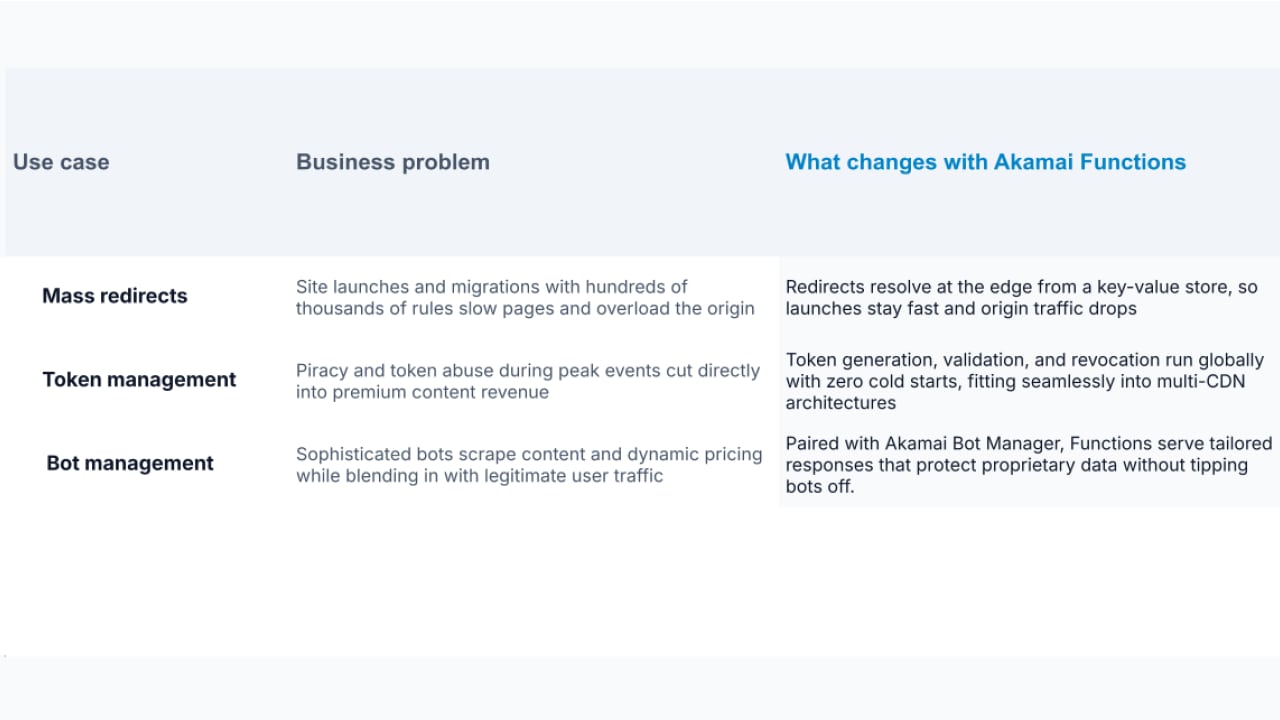
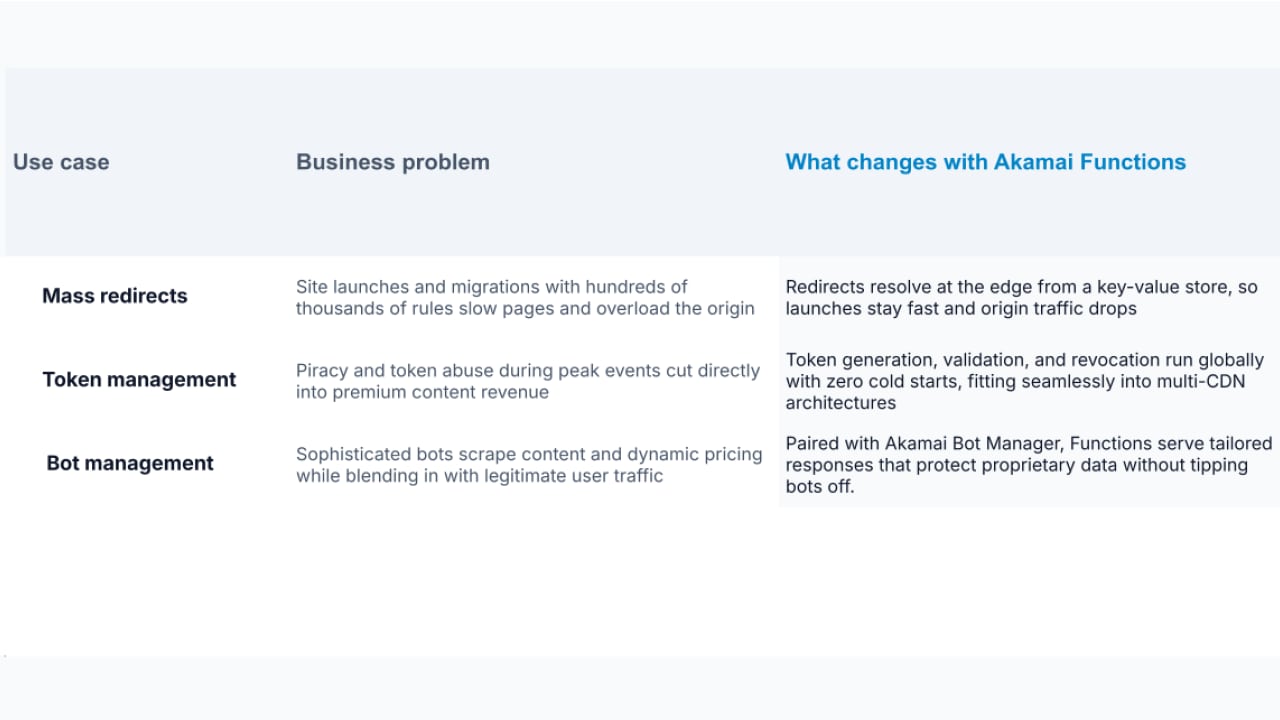
The strongest early returns come from logic that sits between your users and your origin. That makes retail and ecommerce, media and streaming, and gaming — industries in which latency affects revenue — natural places to start.
The pattern is the same in every case. Make the fast decision at the edge, and send heavier work to cloud CPUs or GPUs only when it's needed. Browse the Akamai Functions samples to get started and discover additional use cases.
Many enterprise AI projects don't fail on the model. They stall at security review, because agents write and run code that nobody reviews first. Building the containment yourself means isolation, egress rules, and resource limits, which is slow and specialized work that's easy to get wrong.
Akamai Agent Sandbox extends Akamai Functions to solve that problem by providing deny-by-default Wasm isolation built on the open source Spin SDK. Your agent runs as a function and can call open-weight models through Akamai Inference. The code it writes runs in a second locked-down sandbox inside that function, with no outbound network access by default, and CPU and memory capped by the runtime.
Agent Sandbox isn’t a separate purchase. It extends the Akamai Functions platform you already have.
Additionally, CPU and memory are capped by the runtime. It isn't a separate purchase. It extends the Akamai Functions platform you already have.
For your business, that means:
A clear answer for security teams. Agent-generated code has a bounded blast radius by design, not by prompt.
No sandbox infrastructure to build. Teams spend their time on the agent, not the perimeter around it.
No paying for idle resources. Each agent step gets a fresh sandbox, so you aren't keeping one warm between steps.
As teams connect autonomous agents to tools via emerging protocols like Model Context Protocol (MCP), running those execution loops inside isolated Wasm sandboxes ensures that prompt injections cannot escalate into data exfiltration or unauthorized system calls.
The building blocks are being contributed to Spin, so the approach is open. Want more details? Read our companion blog post for the developer story.
The fastest path to value is to start with a workload that you already know is costing you: a migration with a large redirect set, token checks hitting a central service, or personalization that's too slow today.
Pick one edge-bound workload. Choose logic that runs on every request and currently travels back to your origin.
Turn on Akamai Functions. Akamai Delivery customers already have access through their contract. Everyone else can request a demo.
Deploy globally in one step. Build with Spin, deploy with a single command, and bind the function to your property in Property Manager.
Measure the outcome. Track latency, origin offload, and cost per request before and after.
Akamai Functions brings the speed of the edge, the flexibility of real application compute and the reliability of an SLA together on one platform. The result is faster experiences for your customers and fewer moving parts for your teams.
Check out the Akamai Functions Quick Start Guide or book a demo with our team.
Akamai Functions bills for execution, not idle capacity, so you don't pay to keep regions or containers warm. Running logic at the edge also reduces origin load and egress charges.
Yes. Akamai Functions is generally available and SLA-backed, with per-application resource limits and isolated WebAssembly sandboxes for every function.
Akamai Delivery customers are entitled to Akamai Functions through their existing Delivery contract, with no separate approval step. Other organizations can request a demo.
Regional serverless platforms run in a few centralized cloud regions and can take 100 to 300 milliseconds to start. Akamai Functions runs everywhere on Akamai's distributed cloud by default and starts in less than a millisecond, with no multiregion setup.
EdgeWorkers is optimized for lightweight JavaScript CDN logic. Akamai Functions adds a WebAssembly runtime for broader application logic, APIs, and AI workflows. The two are complementary.
Retail and ecommerce, media and streaming, and gaming see strong fit because they serve global audiences and latency affects revenue. Common use cases include mass redirects, token management, bot management, and SEO/GEO.
Through the Akamai Agent Sandbox, Akamai Functions provides a secure runtime in which AI agents and the code they generate are contained in isolated WebAssembly sandboxes. Outbound network access is blocked by default and resources are capped, bounding the blast radius of agentic workflows.

© 2026 Akamai Technologies