
Tom Emmons
Tom Emmons is a data enthusiast who leads a team focused on machine learning and automation at Akamai. His areas of security expertise are in DDoS and application security.
Additional commentary by Emily Lyons
Welcome back to AI Pulse, our series of blog posts that takes a look at the current state of AI bots. If you missed the first post in this series, you can check it out now.
This post’s topic is a timely one: mitigating AI bots.
Mitigation, at its simplest, means putting controls in place to manage how bots interact with your business. Over Q3 2025, we’ve seen a clear rise in AI bot mitigation as more businesses across industries weigh the pros and cons of blocking these bots outright or allowing AI bots to access their content.
Some bot management vendors have even moved to block AI bots by default in industry segments like publishing. But that decision isn’t without trade-offs.
At Akamai, we view blocking as just one part of the mitigation spectrum. The right approach depends on visibility into what those bots are actually doing.
In ecommerce, for instance, some AI bots can drive discovery or sales; in publishing, however, those same bots might reduce site traffic, shift engagement, and cut into revenue. Businesses need clear insight into the value or risk AI bots bring and then apply the right mix of mitigation strategies.
From July to October 2025, we’ve observed the percentage of total Akamai customers that are actively mitigating AI bots increase from 9.2% to 11% (Figure 1).

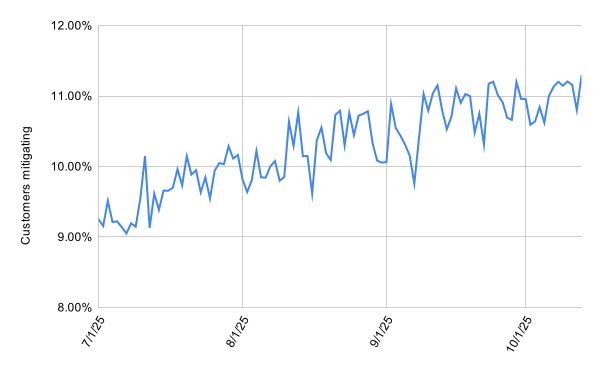
Although this increase may not seem substantial, it is quite large when you consider the short time frame. The increase reflects that our customers, regardless of industry or geography, are actively taking steps to manage the AI bot traffic that continues to expand daily.
In addition to the rising percentage of customers that are mitigating, the actual number of AI bot mitigations is up even more.
Let’s examine AI bot traffic mitigation by:
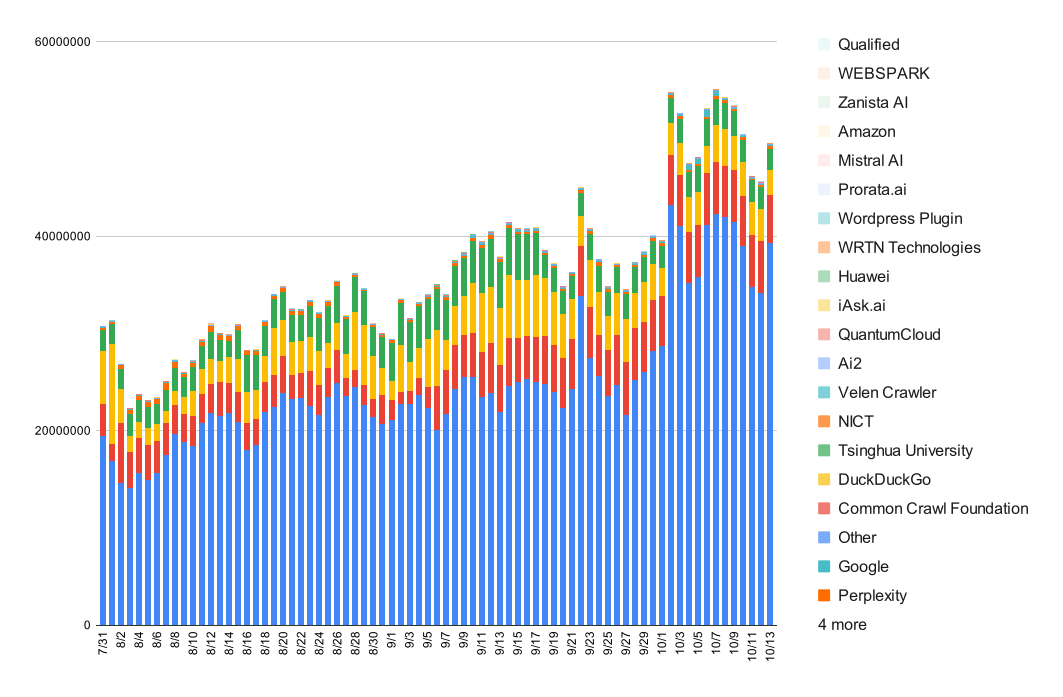
Between August and the beginning of October 2025, ChatGPT-User (OpenAI) was the most mitigated AI bot across our customers, followed by ByteSpider (ByteDance), ClaudeBot (Anthropic), and Meta-ExternalAgent (Meta). We saw a significant spike in the amount of AI bot traffic mitigated over the last 60 days, with peaks in late September and into the first week of October, especially.

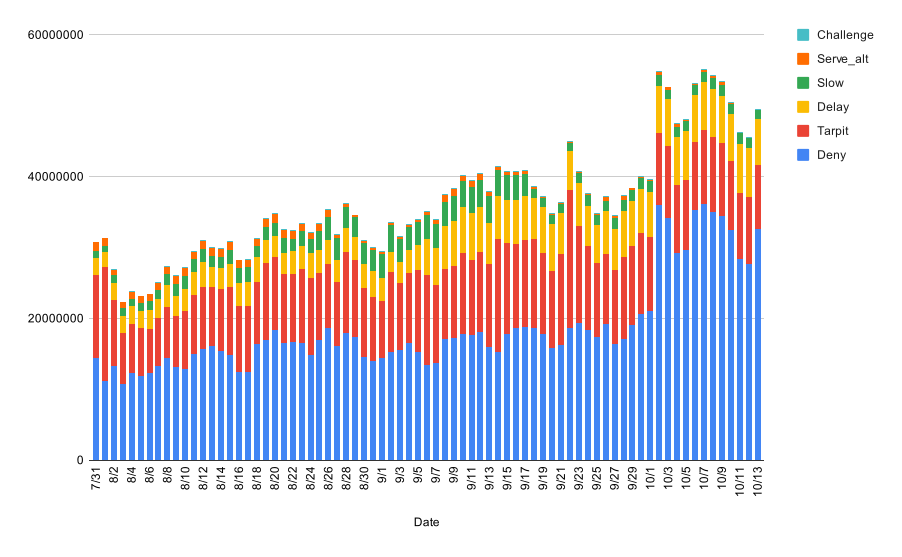
As we mentioned earlier, mitigation is more than just blocking. We provide our customers with the ability to implement control of AI bot traffic in a variety of ways, including slow, delay, tarpit, deny, or serve an alternative.
Across all available actions, we’ve observed customers either blocking outright (deny and serve 402 responses) or tarpitting and delaying (serving no response; Figure 3).

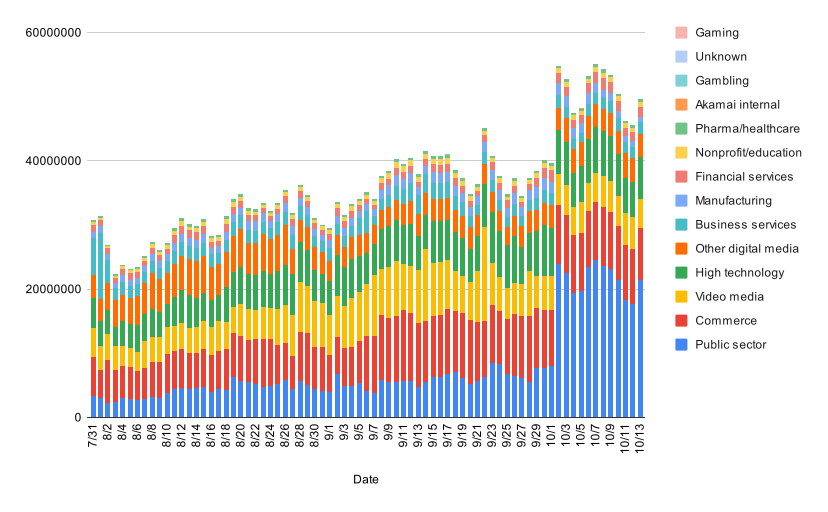
Businesses across all industries are increasingly mitigating AI bot activity. Notably, public sector, commerce, video media, high tech, and publishing (which is a segment of the other digital media industry) account for the highest amount of AI bot traffic mitigation.
We observed a large spike in mitigation across the public sector during the first week of October that seemingly correlates with the spike in OpenAI bot traffic mitigation (Figure 4).

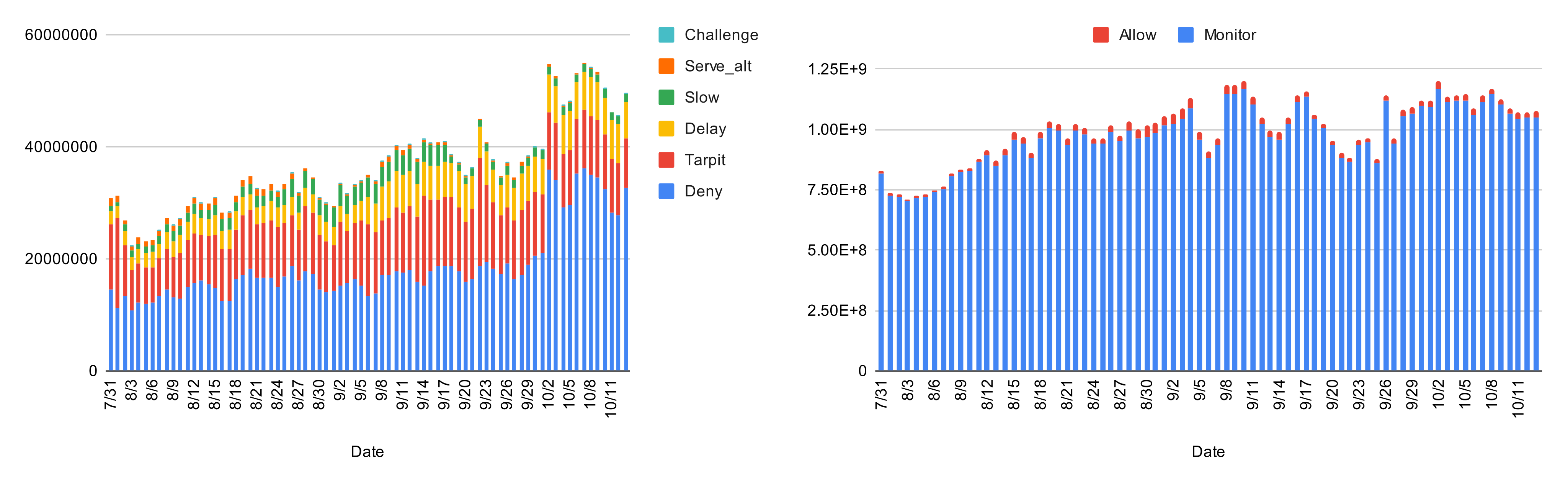
Although the amount of AI bot traffic that is not mitigated still accounts for the majority of AI bot traffic, it is notable that the growth of mitigated AI bot activity far outpaces unmitigated AI bot activity (Figure 5).

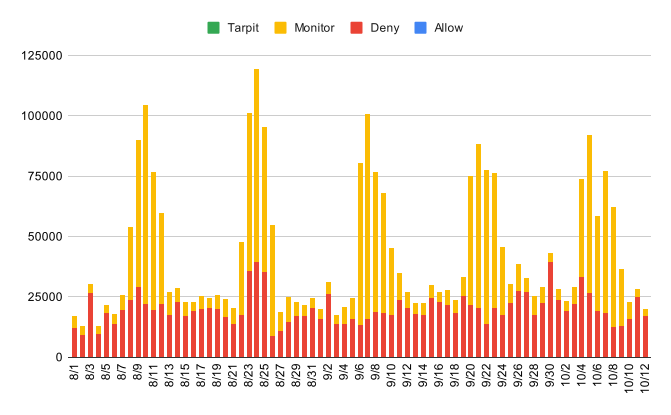
We also see a diversity of mitigation among customers. Figure 6 represents a publishing customer who mitigates AI bot traffic toward some, but not all, of their properties; for example, by blocking AI bots on a page that hosts new and popular content but not evergreen articles.
In some instances, we also see customers blocking or mitigating specific AI bots or vendors vs. all of them.

The rise from 9.2% to 11% of customers that are mitigating AI bots from July to mid-October 2025 shows a clear shift toward active management.
But observability should come before taking action — understanding how AI bots interact with your business is key to deciding when and how to control them. Businesses across publishing, commerce, and the public sector are now shaping bot traffic with more precise strategies.
Stay tuned for the next AI Pulse, in which we’ll present another AI bot traffic insight.
To learn more about how to mitigate your AI bot traffic with Akamai, check out our Bot & Abuse Protection solutions, or contact an expert directly.

© 2026 Akamai Technologies