

Akamai acquires LayerX, delivering end-to-end security and real-time AI usage control to any browser. Get details
Background

Future-Proofing the Internet: Akamai Achieves End-to-End PQC

August 19, 2026 by Tim Daffron

Share

As of August 12, 2026, end-to-end post-quantum cryptography (PQC) is generally available (GA) across the Akamai Enhanced TLS network. This milestone marks a critical shift in how we protect global data, ensuring that every leg of the transport journey — from the client to our edge, across our mid-tier, and through to the customer origin — defends threats emerging from the rapid developments in this era of quantum computing.

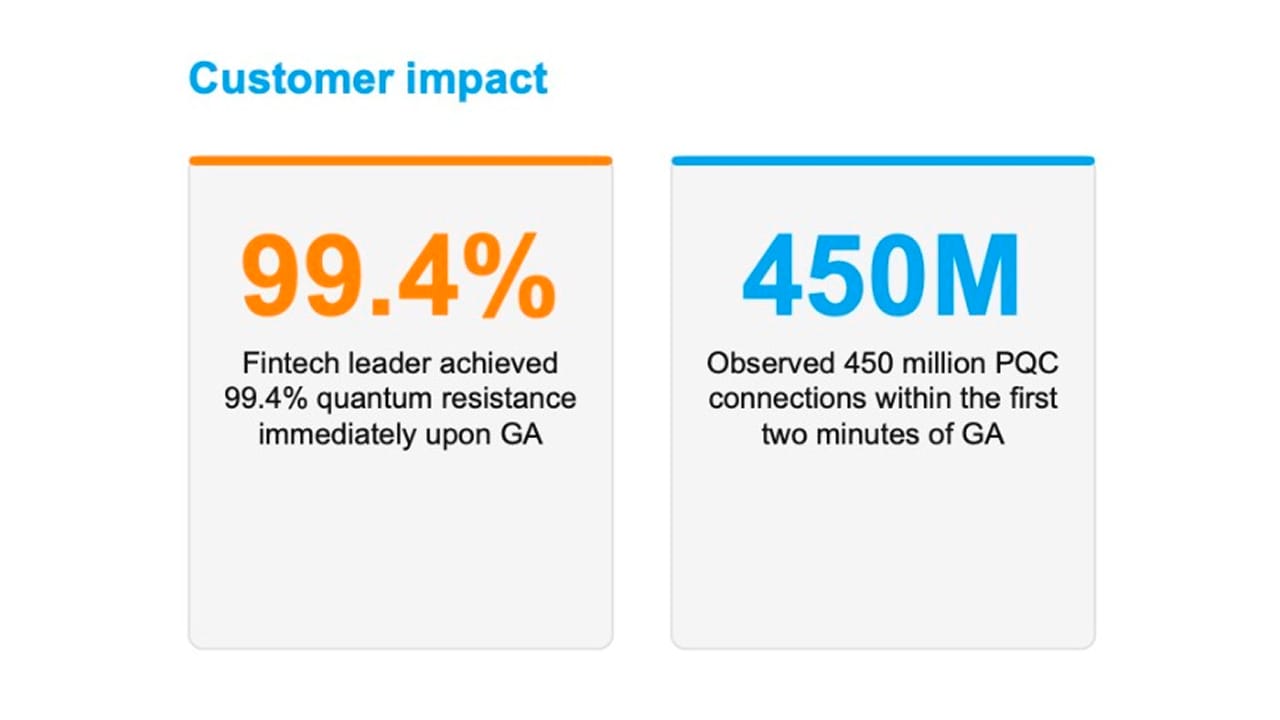
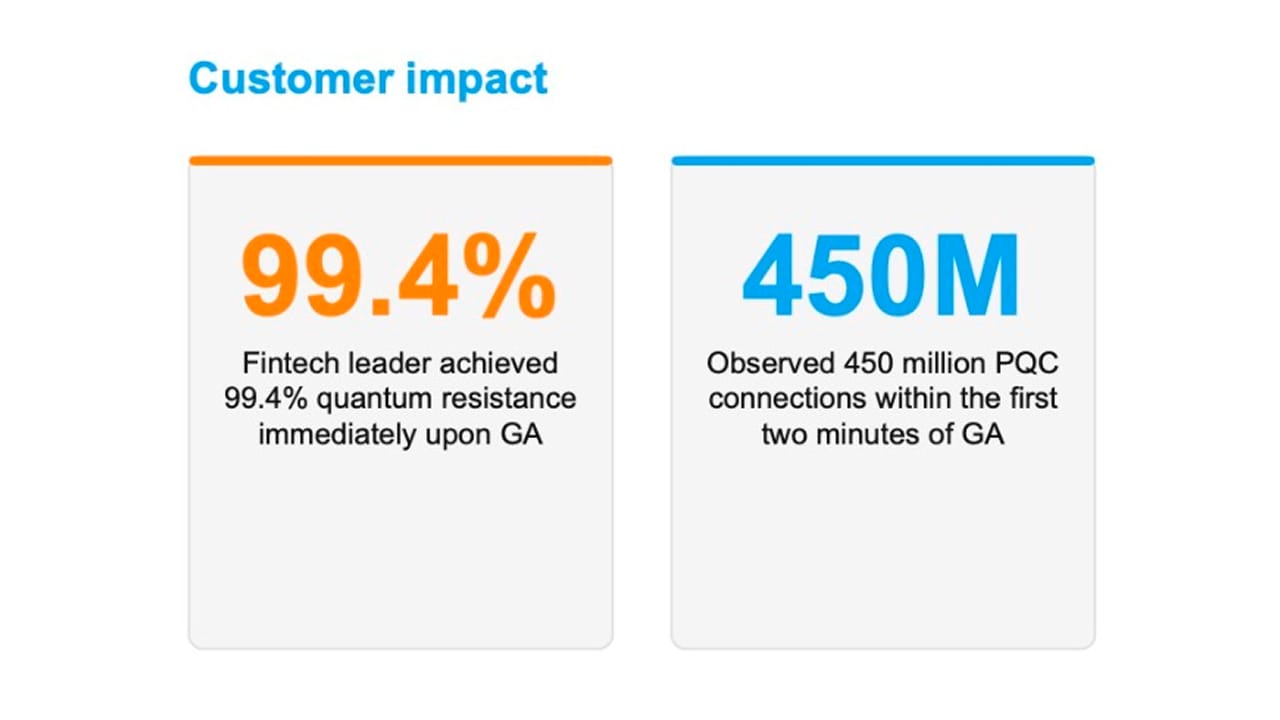
Within the first two minutes of GA, Akamai observed more than 450 million PQC connections, and a leading financial technology customer immediately achieved 99.4% quantum resistance.


Customer Impact
Customer Impact

Why the urgency? The “harvest now, decrypt later” threat

The motivation for this transition is a clear and present danger known as “harvest now, decrypt later.”  Today, capable adversaries are collecting encrypted data with the intent to decrypt them once cryptographically relevant quantum computers become a reality.

Traditional asymmetric encryption, such as used by RSA and Elliptic-Curve Diffie–Hellman, is vulnerable to Shor’s algorithm, which could allow a quantum computer to factor large prime numbers exponentially faster than classical systems. While Q-Day — the point at which quantum computers can break these standards — may still be years away, any data with a long shelf life is at risk right now. By implementing PQC today, we ensure that the key exchanges that are protecting current sessions remain secure for decades to come.

Our implementation: A hybrid approach to safety

Akamai has aligned with National Institute of Standards and Technology (NIST) and Internet Engineering Task Force (IETF) standards by deploying a hybrid post-quantum key agreement. Specifically, we use the X25519MLKEM768 hybrid mechanism as defined in this draft (which is in the IETF publishing preparation phase).

A unified posture across the delivery chain

Achieving end-to-end resistance required upgrading three distinct transport segments of the Akamai delivery path (Table).
 

Transport segmentStatusCustomer configuration
Client-to-AkamaiGA (August 2026)Enabled by default within the Enhanced TLS network; opt out via Property Manager
Akamai-to-AkamaiGA (August 2026)Enabled by default; transparent to customers
Akamai-to-originGA (June 2026)Opt in for customers; supports TLS 1.3 hybrid handshakes
*Future state — transition to on-by-default behavior

The three distinct transport segments of the Akamai delivery path that were upgraded to achieve end-to-end resistance 

What’s next: Authentication and network expansion

While transport security is a massive win, we are not slowing down. Our roadmap for the remainder of 2026 and beyond includes:

  • Post-quantum authentication: We are moving toward the next frontier: securing digital signatures. We are actively targeting ML-DSA and Merkel Tree Certificates to reduce certificate size while maintaining quantum resistance.

  • A 2030 deadline: We are committed to ensuring that our platform is quantum safe as global regulatory expectations accelerate toward a 2030 deadline for quantum-safe signatures.

The transition to a quantum-safe internet is a marathon, not a sprint. We are proud to lead the industry in making these advanced protections a default reality for our enterprise, government, and financial sector customers.

For more information on how to enable PQC, please contact your Akamai account team or visit our technical documentation.  Also, be sure to check out the most recent blog post in our PQC series.

Continuing the conversation: Explore our entire PQC series

If you’ve missed any of our other technical deep dives or policy updates, we invite you to explore the journey toward quantum readiness through our full series of blog posts.

About the Author(s)