
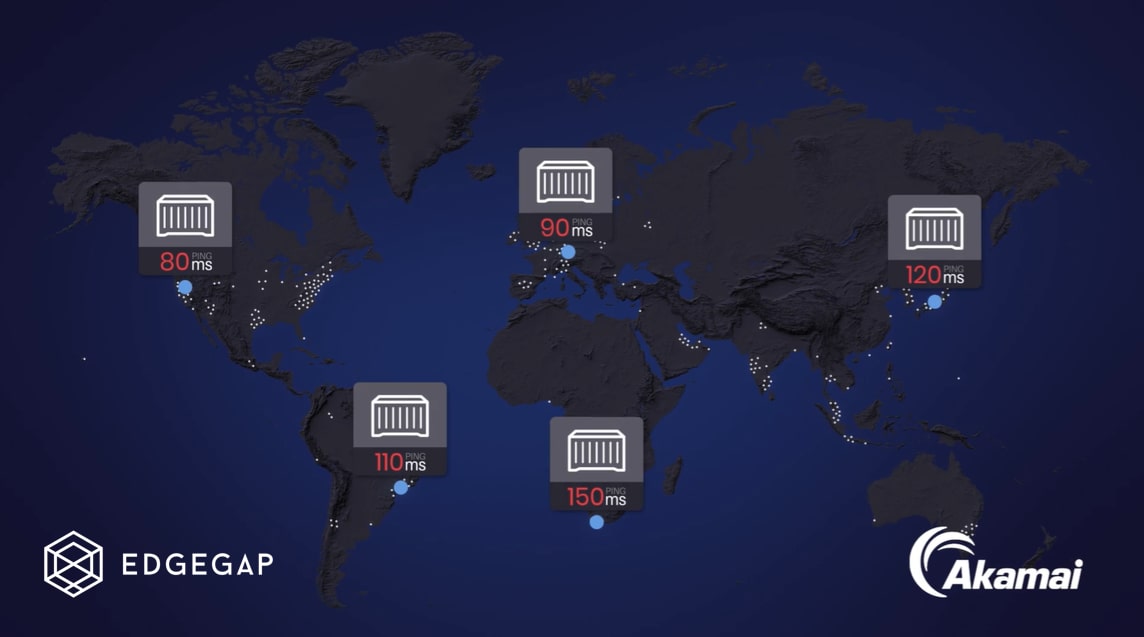
Edgegap provides a tailored orchestration platform designed to reduce online gaming latency through edge computing, helping studios deliver consistently high-performance multiplayer experiences anywhere in the world. As an Akamai Qualified Compute Partner, Edgegap builds on Akamai’s massively distributed cloud to eliminate latency for end users, scale instantly up to 14 million concurrent users in less than 60 minutes, and support unpredictable global demand, such as during game launches. Combining its orchestration technology with Akamai Cloud enables Edgegap to offer near-zero gameplay latency, automated global scaling, and a pay-as-you-go model — helping studios boost player online experiences and retention while keeping infrastructure costs under control.

Powering flawless multiplayer experiences at global scale
Building the foundation for global multiplayer gaming
Edgegap was founded to solve one of gaming’s hardest technical problems: delivering real-time multiplayer experiences to players spread across continents, devices, and networks. Mathieu Duperré, CEO and founder of Edgegap, said he created the company with the idea of leveraging a highly distributed infrastructure to improve players’ experiences.
The company focused on what Duperré described as “the plumbing for multiplayer games,” handling the invisible complexity behind live play. Players might be connecting from different countries, ISPs, and devices, and centralized public clouds often introduce unavoidable latency. Edgegap’s mission was to minimize those connection issues while abstracting infrastructure complexity away from developers.
Today, Edgegap supports millions of players per day worldwide, helping thousands of studios deliver smoother online gameplay and better business outcomes. According to Duperré, the studios that Edgegap serves see less churn, which translates into higher revenues.
Latency as both a technical and business risk
Even with Edgegap’s platform, latency remained one of the biggest threats to player satisfaction and loyalty. Philip Côté, CTO of Edgegap, explained that most public cloud data centers are still concentrated in a small number of regions. As player populations spread outward, those farther from centralized data centers experience lag.
Since these outer-region players are often the first to disengage, Côté underscored that studios risk losing up to 34% of their players due to latency every time a player logs in. Worse, gamers frequently blame publishers or developers for poor performance, turning a networking issue into a brand and reputation problem.
For studios with limited infrastructure expertise, solving this problem internally is a massive challenge shifting precious resources away from game development. It’s why Edgegap provides dedicated tools for game engines and netcode, alongside the ability to deploy game servers from a simple API call. All of this removes the burden of integration and minimizes DevOps workload of server provisioning, security, patching, and maintenance.
Why distributed cloud orchestration mattered
Edgegap’s platform relies on automated orchestration trained on massive volumes of historical and real-time data. Its patented and proprietary user-server decision-making engine evaluates player location, session context, device type, and live network conditions to determine where game servers should be deployed for optimal performance.
To make this approach viable at scale, Edgegap needed a cloud partner with unparalleled geographic reach. Vincent Archambault, CSO of Edgegap, said the gaming industry had long been using centralized data centers, but distributed cloud represents the future. “Akamai Cloud aligns perfectly with Edgegap’s focus on getting closer to players for better multiplayer experiences,” he explained.
Akamai also gives Edgegap the flexibility to deploy instantly, wherever players appear. Duperré said the sheer number of locations and edge sites, combined with Akamai’s brand reputation, provide peace of mind to Edgegap’s largest customers.
Akamai solutions that power Edgegap’s platform
As an Akamai Qualified Compute Partner, Edgegap leverages multiple Akamai cloud solutions to power its globally distributed, latency-optimized gaming platform.
- CPU: Provides globally distributed compute resources deployed close to players for lower latency and improved gameplay performance.
- Clusters: Edgegap’s matchmaking system runs on Akamai Cloud’s clusters to deliver seamless logic-based grouping of players.
- NodeBalancers: Distributes traffic efficiently across game servers to maintain performance and reliability during traffic spikes.
- Block Storage: Supports fast, persistent storage for game server workloads.
- Object Storage: Enables scalable storage for assets, logs, and game data.
- LKE: Managed Kubernetes Engine: Powers containerized orchestration and automated scaling across Akamai Cloud.
- Backups: Protects critical game infrastructure and data with reliable recovery options.
Building the foundation for global multiplayer gaming
Edgegap was founded to solve one of gaming’s hardest technical problems: delivering real-time multiplayer experiences to players spread across continents, devices, and networks. Mathieu Duperré, CEO and founder of Edgegap, said he created the company with the idea of leveraging a highly distributed infrastructure to improve players’ experiences.
The company focused on what Duperré described as “the plumbing for multiplayer games,” handling the invisible complexity behind live play. Players might be connecting from different countries, ISPs, and devices, and centralized public clouds often introduce unavoidable latency. Edgegap’s mission was to minimize those connection issues while abstracting infrastructure complexity away from developers.
Today, Edgegap supports millions of players per day worldwide, helping thousands of studios deliver smoother online gameplay and better business outcomes. According to Duperré, the studios that Edgegap serves see less churn, which translates into higher revenues.
Real-world proof: Scaling instantly when players moved
Akamai’s broad global distribution allows Edgegap to tap into locations wherever demand emerges. Côté shared a launch scenario that illustrated the value of distributed cloud orchestration. A game studio expected most of its players to come from New York after a major U.S. marketing push. What it did not anticipate was an Australian streamer popularizing the game overnight.
Côté called the customer days after launch to explain that all players had been served from Asia for two days. Instead of struggling with lag or downtime, Edgegap automatically spun up servers in Australia using Akamai Cloud locations. Players experienced smooth gameplay with no noticeable latency.
“This outcome would not have been possible with traditional centralized deployments. With Akamai Cloud and Edgegap’s orchestration, infrastructure followed and enabled players in real time,” Côté underscored. “Akamai Cloud eliminates the need to transport game data from one server to another, thereby reducing latency,” added Duperré.
Simplifying operations, controlling costs, and expanding value
Beyond performance, Edgegap helps studios reduce operational overhead. Akamai’s on-demand model means studios pay only for servers in use. “Once a game session ends, customers do not have to pay for idle infrastructure,” Côté said.
Côté also emphasized Akamai’s ease of use. “Deploying new servers is simple, the CPUs are high quality, pricing is competitive, and uptime meets our strict standards.”
As Archambault explained, Akamai further enables Edgegap to expand its service offerings, integrating additional capabilities such as databases as a service when studios need them.
The partnership extends beyond infrastructure. Managing a single global partnership instead of multiple regional providers further reduces complexity. “Akamai’s worldwide presence allows us to manage one relationship while still deploying close to players everywhere,” Côté said. “We also have direct access to Akamai experts and can influence product roadmaps and new site locations, reinforcing the long-term strategic value of the collaboration.”
Enabling the future of multiplayer gaming
With Akamai, Edgegap delivers automated, near-zero-latency multiplayer experiences at global scale while simplifying operations for game studios. The partnership allows Edgegap to focus on its core mission: reducing latency and making multiplayer infrastructure invisible to developers.
“Akamai’s global distribution means studios can be closer to users everywhere, which ultimately leads to better multiplayer experiences for players around the world,” concluded Archambault.
Video Transcript
Games are evolving, the market is growing, and the studios, the game studios, are trying to keep you engaged with the game. The way Edgegap helps those studios is by providing them the tools so that they can focus on making fun games, making sure that they spend all of their resources where it matters, and then leave it up to us to focus on the back end, the plumbing.
We make sure that all of the right connectivity works so that they can spend their time and resources on the artistic side of the house, be it the monetization of the games and really making it fun at the end of the day for players like me.
With the internet, you never know what you're going to get. But if you're really close to the source of the information on the game server, it's just going to bring a better experience. Akamai brings this, you know, this big distribution. They are everywhere in the world, and that allows us to tap into their network basically and say, okay, I want to have more locations over here, more locations over there.
What Akamai has started to build with the connected cloud is the future for gaming because it's about distribution. It's about getting closer to where the users are, where the players are, so that they can have a better experience together.
One of our customers, they called me in advance and said, Phil, we will have like hundreds of thousands of players starting from New York. And that's where the game is supposed to be played most because that's where we're going to do some marketing around. And ended up that one of the streamers in Australia that really liked the game really started pushing it. And when I say a lot, a lot. If you were to be using the traditional way of deploying server, all the server would be located in New York.
However, using Edgegap's technology, all the servers were spun up in Australia. So all the players had a really good experience. They had no lag, no latency, and they were able to play the game. And that's how the game became popular today. None of it would have been possible if we're not using the Akamai connected cloud partnership.
Video Transcript
About Edgegap
Edgegap solves game server hosting for multiplayer games with its patented orchestration, the world’s first global regionless and largest edge network in the world. It provides the most complete hosting and orchestration platform, with unique features like hybrid orchestration with bare metal and cloud, the world’s only matchmaking system with latency-based rules, and a distributed network of relays, alongside fleet-managed and session-managed infrastructure, and more.
About Akamai
Akamai is the cybersecurity and cloud computing company that powers and protects business online. Our market-leading security solutions, superior threat intelligence, and global operations team provide defense in depth to safeguard enterprise data and applications everywhere. Akamai’s full-stack cloud computing solutions deliver performance and affordability on the world’s most distributed platform. Global enterprises trust Akamai to provide the industry-leading reliability, scale, and expertise they need to grow their business with confidence. Learn more at akamai.com and akamai.com/blog, or follow Akamai Technologies on X and LinkedIn.