An operating system (OS) is system software that manages computer hardware and software resources, providing common services for computer programs. It is the fundamental layer that allows hardware to function and other software to run. An app platform, in contrast, is an environment built on top of an operating system (or multiple operating systems and underlying infrastructure) that specifically streamlines the development, deployment, and management of applications. The OS is a foundational component, while the app platform provides a higher level of abstraction and specialized services for application lifecycle management.
What Is an App or Application Platform?
An app platform is a comprehensive, integrated environment designed to facilitate the development, deployment, management, and scaling of applications. It provides the essential infrastructure, tools, and services required throughout the entire application lifecycle. These platforms abstract away underlying complexities, allowing developers to focus on application logic and user experience rather than infrastructure management.
How does an app platform work?
An app platform functions by offering a layered architecture that orchestrates various components necessary for application execution. It typically includes compute resources, storage, networking capabilities, and a suite of development tools and services. When an application is deployed to an app platform, the platform manages resource allocation, scaling, security, and monitoring. This automation ensures that applications remain available and performant, adapting to changing demand without manual intervention. The platform acts as an intermediary, translating application requirements into actions performed by the underlying infrastructure.
What are the core functions of an app platform?
App platforms are engineered with a set of core capabilities that underpin their utility.
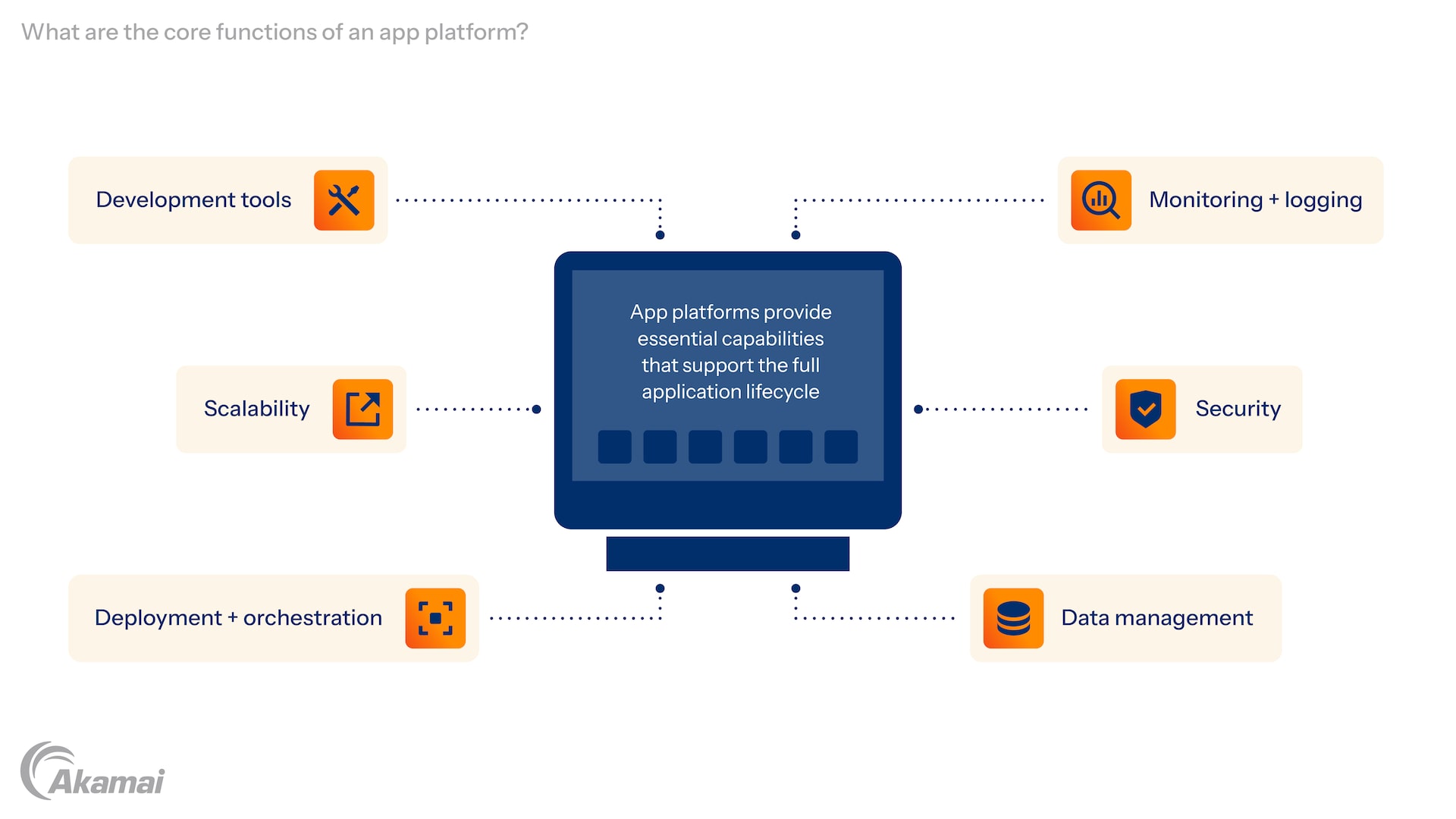
These functions are critical for supporting the complete application lifecycle:
- Application development tools: These tools provide integrated development environments (IDEs), software development kits (SDKs), and application programming interfaces (APIs) to streamline the coding and testing phases.
- Deployment and orchestration: Platforms automate the process of pushing application code to servers, configuring environments, and managing application instances. This includes containerization, load balancing, and continuous integration/continuous deployment (CI/CD) pipelines.
- Scalability and elasticity: An app platform automatically adjusts resource allocation in response to demand fluctuations, ensuring applications can handle varying loads without performance degradation or manual scaling.
- Monitoring and logging: Comprehensive monitoring tools track application performance, resource utilization, and user activity. Logging systems collect and store application logs, which are essential for debugging and auditing.
- Security management: Platforms incorporate security features such as identity and access management (IAM), data encryption, network isolation, and vulnerability scanning to protect applications and data.
- Data management: Integration with various database services, object storage, and caching mechanisms allows applications to store, retrieve, and manage data efficiently.
What are the benefits of using an app platform?
Utilizing an app platform delivers substantial benefits that enhance efficiency, reduce operational overhead, and accelerate time to market. Key benefits include:
- Increased development speed: By providing pre-built tools and automating infrastructure tasks, app platforms allow developers to concentrate on coding, significantly shortening development cycles.
- Reduced operational complexity: The platform manages infrastructure, scaling, and maintenance, decreasing the need for specialized IT operations staff and simplifying management overhead.
- Enhanced scalability and reliability: Applications deployed on a platform can automatically scale to meet demand and are inherently more resilient due to built-in redundancy and failover mechanisms.
- Improved security posture: Platforms often integrate advanced security features and compliance certifications, helping organizations meet security requirements more effectively.
- Cost efficiency: By optimizing resource utilization and automating management tasks, app platforms can lead to reduced infrastructure and operational costs.
- Consistent environment: Platforms provide a standardized environment for development, testing, and production, minimizing compatibility issues and ensuring consistent application behavior.
What are the different types of app platforms?
App platforms are diverse, categorized primarily by their target application environment and the level of abstraction they provide.
- Mobile app platforms are specifically designed for the development and deployment of applications that run on smartphones and tablets. These platforms cater to the unique requirements of mobile devices, including considerations for different operating systems (e.g., iOS, Android), device capabilities (e.g., GPS, camera), and user interfaces. They often include SDKs for native development, cross-platform frameworks, and tools for mobile-specific testing and distribution.
- Web app platforms are engineered to support the creation and hosting of applications accessible via web browsers. These platforms provide the infrastructure for front-end (user interface) and back-end (server-side logic, databases) components of web applications. They typically offer services for hosting static and dynamic content, managing web servers, handling API requests, and integrating with web-specific security and performance optimization tools.
- Low-code/no-code platforms represent a category of app platforms that significantly simplify application development by minimizing or eliminating the need for traditional manual coding.
- Low-code platforms provide visual development environments with drag-and-drop interfaces, pre-built components, and configurable workflows, allowing developers to build applications with minimal code.
- No-code platforms take this further by enabling nontechnical users to create functional applications entirely through graphical interfaces, without writing any code. These platforms are ideal for rapid prototyping and developing line-of-business applications.
What are the key considerations when choosing an app platform?
Choosing the appropriate app platform requires careful evaluation of several critical aspects to ensure it aligns with organizational goals and technical requirements. Key considerations include:
- Scalability requirements: Assess the platform’s ability to handle anticipated growth in user traffic and data volume without performance degradation.
- Supported technologies: Verify that the platform supports the programming languages, frameworks, and databases relevant to the application’s technology stack.
- Integration capabilities: Evaluate how easily the platform integrates with existing systems, third-party services, and external APIs.
- Security features: Examine the platform’s built-in security mechanisms, compliance certifications, and options for implementing custom security policies.
- Cost structure: Understand the pricing model, including compute, storage, data transfer, and any additional service fees, to project total cost of ownership.
- Vendor lock-in: Consider the potential for vendor lock-in and evaluate the ease of migrating applications off the platform if necessary.
- Developer experience: Assess the quality of development tools, documentation, community support, and overall ease of use for developers.
- Monitoring and management tools: Review the platform’s capabilities for application monitoring, logging, debugging, and overall lifecycle management.
- Compliance needs: Determine if the platform meets specific industry or regulatory compliance standards required for the application.
What are the limitations of app platforms?
While app platforms offer numerous advantages, they also present certain limitations that organizations should acknowledge. These limitations often stem from the platform’s inherent design to provide abstraction and standardization.
- Vendor lock-in: Migrating an application from one platform to another can be challenging and costly due to platform-specific services and APIs.
- Limited customization: Platforms often impose constraints on the underlying infrastructure, potentially limiting deep-level customization or access to specific operating system features.
- Performance overhead: The abstraction layer provided by platforms can sometimes introduce slight performance overhead compared to highly optimized, custom-built infrastructure.
- Dependency on vendor: Organizations become dependent on the platform provider for updates, security patches, and service availability, which can impact control.
- Cost management complexity: While often cost-efficient, managing costs on a platform can become complex with varying pricing models for different services and usage tiers.
- Learning curve: Adopting a new platform may require developers and operations teams to learn new tools, APIs, and operational paradigms.
Frequently Asked Questions
Yes, many modern app platforms are designed to be language-agnostic and support a wide range of programming languages. This flexibility is achieved by providing runtime environments or containerization capabilities that can host applications written in different languages such as Python, Java, Node.js, Go, PHP, and Ruby. The platform’s role is to provide the infrastructure and services, allowing developers to use their preferred tools and languages.
Yes, app platforms are often highly suitable for small businesses. They can significantly benefit small businesses by reducing the need for extensive IT infrastructure management and specialized staff. This allows small businesses to rapidly develop and deploy applications with limited resources, focus on core business activities, and scale their applications as they grow, all while maintaining a predictable cost structure. Low-code/no-code platforms, in particular, empower small businesses to build custom solutions without significant development expertise.
Why customers choose Akamai
Akamai is the cybersecurity and cloud computing company that powers and protects business online. Our market-leading security solutions, superior threat intelligence, and global operations team provide defense in depth to safeguard enterprise data and applications everywhere. Akamai’s full-stack cloud computing solutions deliver performance and affordability on the world’s most distributed platform. Global enterprises trust Akamai to provide the industry-leading reliability, scale, and expertise they need to grow their business with confidence.