

Background

When AI Finds the Bugs: Rethinking Exposure in a Flood of Vulnerabilities

November 12, 2026 by Shiran Guez

Share

Key takeaways

Driven by frontier AI discovery, published CVEs have surged to roughly 300 per day in 2026. Traditional scan-and-patch models cannot keep pace with this volume.

Adversaries use AI to reverse-engineer patches and rapidly draft proof-of-concept exploits. The median time from disclosure to active exploitation has dropped to roughly 6 days, with many attacks occurring within 12 to 36 hours.

Teams need immediate controls between disclosure and maintenance windows. Microsegmentation lets defenders ringfence exposed workloads, restrict administrative access, and instantly neutralize attack paths.

Akamai Guardicore Segmentation’s Exposure Analysis and Response (ExAR) combines live network telemetry, segmentation policies, and threat intelligence into an exposure graph, giving security leaders an actionable, evidence-based roadmap to stop both known and zero-day threats.

Frontier AI models are finding vulnerabilities faster than ever, and attackers are turning them into exploits in days, sometimes hours. In this blog post, I’ll explore what that means for security leaders, and how ExAR in Akamai Guardicore Segmentation turns an overwhelming list of vulnerabilities into a short set of actions you can defend.

A decade-old bug found by AI was weaponized in days

On October 5, 2026, a fix for a critical flaw (CVSS v3.1 score of 9.8) in the Linux kernel’s TCP stack was committed upstream. The bug had been hiding in plain sight since Linux 4.4; that is, for nearly 10 years. 

On October 15, 2026, the CVE Numbering Authority (CNA) published it as CVE-2026-98432. Anthropic reported the flaw, and its researchers described using Claude to discover vulnerabilities. 

Twelve days later, Anthropic disclosed that its AI model had built a working exploit: An unauthenticated attacker could run commands as root on any Linux server with a multipath TCP listener. Major distributions had not yet shipped fixed kernels.

This story is no longer unusual; it is the new normal. Vulnerabilities that survived years of human review are now being found by AI at industrial scale, and the time between “a fix exists” and “an exploit exists” keeps collapsing.

The math has changed

For most of the last decade, vulnerability management worked like a backlog: scan, rank by severity, then patch in the next maintenance window. That model assumed that new vulnerabilities would grow slowly and that attackers would need weeks to weaponize them. Neither assumption holds anymore. 

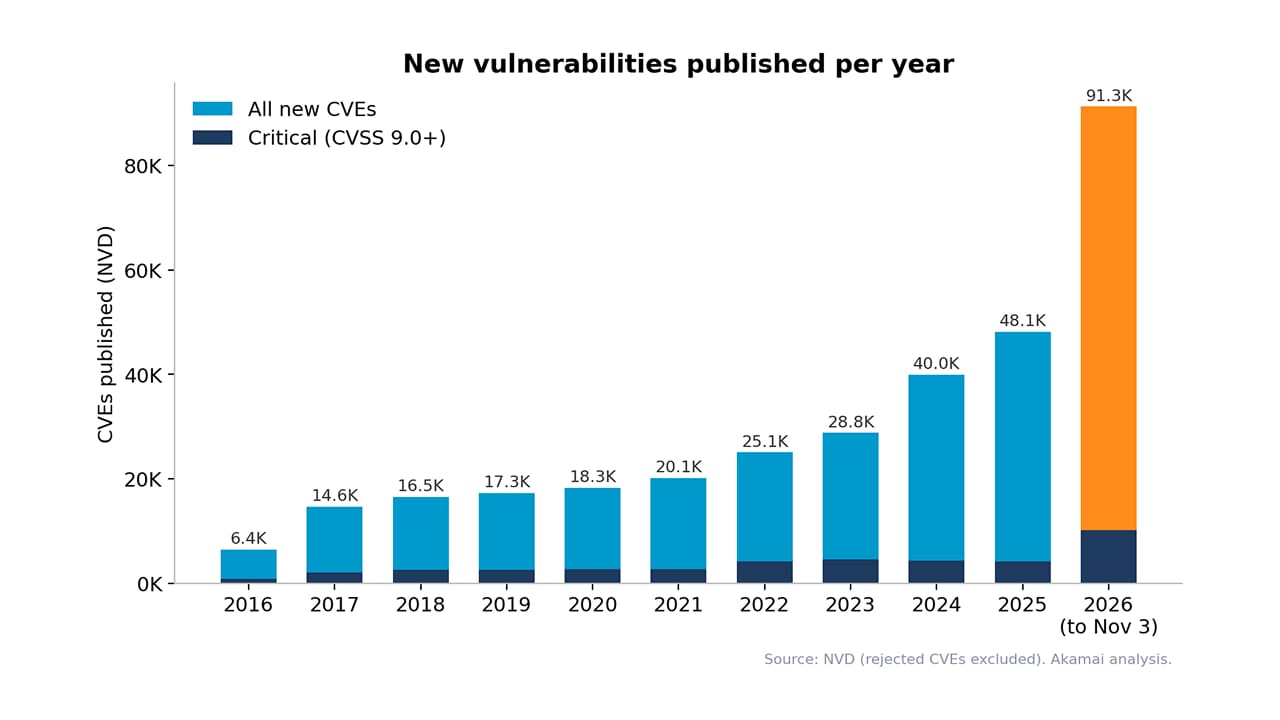
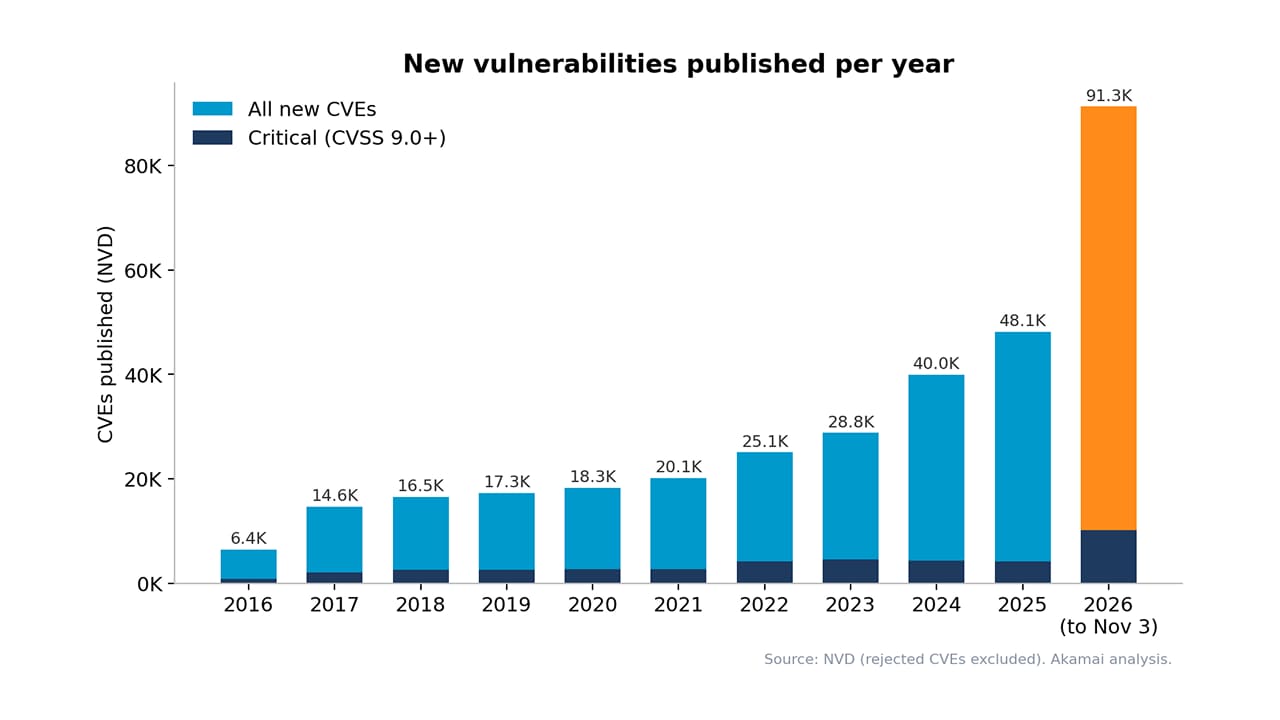
The volume alone tells the story: After years of steady growth, the number of annual CVE disclosures jumped sharply in 2026 (Figure 1).

The volume alone tells the story: After years of steady growth, the number of annual CVE disclosures jumped sharply in 2026 (Figure 1).
Fig. 1: CVE disclosures nearly doubled in 2026, passing 91,000 with two months to go
The volume alone tells the story: After years of steady growth, the number of annual CVE disclosures jumped sharply in 2026 (Figure 1).

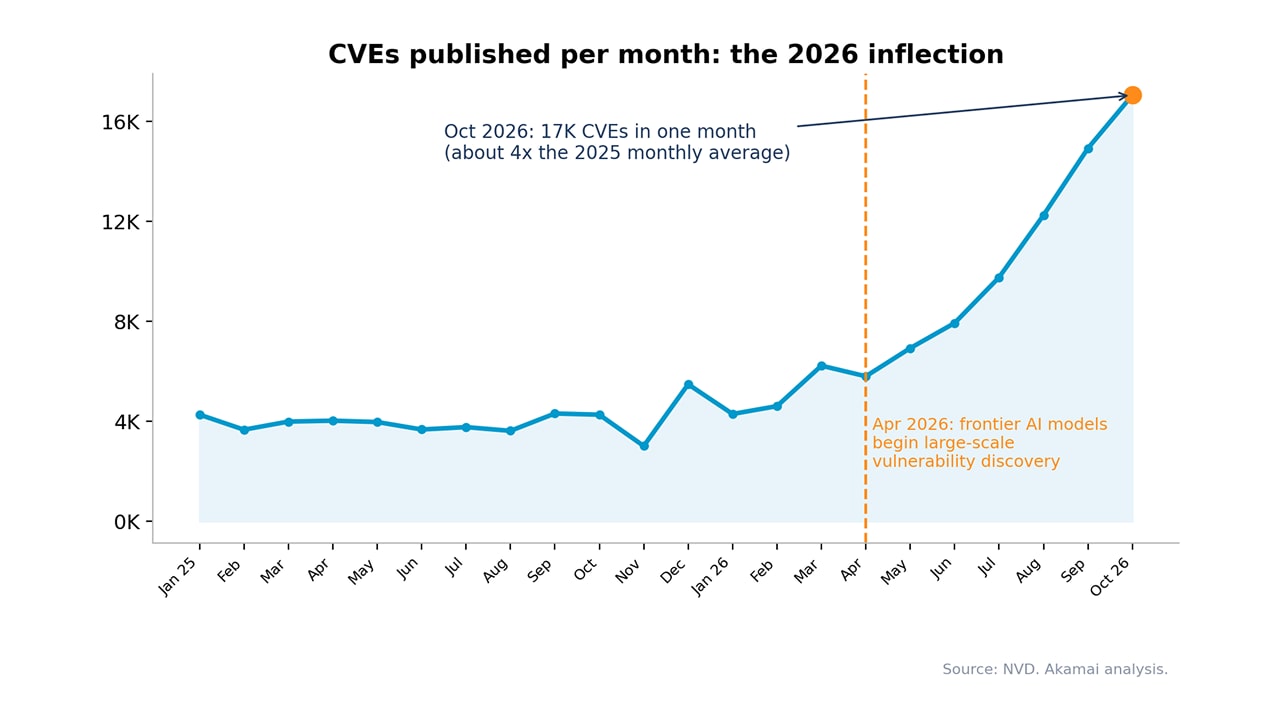
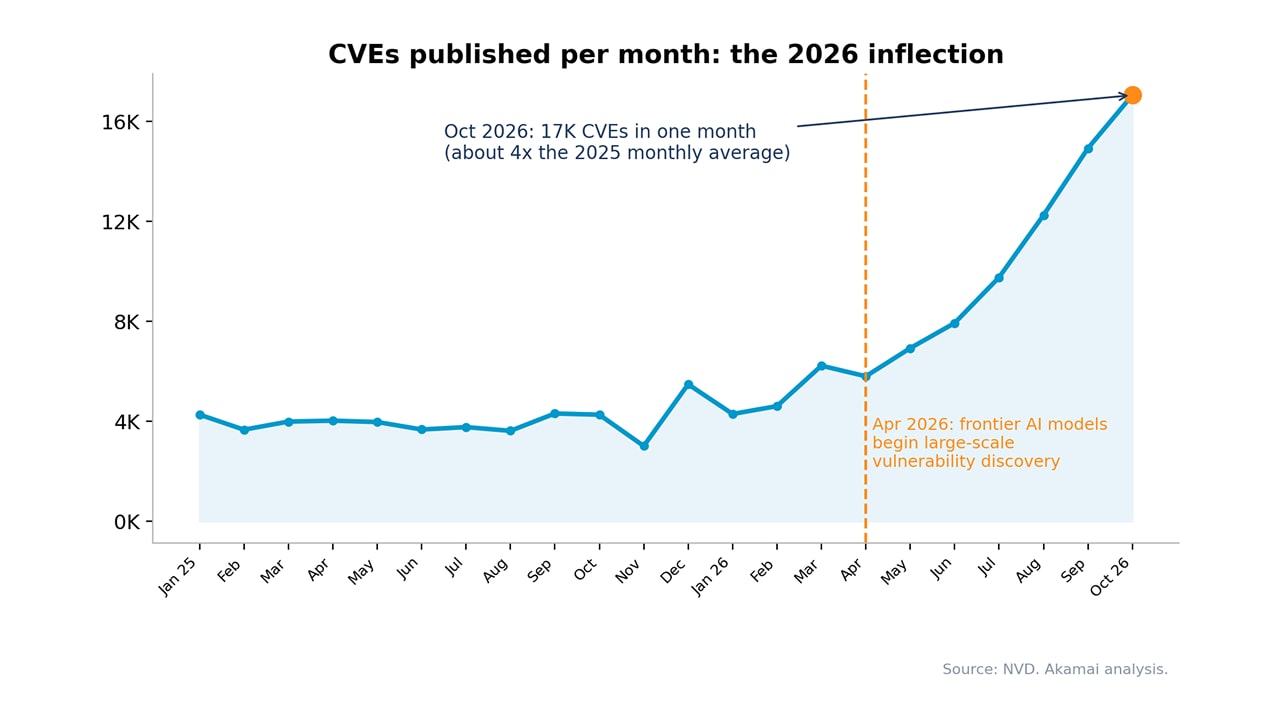
The annual numbers show the trend, but the monthly view shows the break. Through 2025, roughly 4,000 CVEs were published each month. From spring 2026, that number started climbing every month, reaching more than 17,000 in October 2026 alone (Figure 2).

From spring 2026, that number started climbing every month, reaching more than 17,000 in October 2026 alone (Figure 2).
Fig. 2: Monthly CVEs held near 4,000 through 2025, then surged to about 17,000 by October 2026
From spring 2026, that number started climbing every month, reaching more than 17,000 in October 2026 alone (Figure 2).

The scale of this shift becomes clear when we look at the numbers from 2026 so far: 

  • There have been roughly 300 new CVEs every day, up from about 50 per day in 2020. With two months left, 2026 has already produced nearly twice as many CVEs as all of 2025.

  • There were more than 10,000 critical vulnerabilities, about 2.4 times as many as in all of 2025.

  • Even forecasts haven’t been able to keep up. FIRST raised its annual forecast to roughly 66,000 CVEs. The National Vulnerability Database (NVD) has already published more than 91,000.

Frontier AI accelerates offense and defense alike

The increase in numbers is not a reporting artifact. It reflects a step change in what AI models can do with code, both on offense and defense.

Discovery at machine scale

In April 2026, Anthropic’s Claude Mythos found a 27-year-old vulnerability in OpenBSD, one of the world’s most heavily audited operating systems. Anthropic later reported more than 23,000 potential vulnerabilities across more than 1,000 open source projects; external firms confirmed 1,726 and rated more than 1,000 as high or critical. The Linux kernel project alone disclosed 2,308 CVEs in the first half of 2026, and its stable-kernel maintainer expects the AI-driven discovery surge to last at least another 18 months.

That is good news in the long run: Defenders’ findings get fixed. In the short run, however, it means that AI is discovering a flood of new, real vulnerabilities in software every organization runs.

Exploitation at machine speed

The same capability works for attackers. A security fix is a precise map to the bug it fixes. Point a capable model at the difference between the vulnerable and the patched code, and it can often explain the flaw and draft a working proof of concept. 

Academic work has shown this for years: Researchers at the University of Illinois found that a large language model (LLM) agent could autonomously exploit 13 of 15 real-world one-day vulnerabilities (87%) when given the CVE description, and newer research can generate proof-of-concept exploits directly from security patches.

In the wild, exploitation windows are now measured in hours. Attackers first tried to exploit a critical SQL injection in the LiteLLM AI gateway about a day after the advisory, and they attacked a server-side request forgery in the LMDeploy inference engine about 12 hours after disclosure.

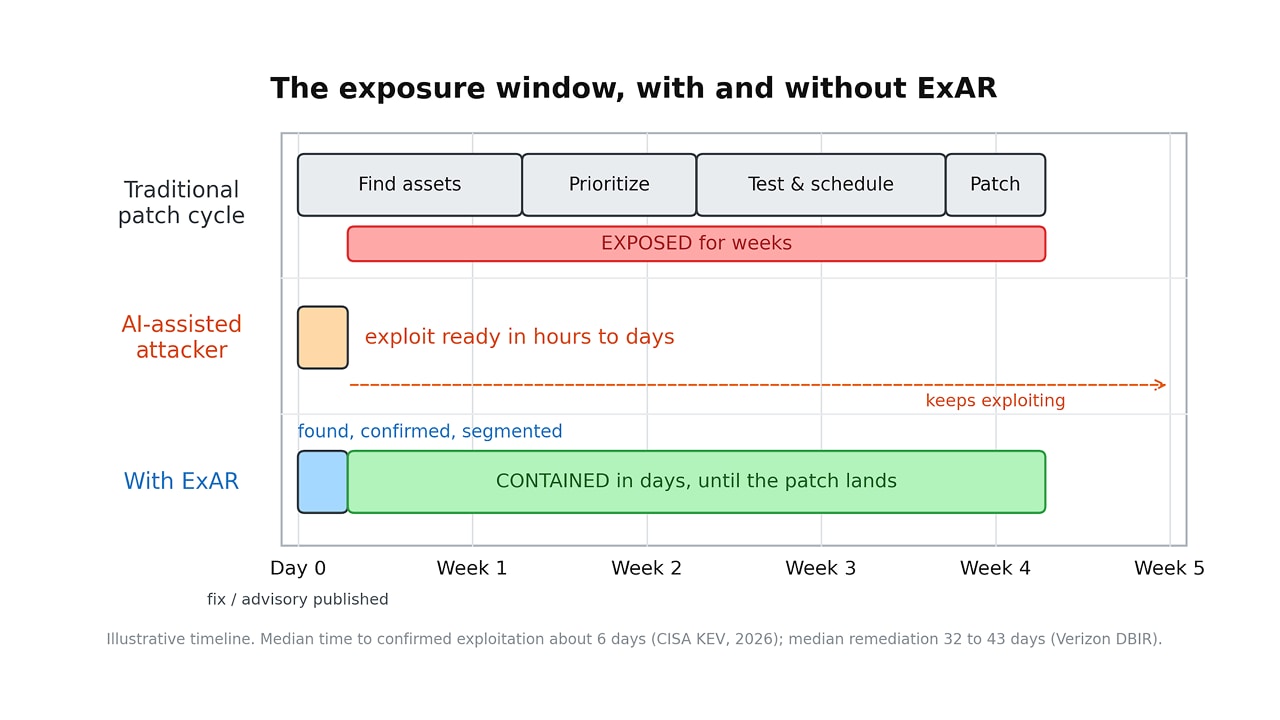
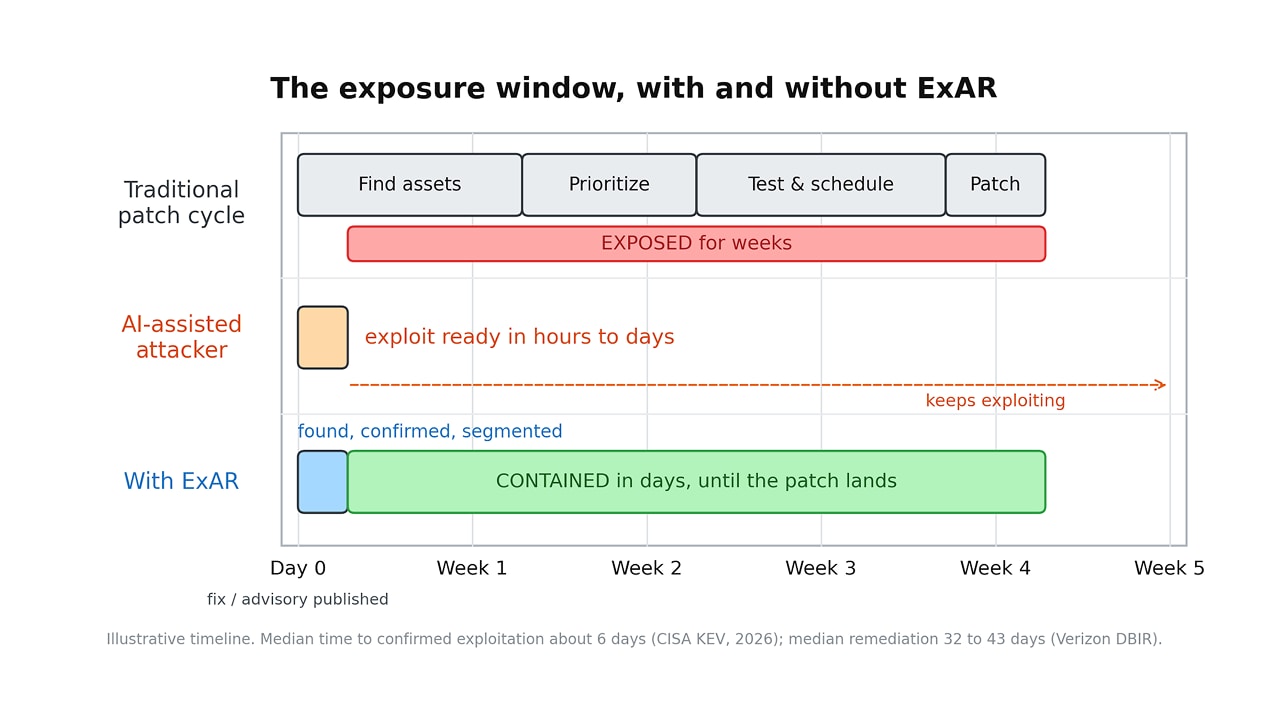
Figure 3 illustrates how the patch lifecycle differs with and without ExAR in the AI-assisted attacker era.

Figure 3 illustrates how the patch lifecycle differs with and without ExAR in the AI-assisted attacker era.
Fig. 3: ExAR contains reachable assets in just days, which is weeks before the patch lands
Figure 3 illustrates how the patch lifecycle differs with and without ExAR in the AI-assisted attacker era.

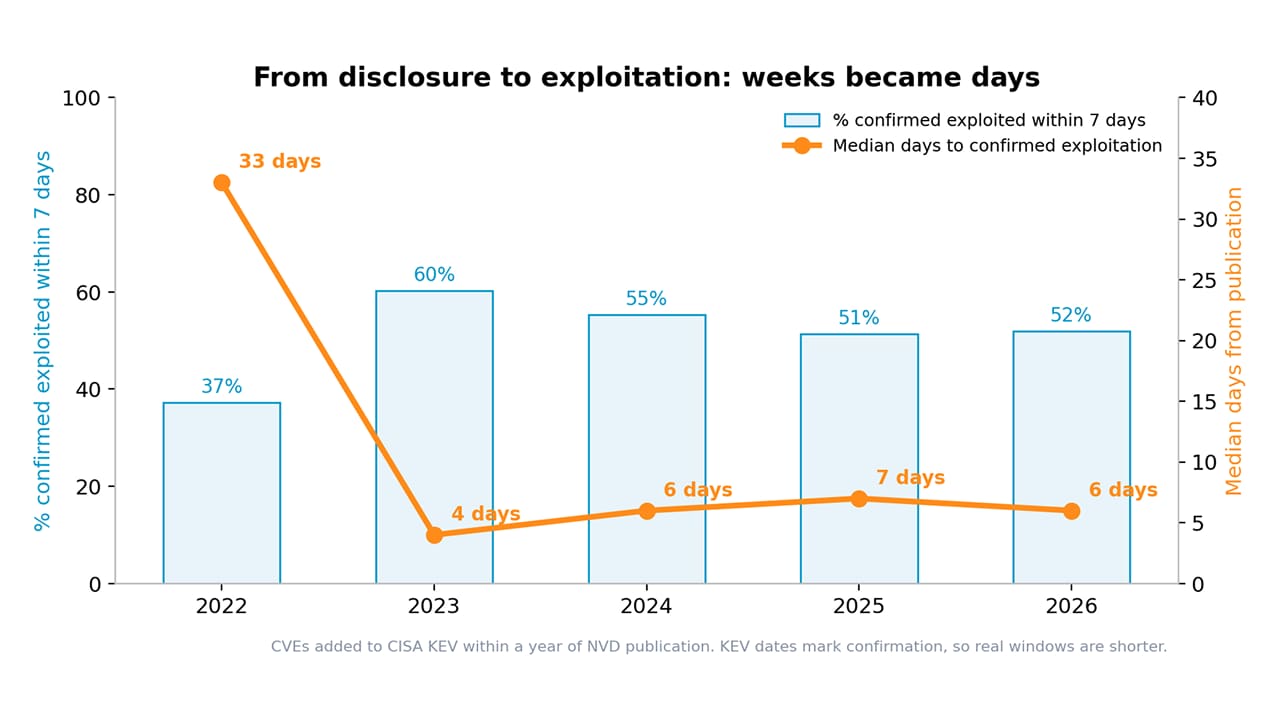
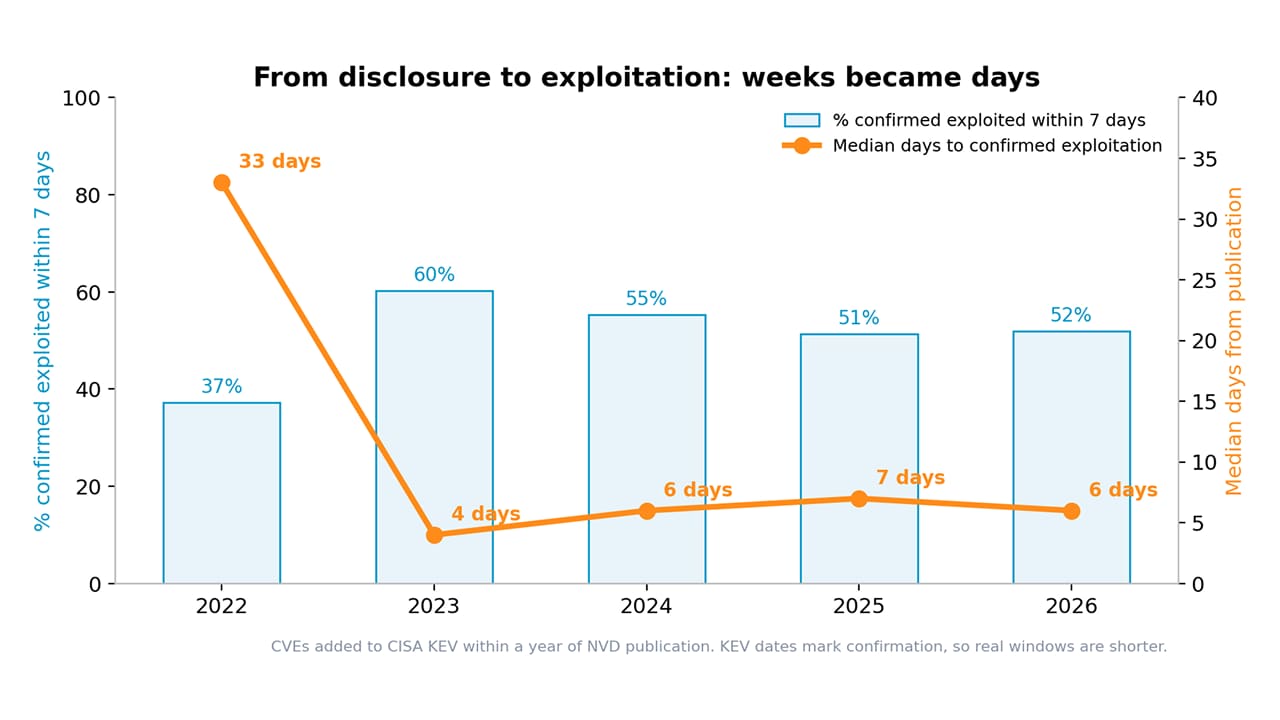
Public data on confirmed exploitation tells the same story. For vulnerabilities that end up in CISA’s Known Exploited Vulnerabilities (KEV) catalog within a year of publication, the median time from publication to confirmed exploitation dropped from 33 days in 2022 to about 6 days in 2026 (Figure 4). About half are confirmed exploited within a week, and about one in four are exploited on or before the day they are published.

For vulnerabilities that end up in CISA’s Known Exploited Vulnerabilities (KEV) catalog within a year of publication, the median time from publication to confirmed exploitation dropped from 33 days in 2022 to about 6 days in 2026 (Figure 4).
Fig. 4: Median time to exploitation fell from 33 days in 2022 to about 6 days in 2026
For vulnerabilities that end up in CISA’s Known Exploited Vulnerabilities (KEV) catalog within a year of publication, the median time from publication to confirmed exploitation dropped from 33 days in 2022 to about 6 days in 2026 (Figure 4).

No team can patch 300 vulnerabilities a day, and a monthly patch cycle now exceeds the median time to exploitation. The question has shifted from “How many vulnerabilities do we have?” to “Which vulnerabilities can an attacker actually reach, and what happens if they do?”

Why severity scores alone are no longer enough

The Common Vulnerability Scoring System (CVSS) describes how bad a vulnerability could be in the worst case. It doesn’t tell you whether the vulnerable software runs in your environment, whether the vulnerable feature is enabled, whether the service is reachable from the internet or a compromised neighbor, or what an attacker could reach next. 

Two recent examples show the gap:

  • A perfect 10 that is often unreachable. CVE-2026-112816, an authentication bypass in Canonical LXD, carries the maximum CVSS score of 10. But exploitation requires network access to the LXD API, which many hosts don’t expose and which listens only locally. A severity-only program treats every LXD installation as an emergency; an exposure-aware program fixes the exposed ones first.

  • Reach turns a flaw into a crisis. Vulnerabilities in widely deployed runtimes, such as the Node.js Brotli decoder flaw (Node2Shell) or the PHP core flaws (PHP2Shell), are dangerous because they sit inside internet-facing applications across a large share of networks. Context, not the score, decides urgency.

How ExAR helps

Exposure Analysis and Response (ExAR) is a set of capabilities in Akamai Guardicore Segmentation, included in the Guardicore Plus and Premier tiers. It brings together three kinds of input: 

  1. Telemetry that Akamai Guardicore Segmentation already collects through its agents (assets, observed network traffic, host and software inventory, and identity and access context) 

  2. The segmentation policy itself (which flows are allowed, blocked, or not yet controlled); this tells ExAR whether a vulnerable asset is actually reachable

  3. Intelligence (Akamai threat research; public vulnerability and exploit data such as NVD, CISA KEV, and Exploit Prediction Scoring System [EPSS]; and vendor advisories with fix status) 

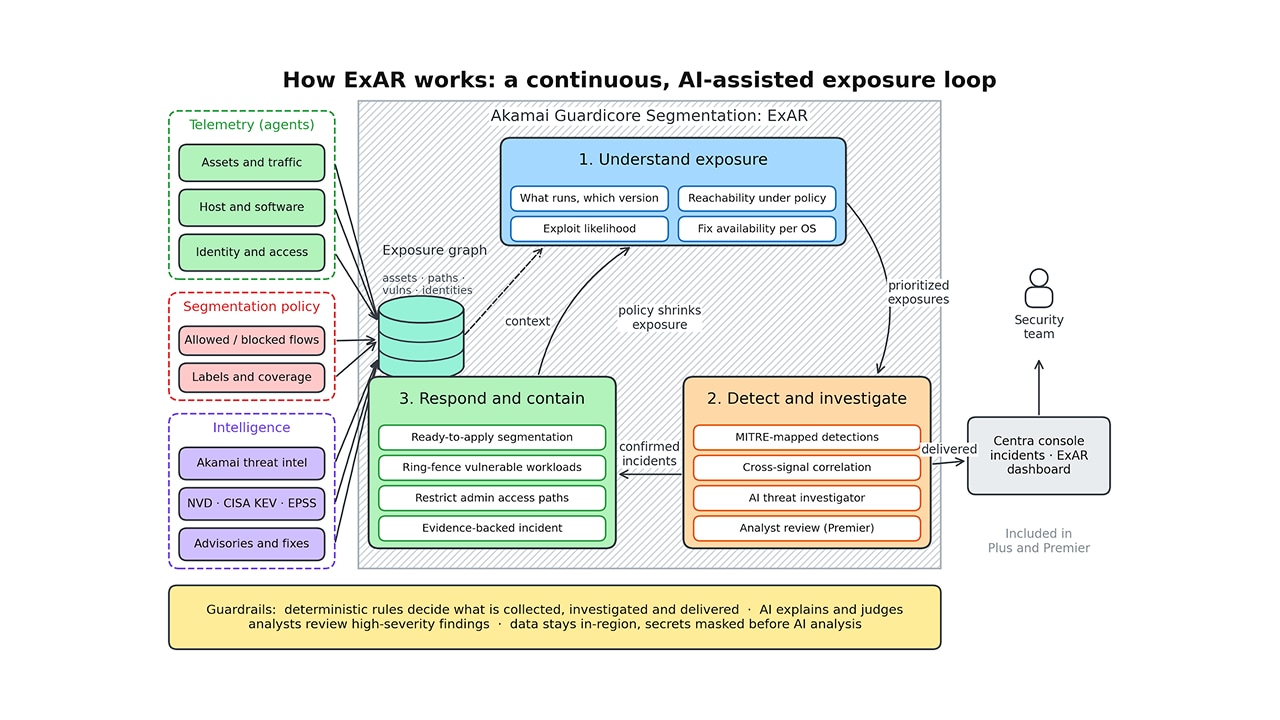
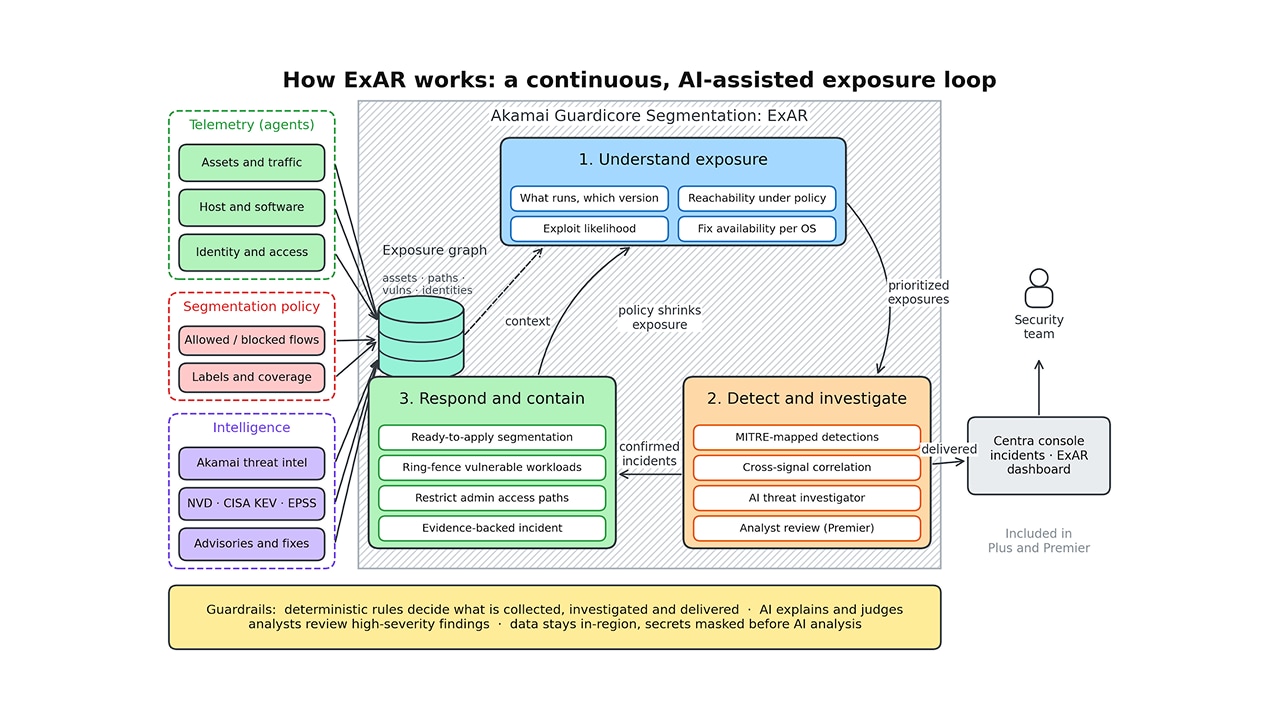
ExAR combines them into an exposure graph, a continuously updated picture of what runs where, how it connects, what is vulnerable, and who can reach it, and uses it to drive a continuous loop (Figure 5).

ExAR combines them into an exposure graph, a continuously updated picture of what runs where, how it connects, what is vulnerable, and who can reach it, and uses it to drive a continuous loop (Figure 5).
Fig. 5: Telemetry, policy, and threat intel feed one exposure graph that drives detection and containment
ExAR combines them into an exposure graph, a continuously updated picture of what runs where, how it connects, what is vulnerable, and who can reach it, and uses it to drive a continuous loop (Figure 5).

ExAR operates as a continuous, three-stage lifecycle that turns overwhelming threat data into decisive containment: 

  1. Understand exposure

  2. Detect and investigate

  3. Respond and contain

Understand exposure

ExAR correlates known vulnerabilities with what is actually running and how it’s reachable. For every vulnerable workload, it answers four questions: 

  • Is the affected software present and active, and in which version? 

  • Can an attacker reach it from the internet or laterally over administrative ports from a likely foothold, given the segmentation policy in force? 

  • How likely is exploitation, based on known exploitation in the wild and exploit prediction? 

  • Is a vendor fix available for that specific operating system and version? 

The result is a short, prioritized list of real exposures, ranked by reachability and business impact rather than by CVSS score alone.

Detect and investigate

Exposure is only half the picture. Protecting against known exposure is one thing, but protecting against unknown zero-day threats is another since attackers don’t wait for public disclosures (PHP2Shell was exploited days before disclosure). 

ExAR continuously looks for attacker behavior across network, endpoint, and identity signals, maps it to MITRE ATT&CK, and enriches it with Akamai threat intelligence. It correlates related signals so scattered events become one story. An AI threat investigator then examines each finding in context (the asset and its role, its connections, the processes and users involved, and similar past activity) and reaches a verdict that explains what happened, which assets were involved, and why it matters — with the evidence behind it. 

This capability lets ExAR protect against both known and unknown threats. For Premier customers, experienced Akamai analysts also review the most severe findings.

Respond and contain

Patching remains the fix, but it rarely happens on the same day that the patch is released. Each confirmed incident arrives in the Centra console with what happened, why it matters, and what to do next, including specific, ready-to-apply segmentation recommendations that ringfence vulnerable workloads, restrict administrative access, and block the paths an attacker would use to move laterally. 

Because Akamai Guardicore Segmentation already enforces policy across the estate, you can turn a recommendation into protection quickly, without waiting for a maintenance window. Every policy applied shrinks the exposure that the next turn of the loop measures.

From disclosure to action: Recent examples

The Akamai Security Intelligence Group publishes analyses of major vulnerabilities as they emerge. ExAR turns that research into environment-specific answers for each customer. For example:

  • CVE-2026-98432: Linux kernel remote use-after-free (TCP stack). Soon after disclosure, ExAR customers received incident reports listing affected Linux workloads, fix status by distribution and kernel line, interim mitigations, segmentation recommendations, and a link to Akamai’s open source validation and mitigation script.

  • Node2Shell (CVE-2026-111497) and PHP2Shell (CVE-2026-109618, CVE-2026-109619): Remote code execution in two of the most widely deployed web runtimes. Exposure context shows which affected workloads are internet-facing, so teams can prioritize and ring-fence them while patches roll out.

  • CVE-2026-21589 (Atlassian), StyleSmuggler (CVE-2026-75650, Adobe Commerce and Magento), and KindaRails2Shell (CVE-2026-66066, Ruby on Rails): Critical flaws in business applications that often sit next to sensitive data. The question is not only “Is it patched?” but “What can it reach?”, which is exactly what segmentation answers.

  • A real intrusion, contained. In a recently published case, ExAR’s AI threat investigator, working with Akamai analysts, connected scattered signals (a web-facing entry point, reverse shells to command-and-control infrastructure, and directory reconnaissance) into one incident. Segmentation policy then constrained the attack paths before the intrusion became a broader operational event.

AI where it helps, guardrails where it matters

If attackers use AI to move faster, defenders have to as well. ExAR uses AI where it adds the most value: working at machine-speed, correlating many weak signals, investigating each finding in context, and writing a clear explanation and recommendation. It does not run unsupervised.

  • AI is deterministic where it counts. Explicit, auditable rules decide what data to collect, which findings to investigate, and which incidents to deliver. AI provides the judgment and the explanation.

  • Humans stay in the loop. Our analysts review the highest-severity findings for Premier customers, and every incident carries the evidence behind its conclusion.

  • Data is handled with care. We process investigation data within the customer’s region, and we mask secrets before any AI analysis.

What this means for security leaders

When vulnerabilities grow exponentially, and exploitation takes days, it changes the questions a board should ask. Instead of “How many vulnerabilities do we have?”, ask:

  • How many of our critical vulnerabilities are actually reachable from the internet or from a likely foothold?

  • How long does it take to know which assets are affected after a major disclosure: Hours or weeks?

  • What protects us between disclosure and patch? Can we contain a vulnerable workload today, without waiting for a maintenance window?

  • Are we seeing exploitation right now, and can we connect the signals into one story?

ExAR is designed to make each of these answers short and evidence-based.

Learn more

ExAR is included in Akamai Guardicore Segmentation Plus and Premier. To see your own exposure picture, contact your Akamai account team or visit the Akamai Guardicore Segmentation product page.

FAQ

Frontier AI is finding vulnerabilities at machine scale, pushing published CVEs to roughly 300 per day in 2026. Attackers also use frontier AI to analyze security fixes and draft exploits, cutting the median time from disclosure to exploitation to about 6 days. Monthly scan-and-patch cycles can no longer keep up, so teams need to prioritize by real exposure and contain risk before patches land.

ExAR is a set of capabilities in Akamai Guardicore Segmentation, included in the Plus and Premier tiers. It combines agent telemetry, segmentation policy, and threat intelligence to show which vulnerable workloads are actually reachable. It also detects and investigates attacker activity and recommends segmentation policies to contain the threat.

Microsegmentation restricts which workloads can communicate and over which ports. By ringfencing a vulnerable workload and restricting administrative access, it shrinks the paths that an attacker can use to reach it or to move laterally, even before a patch is applied or before a patch exists. ExAR identifies which workloads need this and recommends the specific policy.

FAQ

About the author

Shiran Guez

Shiran Guez

With a career spanning more than two decades, Shiran Guez has built a strong foundation in networking and the telecom industry. A passion for technology and his entrepreneurial mindset have driven his success across various domains. In 2014, Shiran joined Akamai and is today Director of Engineering in Akamai Guardicore Segmentation ExAR. A firm believer in continuous learning, Shiran relishes new challenges that enable him to expand his expertise. Outside of work, Shiran is a devoted husband and father of three. He recognizes the importance of balancing work and personal life, and his commitment to both demonstrates his determination and adaptability in an ever-evolving industry.