A cloud native application is a software application designed to be built, deployed, and run in a cloud computing environment using modern architectures such as microservices, containers, and APIs. Cloud-native applications leverage cloud elasticity, scalability, and automation to improve agility, resilience, and speed of innovation.
An overview of cloud native applications
A cloud native application is a software program that’s built to run within a cloud computing environment. Cloud native apps take advantage of the nature of the cloud delivery model, leveraging the elasticity, scale, resiliency, and flexibility that the cloud offers to enable organizations to move with greater speed and agility. Rather than being tightly coupled to on-premises infrastructure or traditional virtual machines (VMs), cloud-native applications are designed for dynamic, distributed environments.
Built with a microservices architecture, cloud native apps enable quick and frequent updates to applications without impacting service delivery, giving organizations a competitive edge and supporting application modernization initiatives across hybrid cloud environments.
An overview of cloud native applications
A cloud native application is a software program that’s built to run within a cloud computing environment. Cloud native apps take advantage of the nature of the cloud delivery model, leveraging the elasticity, scale, resiliency, and flexibility that the cloud offers to enable organizations to move with greater speed and agility. Rather than being tightly coupled to on-premises infrastructure or traditional virtual machines (VMs), cloud-native applications are designed for dynamic, distributed environments.
Built with a microservices architecture, cloud native apps enable quick and frequent updates to applications without impacting service delivery, giving organizations a competitive edge and supporting application modernization initiatives across hybrid cloud environments.
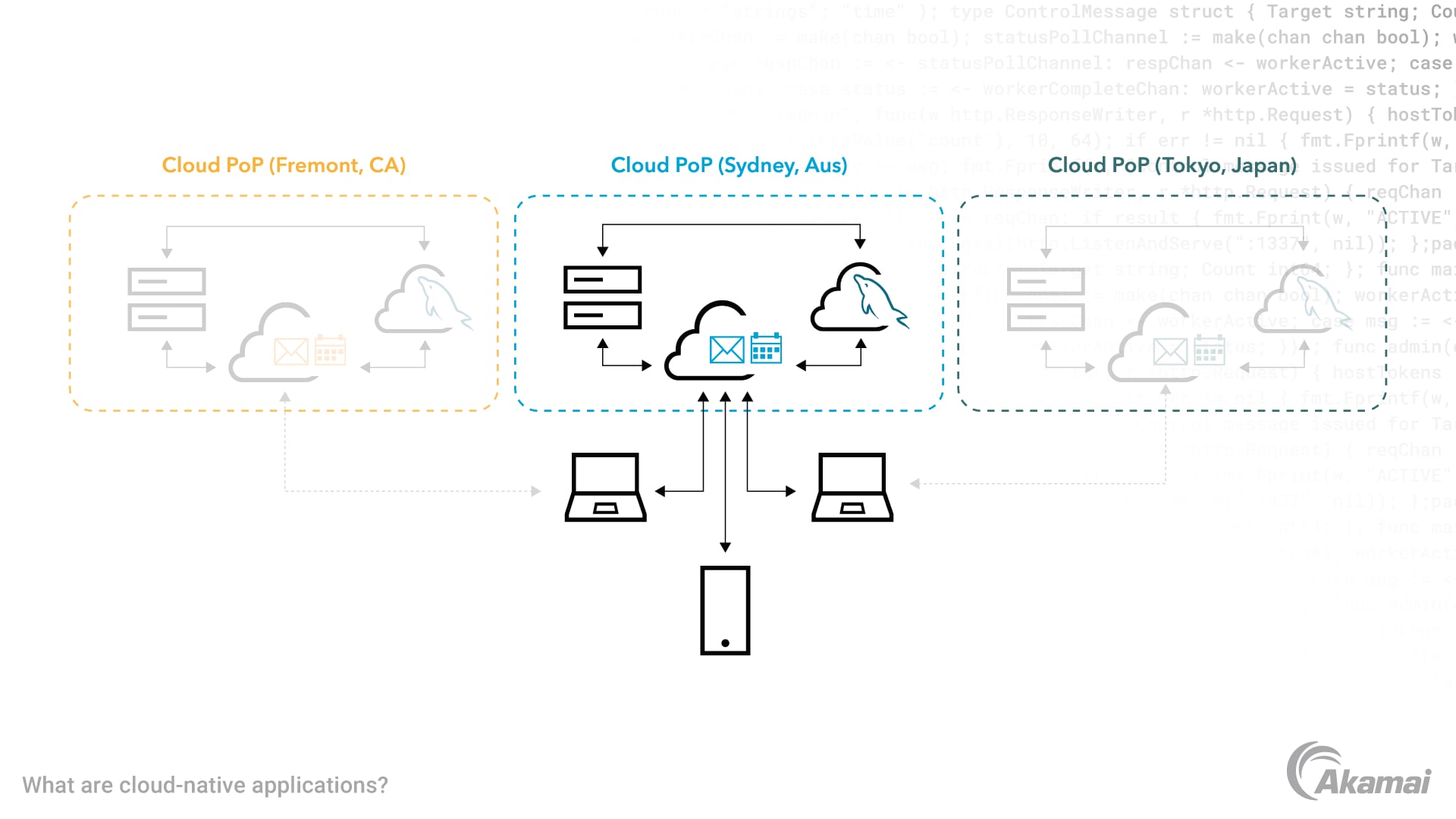 Diagram illustrates how a cloud-native application might scale and spin up virtual point of presence servers (PoPs) to support client demand and location.
What are the components of cloud native applications?
Cloud native applications are built with several key technologies to form a flexible cloud ecosystem.
- Microservices are a common architectural pattern in cloud native applications. These loosely coupled, reusable programs are designed to integrate into any cloud environment. Microservices work together to make the application run, but each microservice can be scaled independently and continuously improved through iterations, making the development of cloud native applications faster and more flexible. Microservices are often deployed inside containers and can incorporate modern frameworks for observability, security, and performance optimization.
- Containers combine all of an application’s dependencies, including source code, runtime components, and libraries, allowing the application code to run in any environment while sharing the host operating system kernel. This allows many isolated applications to run on the same server with minimal overhead.
- APIs (application programming interfaces) are collections of resources, most notably URL endpoints, that make it easier for services and SaaS applications to communicate and integrate. APIs enable modular development and extensibility across cloud-native systems.
- Software-defined infrastructure abstracts compute, storage, and networking resources through software layers, enabling automated provisioning and dynamic scaling across cloud platforms like Akamai, Amazon Web Services (AWS), Azure, and VMWare environments.
- Dynamic orchestration minimizes the complexity of managing container lifecycles at runtime, handling resource management, load-balancing, scheduling restarts after an internal failure, and provisioning nodes of server clusters.
- Service mesh is a layer of software used to manage communication between multiple microservices. The service mesh routes traffic between all of the parts of an application that need to communicate with one another, enabling traffic management, security, and observability without modifying application code.
- Backing services include resources like message brokers, data stores, machine learning services, security services, and monitoring capabilities.
- Automation enables cloud environments to be rapidly provisioned with features and updates, accelerating releases and improvements without causing interruption to the user experience.
How are cloud native apps developed?
Developers use several tools to manage the cloud native application development process. Kubernetes is a platform designed for management and container orchestration of Linux containers. Docker is an open-source platform for creating, deploying, and managing virtualized application containers that use a common operating system. GitLab is a DevOps platform that supports source code management and continuous integration/continuous development (CI/CD), automating testing, deployment, and application lifecycle workflows. Any number of programming languages are used to create real-time microservices like newsfeeds and chat. Infrastructure as code tools like Terraform manage versions of deployments so that developers can see when and where resources have been changed.
What are cloud native vs. cloud-based apps?
Cloud native applications are designed specifically for the cloud. Cloud-based applications are hosted in the cloud and may take advantage of the elasticity and scalability of cloud infrastructure, but they do not take full advantage of the inherent design of cloud architecture.
What are the advantages of cloud native applications?
- Minimal costs. Cloud native applications enable organizations to take advantage of the scalability of cloud services, eliminating the cost of overprovisioning. Cloud native apps also allow organizations to avoid the cost of purchasing and maintaining hardware and software on site.
- Greater agility. The microservices within cloud native applications can scale independently, allowing some components of a software program to be updated quickly without needing to update the entire application. Cloud native apps offer flexible deployment across the network and are easier to develop and iterate, making it ideal for startups and enterprises pursuing modernization.
- Portability. Because cloud native applications can be easily ported between different infrastructures, organizations can avoid being tied to the services of a single vendor.
- Enhanced reliability. The use of containers and cloud native applications means that when one microservice fails, a cloud native application can continue to operate with minimal downtime.
- Automated management. Cloud native apps rely on automation to deploy features and updates, simplifying tasks for IT teams.
- Clear visibility. The isolation inherent in a microservice architecture makes it easier for IT teams to understand how applications work together.
- Immense scalability. Cloud native applications use software-defined infrastructure to minimize hardware dependency, adding additional commodity servers that enable horizontal scalability.
- Zero downtime. Orchestration solutions like Kubernetes enable cloud native apps to be updated with virtually no downtime.
What are the challenges of cloud native applications?
- Implementing cloud native architecture requires established DevOps practices that can handle the distributed workflow and responsibilities required to develop microservices.
- Managing the many iterations of cloud native apps is a highly complicated task that can be overwhelming for development and IT teams.
- Rapid scaling of the containers required for cloud native apps can introduce risks to enterprise cloud security that — when not properly monitored and remediated — may lead to breaches.
- Migrating from legacy applications to applications built on microservices and containers can lead to complex problems with interdependencies or application functionality.
- Regulations and requirements concerning data location, retention demands, and data privacy require developers to find new solutions for cloud storage and cloud databases that can match the flexibility of cloud native architecture.
How does cloud native application development work?
Building cloud native applications relies on continuous integration (CI) and continuous delivery (CD) practices. CI consists of making small, frequent changes to code, making it easier to identify and remediate issues faster. CD ensures that microservices are always ready to be deployed to the cloud, relying on software automation tools to reduce risk when making changes. This approach allows organizations to run applications efficiently at scale while continuously optimizing performance and security.
What are cloud native applications vs. traditional applications?
Traditional, monolithic software programs take longer to build and are released far less frequently than cloud native apps.
Where cloud native apps may run on operating systems that have been abstracted, traditional apps require close dependencies between the underlying OS, hardware, and storage, making it difficult to migrate and scale applications across new infrastructure.
Cloud native apps allow right-sized provisioning, where IT teams can allocate resources as needed rather than provisioning oversized and overbuilt infrastructure designed to meet the needs of potential spikes in demand.
Frequently Asked Questions
Managed Kubernetes is a service that provides automated deployment, scaling, and management of Kubernetes clusters, allowing organizations to run containerized applications without managing the underlying infrastructure. Cloud providers handle tasks such as updates, security patches, and cluster maintenance.
Cloud native architecture is an application design approach that uses microservices, containers, APIs, and automation to build scalable and resilient applications for cloud environments. This architecture supports rapid development, workload transfers, independent service deployment, and portability across cloud and hybrid environments.
The Cloud Native Computing Foundation (CNCF) is an open-source software foundation that supports the development, adoption, and standardization of cloud-native technologies, including Kubernetes, container runtimes, and observability tools.
A content delivery network (CDN) is a globally distributed network of servers that uses cloud infrastructure to deliver web content quickly and reliably. Cloud CDNs reduce latency by caching content closer to users and dynamically scaling to meet traffic demand.
Why customers choose Akamai
Akamai is the cybersecurity and cloud computing company that powers and protects business online. Our market-leading security solutions, superior threat intelligence, and global operations team provide defense in depth to safeguard enterprise data and applications everywhere. Akamai’s full-stack cloud computing solutions deliver performance and affordability on the world’s most distributed platform. Global enterprises trust Akamai to provide the industry-leading reliability, scale, and expertise they need to grow their business with confidence.