Microservices architecture and platform engineering complement each other by addressing the complexities inherent in distributed systems. Platform engineering provides the standardized tools and automated processes necessary to effectively deploy, manage, and observe a large number of independent microservices. The IDP simplifies concerns such as service discovery, load balancing, inter-service communication, and monitoring, which are critical for the success of a microservices approach.
Platform engineering is a discipline focused on designing, building, and maintaining an integrated product that offers a curated experience for software delivery and lifecycle management. This “internal developer platform” (IDP) provides self-service capabilities for developers, enabling them to deploy and operate applications efficiently without deep knowledge of the underlying infrastructure. The primary goal is to enhance developer experience and productivity by abstracting away operational complexities.
How does platform engineering work?
Platform engineering functions by creating a “golden path” for development teams. This path consists of standardized tools, services, and processes that are preconfigured and integrated. Developers interact with the IDP through a unified interface, which handles the intricacies of infrastructure provisioning, deployment pipelines, monitoring, and other operational tasks. The platform engineering team acts as the provider of this internal product, ensuring its reliability, scalability, and usability.
Core components of a platform
A typical internal developer platform comprises several core components:
- Infrastructure as code (IaC): Defines and manages infrastructure resources programmatically
- Continuous integration/continuous deployment (CI/CD) pipelines: Automates the build, test, and deployment processes
- Service catalog: Offers a curated list of ready-to-use services and templates
- Observability tools: Provides integrated logging, monitoring, and tracing capabilities
- Security controls: Enforces policies and best practices for application and infrastructure security
- Developer portals: A unified interface for accessing all platform capabilities and documentation
- Runtime environments: Standardized environments for deploying and running applications
Platform engineering principles and practices
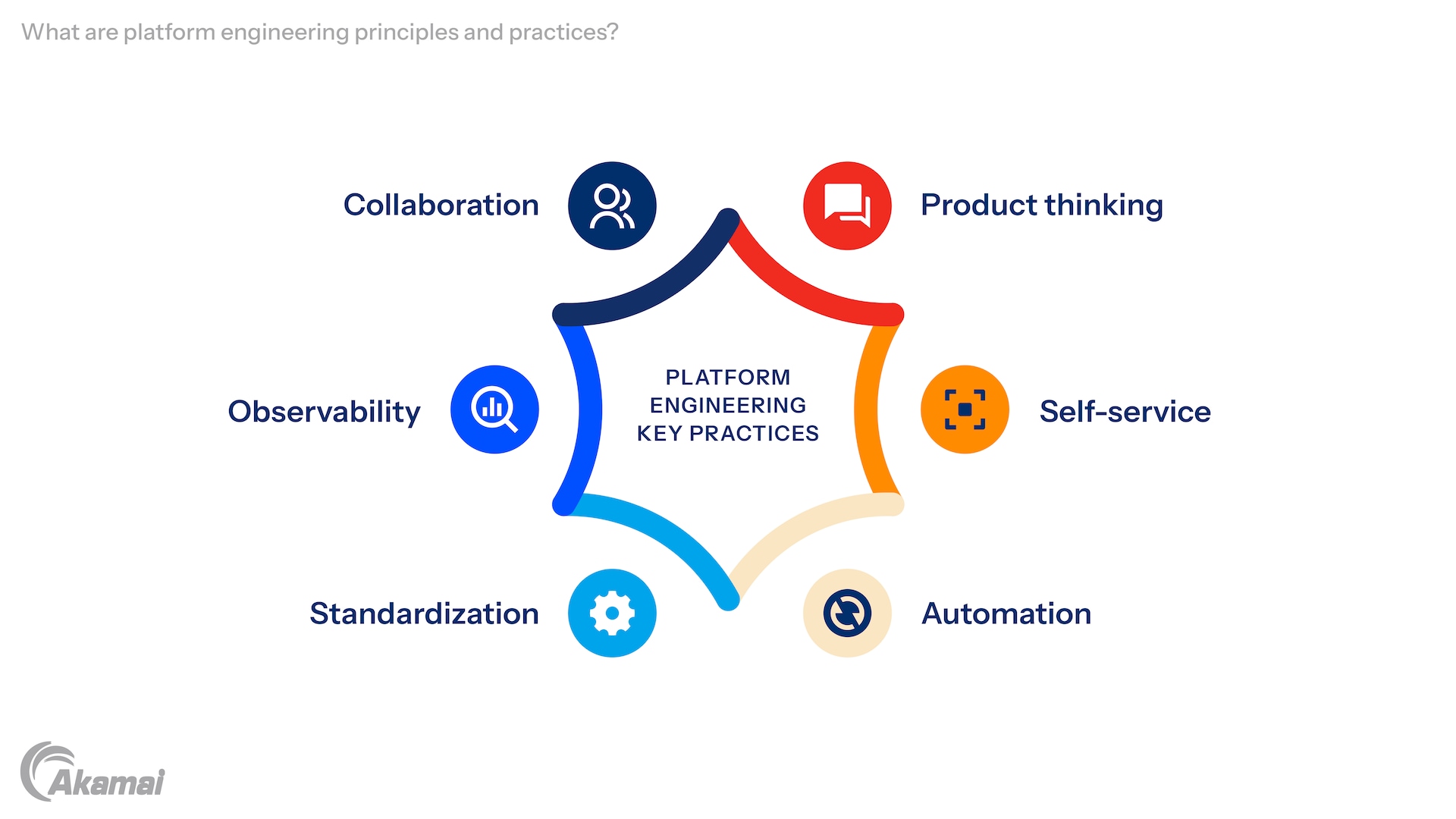
Platform engineering adheres to principles centered on developer experience, automation, and self-service. Key practices include:
- Product thinking: Treating the internal developer platform as a product with its own users (developers), roadmap, and feedback loops
- Self-service: Empowering developers to provision resources and deploy applications independently
- Automation: Automating repetitive operational tasks to reduce manual effort and errors
- Standardization: Establishing consistent tools, technologies, and processes across the organization
- Observability: Building in robust monitoring and logging from the outset to ensure transparency
- Collaboration: Fostering close collaboration between platform teams and application development teams
Platform engineering in cloud native environments
In cloud native environments, platform engineering leverages technologies such as Kubernetes, containers, and microservices to build scalable and resilient platforms. The IDP orchestrates cloud native tools and services, providing a streamlined experience for deploying and managing cloud native applications. This often involves integrating with public cloud providers’ services and open source, cloud native projects.
Platform engineering in hybrid cloud environments
For hybrid cloud setups, platform engineering focuses on creating a consistent operational model across both public and private cloud infrastructures. The platform abstracts away the underlying differences, allowing developers to deploy applications without knowing the specific location. This typically involves using technologies that can span multiple environments, such as Kubernetes with multi-cluster management solutions.
Platform engineering in on-premises systems
When dealing with on-premises systems, platform engineering concentrates on standardizing and automating the deployment and management of applications within an organization’s own data centers. This might involve utilizing virtualization technologies, bare-metal automation, and integrating with existing enterprise tools. The objective remains to provide a developer-friendly interface that simplifies interaction with on-premises infrastructure.
Platform engineering culture
The culture surrounding platform engineering is characterized by a strong emphasis on empathy for developers, a product-oriented mindset, and continuous improvement. It promotes collaboration between infrastructure and development teams, shifting away from a siloed approach. The platform team views developers as their customers, actively seeking feedback to evolve and enhance the platform. This cultural shift is crucial for successful platform adoption and effectiveness.
Platform engineering vs. DevOps
Platform engineering and DevOps are complementary but distinct. DevOps is a set of cultural philosophies, practices, and tools that increases an organization’s ability to deliver applications and services at high velocity. It focuses on breaking down silos between development and operations.
Platform engineering is a realization of DevOps principles through the creation of a dedicated product — the internal developer platform. While DevOps defines how teams should collaborate and improve software delivery, platform engineering provides the tools and infrastructure to achieve those goals in a standardized, self-service manner. Platform engineering operationalizes DevOps practices, offering a structured approach to achieve the benefits of DevOps at scale.
Benefits of platform engineering
The adoption of platform engineering yields several significant benefits:
- Increased developer productivity: Developers spend less time on infrastructure concerns and more time on writing application code.
- Faster time to market: Streamlined deployment processes enable quicker delivery of features and applications.
- Improved operational efficiency: Automation reduces manual tasks and potential errors, leading to more stable operations.
- Enhanced standardization: Consistent environments and tooling reduce complexity and improve maintainability.
- Better security and compliance: Built-in security controls and automated compliance checks strengthen the overall posture.
- Reduced cognitive load for developers: Developers interact with a simplified interface, abstracting away complex infrastructure details.
- Greater consistency: This ensures applications are deployed and managed in a uniform manner across the organization.
Why adopting platform engineering matters
Adopting platform engineering is crucial for organizations seeking to scale their software delivery capabilities while maintaining speed and quality. In rapidly evolving technological landscapes, the ability to efficiently build and deploy applications is a key differentiator. Platform engineering empowers development teams to innovate faster, reduces operational bottlenecks, and establishes a resilient foundation for future growth. It provides a strategic advantage by optimizing the entire software development lifecycle.
Optimizing the development process with platform engineering
Platform engineering optimizes the development process by:
- Providing self-service infrastructure: Provisions resources on demand without waiting for operations teams
- Automating CI/CD pipelines: Eliminates manual steps in the build, test, and deployment phases
- Standardizing development environments: Ensures consistency from local development to production
- Offering curated tools and services: Reduces decision fatigue and streamlines technology choie
- Centralizing observability: Provides a unified view of application performance and health
Kubernetes in platform engineering models
Kubernetes often serves as the foundational orchestration layer within platform engineering models, especially in cloud native environments. It provides the capabilities for container orchestration, service discovery, load balancing, and automated rollouts/rollbacks. The platform engineering team builds an abstraction layer on top of Kubernetes, exposing its power through simplified interfaces and custom resources. This allows application developers to deploy and manage their containerized applications without directly interacting with complex Kubernetes YAML configurations or kubectl commands.
Frequently Asked Questions
Implementing platform engineering involves several steps:
- Assess current state: Identify pain points for developers and operational bottlenecks.
- Define platform vision: Determine the scope and core offerings of your IDP.
- Start small: Begin with a minimal viable platform (MVP) addressing critical needs.
- Adopt product thinking: Treat the platform as a product with dedicated ownership and a roadmap.
- Gather feedback: Continuously solicit input from developers and iterate on the platform.
- Build a dedicated team: Assemble a team with expertise in infrastructure, automation, and software engineering.
- Champion culture change: Foster collaboration and shared responsibility.
Key metrics to track include:
- Developer productivity: Time to deployment, number of deployments per day, lead time for changes
- Platform usage: Adoption rate of platform components, active users
- Platform performance: Uptime, latency, error rates of platform services
- Cost efficiency: Infrastructure costs per application or team
- Developer satisfaction: NPS (Net Promoter Score) for the platform, feedback survey results
- Operational stability: Incident rates, MTTR (mean time to recovery)
The main goal of platform engineering is to enhance developer experience and productivity by providing a self-service, opinionated, and highly automated internal developer platform that abstracts away infrastructure complexities, enabling faster and more reliable software delivery.
Kubernetes fits into the platform engineering workflow as a core orchestration engine. The platform engineering team builds abstractions and automations on top of Kubernetes, allowing developers to deploy and manage containerized applications without direct interaction with Kubernetes primitives. This includes features like standardized deployment templates, automated scaling, and integrated observability, all managed through the IDP.
Culture plays a critical role in platform engineering. A successful platform relies on a culture of empathy towards developers, treating the platform as a product, fostering collaboration between platform and application teams, and embracing continuous feedback loops. Without a supportive culture, adoption may be hindered, and the platform may fail to meet developer needs.
Key benefits of using open source tools in platform engineering include:
- Cost savings: Reduces licensing fees compared to proprietary solutions
- Flexibility and customization: Allows for adaptation to specific organizational needs
- Community support: Access to a broad community for troubleshooting and innovation
- Transparency and security: Code is auditable, leading to more secure and reliable systems
- Avoidance of vendor lock-in: Provides greater control over the technology stack
Platform engineering improves the application lifecycle by:
- Streamlining development: Providing self-service tools and standardized environments
- Accelerating deployment: Automating CI/CD pipelines and infrastructure provisioning
- Enhancing operations: Integrating observability, security, and compliance into the platform
- Simplifying maintenance: Offering consistent patterns for updates and scaling
- Fostering innovation: Allowing developers to focus on business logic rather than operational overhead
Why customers choose Akamai
Akamai is the cybersecurity and cloud computing company that powers and protects business online. Our market-leading security solutions, superior threat intelligence, and global operations team provide defense in depth to safeguard enterprise data and applications everywhere. Akamai’s full-stack cloud computing solutions deliver performance and affordability on the world’s most distributed platform. Global enterprises trust Akamai to provide the industry-leading reliability, scale, and expertise they need to grow their business with confidence.