Akamai to acquire LayerX to enforce AI usage control on any browser. Get details

What Is an AI Agent?

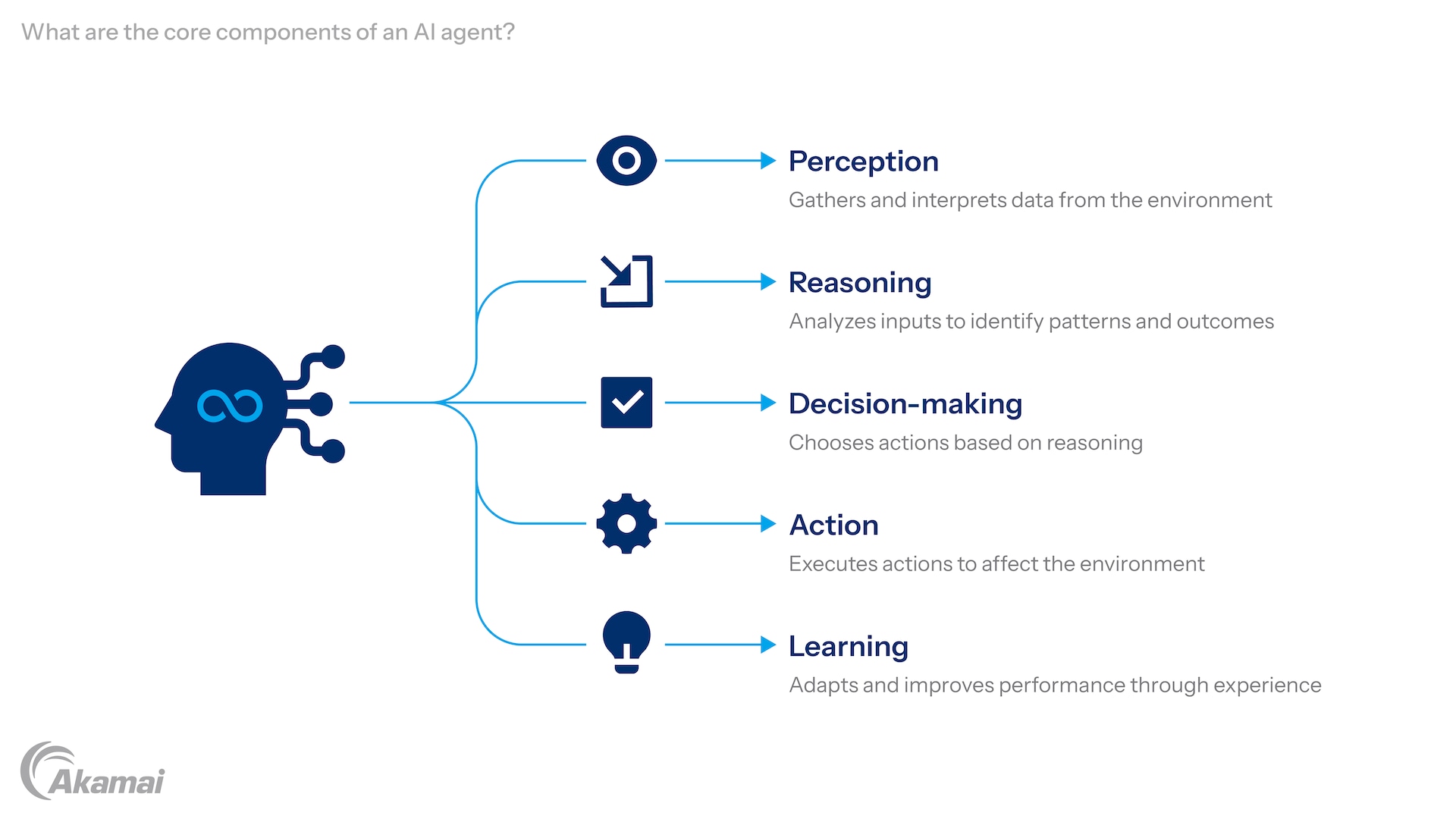
An AI agent is a sophisticated autonomous entity designed to perceive its environment, process information, make decisions, and execute actions to achieve specific goals. These agents operate independently or semiautonomously, continuously interacting with their surroundings. They are equipped with sensors to gather data and effectors to perform actions. The core components of an AI agent typically include:

  • Perception: The ability to receive and interpret data from the environment

  • Reasoning: The process of analyzing perceived data to infer patterns, relationships, and potential outcomes

  • Decision-making: The selection of an appropriate action or sequence of actions based on reasoning

  • Action: The execution of the chosen actions to influence the environment

  • Learning: The capacity to improve performance over time through experience, adapting its internal models and strategies

Diagram of the AI agent cycle: Perception, Reasoning, Decision-making, Action, and Learning.

AI agents are distinct from simpler AI programs due to their autonomous nature, goal-oriented behavior, and often, their ability to learn and adapt. They are engineered to operate within dynamic environments, responding to changes and pursuing objectives without constant human intervention.

Advantages of AI Agents

AI agents offer several significant advantages across various domains due to their autonomous and adaptive capabilities. These benefits include:

  • Automation of complex tasks: AI agents can automate intricate processes that require real-time decision-making and adaptation, reducing the need for human oversight in repetitive or data-intensive operations.

  • Enhanced efficiency and productivity: By performing tasks faster and with greater accuracy than human operators, AI agents significantly improve operational efficiency and overall productivity.

  • Scalability: AI agents can be deployed and scaled rapidly to handle increased workloads or expanded operational scopes without the limitations of human resource constraints.

  • Continuous operation: Unlike human workers, AI agents can operate 24/7 without fatigue, breaks, or downtime, ensuring uninterrupted service delivery and task execution.

  • Improved accuracy and consistency: AI agents follow predefined logic and learned patterns, which minimizes human error and ensures a high degree of consistency in performance and output.

  • Adaptability to dynamic environments: Advanced AI agents can learn from new data and adapt their strategies to changing environmental conditions, making them effective in unpredictable scenarios.
  • Data-driven decision-making: AI agents can analyze vast quantities of data to inform their decisions, leading to more informed and optimized outcomes than intuition-based human judgments.

Types of AI agents

AI agents can be categorized based on their complexity, learning capabilities, and the nature of their decision-making processes. Key types include:

  • Simple reflex agents: These agents operate based on direct stimulus-response rules. They react to the current precept without considering past actions or future consequences. They’re effective in fully observable environments in which the optimal action depends only on the current state.

    • Characteristics: No internal state, no memory, fast decision-making

    • Example: A thermostat that turns a heater on or off based solely on the current temperature threshold

  • Model-based reflex agents: These agents maintain an internal state (a model of the world) that describes the unobserved aspects of the current state. They use this model, along with their current precept, to determine actions.

    • Characteristics: Internal state, memory of past precepts, more complex decision logic

    • Example: A self-driving car that uses its internal map and sensor data to navigate, even when parts of the road are temporarily obscured

  • Goal-based agents: These agents have explicit goals and make decisions by considering the sequence of actions that will lead to the attainment of those goals. They often employ search and planning algorithms.

    • Characteristics: Goal-oriented, planning capabilities, can evaluate future states

    • Example: A robotic arm tasked with assembling a product, where it plans the sequence of movements to achieve the final assembly state

  • Utility-based agents: These agents are more sophisticated than goal-based agents. They not only consider achieving goals but also strive to achieve them in the most optimal way, maximizing a predefined utility function. This utility function quantifies the desirability of different states or outcomes.

    • Characteristics: Optimization, cost-benefit analysis, nuanced decision-making

    • Example: An automated trading system that seeks to maximize profit while minimizing risk, considering various market conditions and potential outcomes

  • Learning agents: These agents possess the ability to learn from experience and improve their performance over time. They typically include a learning element that modifies the agent’s performance element, a critic that provides feedback, and a problem generator that suggests new actions to explore.
    • Characteristics: Adaptability, continuous improvement, knowledge acquisition
    • Example: A spam filter that learns to identify new spam patterns based on user feedback and evolving email characteristics

AI agents vs. traditional AI

  • Autonomy and goal-oriented behavior:

    • AI agents: Are designed to act autonomously, perceiving their environment and making decisions to achieve specific, often complex, goals without constant human intervention. They’re typically proactive.

    • Traditional AI: Often refers to rule-based systems, expert systems, or machine learning models that perform specific analytical or predictive tasks. They’re typically reactive, executing predefined algorithms or providing outputs based on given inputs, often requiring human initiation or oversight.

  • Interaction with environment:

    • AI agents: Continuously interact with a dynamic environment through sensors and effectors, adapting their behavior based on real-time feedback. Their actions have consequences that influence subsequent perceptions.

    • Traditional AI: May process data from an environment but doesn’t necessarily act within that environment in a goal-directed manner. For instance, a predictive model analyzes data but doesn’t independently implement changes based on its predictions.

  • Learning and adaptability:

    • AI agents: Many advanced AI agents incorporate learning mechanisms, allowing them to improve their performance, adapt to new situations, and evolve their strategies over time without explicit reprogramming.

    • Traditional AI: While machine learning models are a component of AI, they typically learn during a distinct training phase. Once deployed, a traditional model often operates based on its learned parameters without continuous adaptation to novel, unpredicted environmental changes, unless retrained.

  • Complexity of task and scope:

    • AI agents: Are often employed for tasks requiring sequential decision-making, planning, and long-term objective pursuit in complex, uncertain environments. Their scope often encompasses a complete operational cycle.

    • Traditional AI: Frequently used for specialized sub-tasks such as image recognition, natural language processing (NLP), or data classification, in which the output is a discrete answer, or prediction rather than a series of environmental manipulations.

  • Internal state and world model:

    • AI agents: Advanced agents often maintain an internal “world model” or state representation, allowing them to reason about unobserved aspects of their environment and plan future actions.
    • Traditional AI: May not explicitly maintain a dynamic internal model of an external world; its processing is often confined to the input data provided.


AI agent use cases

AI agents are being deployed across a broad spectrum of industries, providing solutions for complex problems that require autonomy, adaptability, and continuous operation. Some prominent use cases include:

  • Customer service and support:

    • Virtual assistants and chatbots: AI agents handle routine inquiries, provide instant support, troubleshoot common issues, and guide users through processes, improving response times and customer satisfaction.

    • Automated call routing: Agents analyze customer intent during calls and direct them to the most appropriate human agent or automated service, optimizing service delivery.

  • Autonomous systems:

    • Self-driving vehicles: AI agents perceive road conditions, traffic, and pedestrian movements, making real-time decisions for navigation, speed control, and obstacle avoidance.

    • Robotics in manufacturing: Agents control industrial robots for assembly, quality control, and logistics, adapting to variations in materials and production requirements.

    • Drones for inspection and delivery: AI-powered drones autonomously navigate complex environments, perform inspections of infrastructure, or deliver packages.

  • Financial services:

    • Algorithmic trading: AI agents analyze market data, predict trends, and execute trades at optimal times to maximize returns or minimize risks.

    • Fraud detection: Agents monitor transactions in real time, identify unusual patterns indicative of fraudulent activity, and trigger alerts or blocks.

    • Credit scoring and loan underwriting: Agents assess risk profiles of applicants by analyzing vast datasets, leading to more accurate and unbiased lending decisions.

  • Healthcare:

    • Medical diagnosis support: AI agents assist clinicians by analyzing patient data, medical images, and literature to suggest potential diagnoses and treatment plans.

    • Drug discovery: Agents sift through molecular databases and conduct simulations to identify potential drug candidates and optimize their properties.

    • Personalized medicine: Agents develop customized treatment regimens based on individual patient genetic profiles, lifestyle, and medical history.

  • Cybersecurity:

    • Threat detection and response: AI agents continuously monitor network traffic, identify anomalous behavior, detect emerging threats, and automate responses like isolating compromised systems.

    • Vulnerability management: Agents scan systems for vulnerabilities, prioritize them based on risk, and suggest remediation strategies.

    • Security orchestration, automation, and response (SOAR): Agents automate routine security tasks, orchestrate complex incident response workflows, and reduce manual effort.

  • Logistics and supply chain management:

    • Route optimization: AI agents dynamically plan and optimize delivery routes for fleets, considering traffic, weather, and delivery schedules.

    • Inventory management: Agents predict demand, manage stock levels, and automate ordering processes to prevent shortages or overstocking.

  • Personal assistants:

    • Smart home automation: AI agents manage smart devices, learn user preferences, and automate tasks like lighting control, temperature adjustment, and security monitoring.
    • Personalized recommendations: Agents suggest content, products, or services based on user behavior and preferences across various platforms.


Why are AI agents important for security?

AI agents are becoming indispensable in the realm of cybersecurity due to their unique capabilities that address the evolving nature of cyberthreats. Their importance stems from several critical aspects:

  • Real-time threat detection and response:

    • Speed: Traditional security systems often rely on human analysis, which is too slow to counteract sophisticated, rapidly evolving cyberattacks. AI agents can process vast amounts of data and identify malicious activities in milliseconds, enabling immediate responses.

    • Anomaly detection: Agents are adept at establishing baselines of normal network behavior and identifying deviations (anomalies) that may indicate new or unknown threats, often referred to as zero-day attacks, which signature-based systems can’t detect.

    • Automated remediation: Upon detecting a threat, AI agents can automatically initiate response actions, such as isolating compromised endpoints, blocking malicious IP addresses, or rolling back system changes, thereby minimizing damage and reducing dwell time.

  • Proactive threat hunting and vulnerability management:

    • Predictive analysis: AI agents can analyze historical threat data and current indicators to predict potential attack vectors and proactively strengthen defenses.

    • Vulnerability scanning and prioritization: Agents can continuously scan systems for vulnerabilities, assess their risk levels, and prioritize remediation efforts based on the potential impact and exploitability.

    • Threat intelligence integration: Agents can rapidly consume and integrate vast amounts of global threat intelligence, updating their knowledge base and improving their ability to identify emerging threats.

  • Scalability and efficiency:

    • Handling data volume: Modern networks generate immense volumes of data. AI agents can analyze this data at scale, which is impossible for human analysts, ensuring comprehensive monitoring.

    • Resource optimization: By automating repetitive and time-consuming security tasks, AI agents free up human security professionals to focus on more complex strategic initiatives and sophisticated threat analysis.

  • Adaptability to evolving threats:

    • Learning capabilities: Advanced AI agents can learn from new attack patterns and adapt their detection models over time, making them resilient against polymorphic malware and adaptive adversaries.

    • Reduced alert fatigue: AI agents can correlate multiple low-level alerts to identify true security incidents, significantly reducing the volume of false positives that often overwhelm human analysts, leading to “alert fatigue.”

  • Behavioral analysis:

    • User and entity behavior analytics (UEBA): AI agents can profile the normal behavior of users, endpoints, and applications. Any significant deviation from these established baselines can signal a potential insider threat or compromised account, even if the activity itself is not inherently malicious.

Frequently Asked Questions

AI agents are autonomous entities designed to perceive, reason, decide, and act in an environment to achieve specific goals, often involving physical or digital interactions beyond just communication. They can encompass a wide range of functionalities, from controlling robotic systems to managing complex supply chains.

Chatbots, while a type of AI agent, are specifically designed for conversational interaction with humans. Their primary function is to understand, and respond to natural language inputs, typically for information retrieval, customer support, or simple task execution through a text or voice interface. While some advanced chatbots may exhibit goal-oriented behavior, their operational scope is generally confined to dialogue and information processing rather than broader environmental interaction and action. All chatbots are AI agents, but not all AI agents are chatbots.
The deployment of AI agents raises several critical ethical considerations that necessitate careful attention:

  • Bias and discrimination: AI agents learn from data, and if this data contains societal biases, the agents can perpetuate or even amplify discrimination in their decision-making (e.g., in loan applications, hiring, or criminal justice).

  • Accountability: Determining who’s responsible when an autonomous AI agent makes an error or causes harm can be complex. Is it the developer, the deployer, or the agent itself?

  • Transparency and explainability: The decision-making processes of complex AI agents, particularly those using deep learning, can be opaque (“black boxes”). This lack of transparency makes it difficult to understand why an agent made a particular decision, hindering debugging, auditing, and trust.

  • Privacy: AI agents often process vast amounts of personal data to function effectively, raising concerns about data collection, storage, security, and potential misuse.

  • Autonomy and control: As AI agents become more autonomous, questions arise about the extent of human oversight required and the potential for agents to operate in ways unintended or unanticipated by their creators.

  • Job displacement: Automation enabled by AI agents can lead to significant job displacement in various industries, prompting ethical discussions about economic impact and social responsibility.
  • Misuse and malicious applications: AI agents can be co-opted or specifically designed for malicious purposes, such as autonomous weapons systems, sophisticated propaganda generation, or highly targeted cyberattacks, raising profound ethical and societal risks.

Large language models (LLMs) play a crucial role in enhancing the capabilities of many AI agents, particularly those requiring advanced natural language understanding, generation, and reasoning. Their primary contributions include:

  • Natural language interface: LLMs enable AI agents to understand and respond to human language instructions, making them more accessible and user-friendly. This allows for more intuitive interaction, replacing rigid commands with conversational input.

  • Complex reasoning and planning: LLMs can assist agents in processing and synthesizing vast amounts of textual information, performing complex reasoning tasks, and generating logical steps for multistage goals. They can help agents break down complex problems into manageable subtasks.

  • Knowledge acquisition and synthesis: LLMs are trained on massive datasets, endowing them with extensive world knowledge. Agents can leverage this knowledge to answer questions, provide context, and inform decisions without explicit programming for every piece of information.

  • Content generation: For agents involved in tasks like report generation, email composition, or creative writing, LLMs provide the ability to generate coherent, contextually relevant, and human-like text outputs.
  • Contextual understanding: LLMs enable agents to maintain conversational context over extended interactions, improving the relevance and coherence of their responses and actions.
  • Adaptability and generalization: While LLMs are not inherently “learning agents” in the sense of continuous environmental interaction, their foundational knowledge allows agents built upon them to generalize across diverse tasks and adapt to nuanced instructions more effectively.

AI agents learn and adapt through various mechanisms, primarily by processing data from their environment and updating their internal models or decision-making processes. The key methods include:

  • Supervised learning: Agents learn from labeled datasets where each input is paired with a desired output. The agent adjusts its internal parameters to map inputs to correct outputs (e.g., classifying emails as spam or not spam based on labeled examples).

  • Unsupervised learning: Agents discover patterns and structures within unlabeled data. This is used for tasks like clustering data points, identifying anomalies, or reducing data dimensionality without predefined outputs (e.g., grouping customers with similar purchasing behaviors).

  • Reinforcement learning (RL): This is a powerful paradigm where agents learn by interacting with an environment and receiving feedback in the form of rewards or penalties. The agent's goal is to learn a policy (a mapping from states to actions) that maximizes the cumulative reward over time. It involves:

    • Trial and error: The agent explores different actions and observes their consequences.

    • Reward function: A predefined function guides the agent towards desired behaviors by assigning positive rewards for good actions and negative penalties for undesirable ones.

    • Value function: The agent learns to estimate the long-term value of being in a particular state or taking a particular action.

    • Policy update: Based on rewards and values, the agent iteratively refines its policy to make better decisions in the future.

  • Active learning: In this approach, the agent intelligently queries an oracle (e.g., a human expert) for labels on specific, informative data points it finds ambiguous. This reduces the amount of labeled data required and improves learning efficiency.

  • Transfer learning: Agents leverage knowledge gained from solving one task (source domain) to improve performance on a different but related task (target domain). This often involves using pretrained models and fine-tuning them for the new task.
  • Online learning: Agents continuously learn and update their models in real time as new data becomes available, allowing them to adapt quickly to dynamic environments and evolving patterns without requiring a full retraining cycle.

Despite their advanced capabilities, current AI agents face several significant limitations:

  • Lack of true common sense: AI agents often struggle with common-sense reasoning, which humans acquire through everyday experiences. They may fail to understand implicit context, subtle nuances, or make logically intuitive inferences outside their training data.

  • Limited generalization: While some agents can generalize within their learned domain, they often struggle to transfer knowledge effectively to entirely new, unencountered situations or domains without significant retraining or adaptation. Their learning is often narrow.

  • Dependency on data quality and quantity: The performance of AI agents is heavily dependent on the quality, quantity, and representativeness of their training data. Biased, incomplete, or insufficient data can lead to biased, inaccurate, or ineffective agents.

  • Explainability (black box problem): Many advanced AI agents, particularly those based on deep neural networks, are “black boxes.” It’s difficult to interpret why they make certain decisions, which hinder trust, debugging, and compliance in critical applications.

  • Vulnerability to adversarial attacks: AI agents, especially those using machine learning, can be susceptible to adversarial attacks in which subtly modified inputs (imperceptible to humans) can trick the agent into making incorrect classifications or decisions.

  • Resource intensity: Training and deploying sophisticated AI agents, particularly large language models or complex reinforcement learning agents, requires significant computational power, large datasets, and energy resources, making them costly.

  • Fragility and brittleness: AI agents can sometimes be brittle, performing well within their training parameters but failing unexpectedly or catastrophically when faced with inputs or scenarios slightly outside their learned distribution.
  • Ethical and societal concerns: As discussed previously, limitations also arise from the ethical challenges they pose, including bias, privacy invasion, accountability gaps, and potential for misuse.


Why customers choose Akamai

Akamai is the cybersecurity and cloud computing company that powers and protects business online. Our market-leading security solutions, superior threat intelligence, and global operations team provide defense in depth to safeguard enterprise data and applications everywhere. Akamai’s full-stack cloud computing solutions deliver performance and affordability on the world’s most distributed platform. Global enterprises trust Akamai to provide the industry-leading reliability, scale, and expertise they need to grow their business with confidence.

Related Blog Posts

Increase Performance, Decrease Costs with a Flexible Distributed Cloud
Learn why industry leaders say that building and deploying applications across a flexible cloud will pay dividends in optimized performance and lower cost.
Media IT Leaders Say Distributed Cloud Will Boost Performance, Lower Cost
Building and deploying applications across a distributed cloud pays dividends in performance, latency, and cost. Read about what industry leaders have to say.
A Distributed Cloud Platform Is a Priority for Gaming IT Leaders
Gaming industry leaders say that building and deploying applications across the cloud continuum will improve performance, lower latency, and lower cost.

Related Customer Stories

Explore all Akamai Security Solutions

Start your free trial and see what a difference having the world’s largest and most trusted cloud delivery platform can make.