Artificial intelligence (AI) refers to the simulation of human intelligence in machines that are programmed to think like humans and mimic their actions. It encompasses a wide range of capabilities, including learning, reasoning, problem-solving, perception, and understanding language.
An AI factory is a specialized infrastructure designed to streamline the entire lifecycle of artificial intelligence (AI) and machine learning (ML) model development, from data ingestion and processing to model training, deployment, and continuous optimization. This concept extends beyond traditional data centers by integrating purpose-built hardware, software, and operational methodologies optimized for the intensive computational demands of AI workloads.
The concept of an AI factory
The concept of an AI factory uses a structured process in which input data is systematically transformed into trained AI models through automated workflows. In the context of AI, the “raw materials” are data, and the “finished products” are trained AI models ready for deployment. This structured approach aims to accelerate innovation, improve efficiency, and ensure the reliability of AI systems at scale. It consolidates the necessary resources and expertise into a cohesive environment, fostering rapid iteration and continuous improvement in AI development.
AI factories vs. traditional data centers
Although both AI factories and traditional data centers house computational resources, their architectural designs and operational focuses differ significantly.
Traditional data centers are general-purpose infrastructures primarily designed for a broad range of computing tasks, including data storage, web hosting, and enterprise applications. They typically rely on general-purpose CPUs and are optimized for stable, predictable workloads.
AI factories are specialized infrastructures explicitly engineered for AI/ML workloads. They are characterized by:
Specialized hardware: Heavy reliance on graphics processing units (GPUs), tensor processing units (TPUs), and other AI accelerators
High-performance networking: Low-latency, high-bandwidth interconnects to facilitate rapid data movement between computational units
Optimized software stacks: Integrated platforms and tools specifically designed for AI development, such as machine learning (ML) frameworks, data orchestration tools, and model management systems
- Specialized hHardware: Heavy reliance on gGraphics pProcessing uUnits (GPUs), tTensor pProcessing uUnits (TPUs), and other AI accelerators.
How does an AI factory work?
An AI factory operates through a series of four interconnected stages, each optimized for specific aspects of the AI lifecycle.
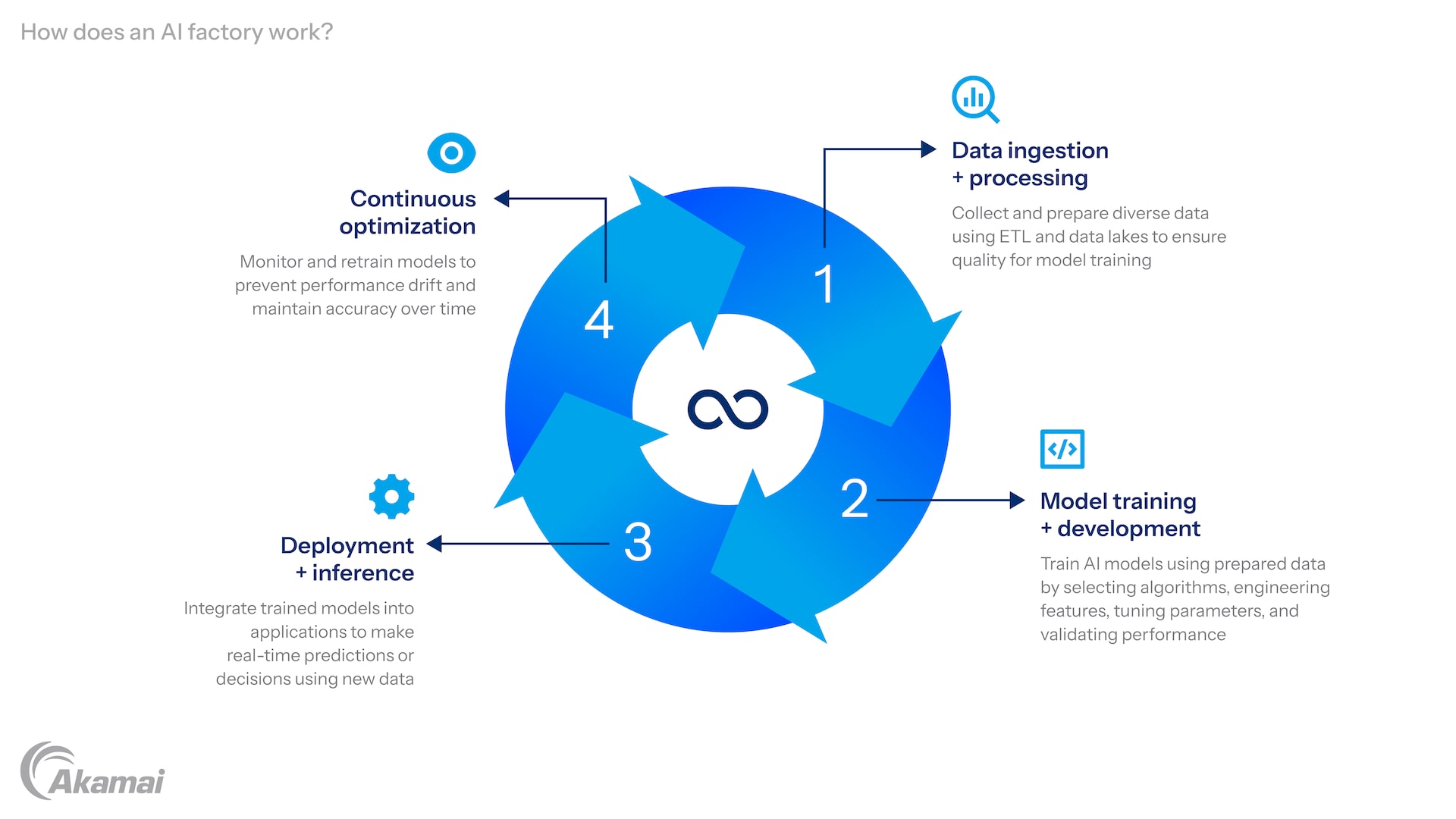
- Data ingestion and processing — This initial stage involves collecting, cleansing, transforming, and preparing vast quantities of diverse data. Data sources can include sensors, databases, logs, images, and text. Tools for extract, transform, and load (ETL); data warehousing; and data lakes are employed to consolidate and prepare the data for subsequent model training. Data quality, consistency, and relevance are paramount during this phase.
- Model training and development — Once data is prepared, it is fed into specialized hardware to train AI models. This process involves:
- Algorithm selection: Choosing appropriate machine learning algorithms (e.g., neural networks, decision trees) based on the problem
- Feature engineering: Identifying and creating relevant features from the raw data that improve model performance
- Hyperparameter tuning: Adjusting model parameters that are not learned from the data (e.g., learning rate, number of layers) to optimize performance
- Model validation: Evaluating model performance using unseen data to ensure generalization and prevent overfitting
- Deployment and inference — After training and validation, the AI model is deployed into production environments. Deployment refers to integrating the model into applications, or services where it can make predictions or decisions based on new, real-time data. Inference is the process by which a deployed model processes newly input data to generate an output, such as a classification, prediction, or recommendation. This stage often requires efficient, low-latency infrastructure to handle real-time requests.
- Continuous optimization — The AI lifecycle doesn’t end with deployment. Continuous optimization involves monitoring the model’s performance in production, identifying model drift (when a model’s performance degrades over time due to changes in data distribution), and retraining the model with new data. This iterative feedback loop ensures that AI models remain accurate, relevant, and effective over time.
Key components of an AI factory
The successful operation of an AI factory relies on the seamless integration of several critical components.
High-performance computing infrastructure — This forms the backbone of an AI factory, providing the raw computational power required for intensive AI workloads. It includes servers, storage systems, and networking equipment designed for demanding tasks.
Specialized hardware (GPUs, TPUs)
○ Graphics processing units (GPUs): Initially designed for rendering computer graphics, GPUs are highly effective at performing parallel computations, making them ideal for training deep learning models.
○ Tensor processing units (TPUs): Developed by Google, TPUs are application-specific integrated circuits (ASICs) custom-built to accelerate machine learning workloads, particularly those involving tensor operations common in neural networks.
Data management systems — These systems are crucial for handling the vast quantities of data required for AI. They include:
○ Distributed storage: Solutions like Hadoop Distributed File System (HDFS) or Akamai Object Storage for massive datasets
○ Data lakes: Repositories that store raw, unstructured data in its native format
○ Data warehouses: Structured repositories optimized for analytics and reporting
○ Database management systems: For managing structured data
AI/ML platforms and tools — These software layers provide the necessary frameworks and utilities for developing, managing, and deploying AI models. Examples include:
○ Machine learning frameworks: TensorFlow, PyTorch, Keras
○ Orchestration tools: Kubernetes for managing containerized applications
○ MLOps platforms: Tools that streamline the entire ML lifecycle, from experimentation to deployment and monitoring
Networking capabilities
○ Power, cooling, and physical infrastructure: AI factories require high-density power delivery, advanced cooling, and facility designs that can support dense accelerator clusters. These constraints often shape where and how AI infrastructure can be deployed.
Benefits of an AI factory
The adoption of an AI factory model offers several significant advantages for organizations that are using AI.
- Accelerated AI development — By centralizing and optimizing resources, AI factories significantly reduce the time required to develop, train, and deploy AI models. This leads to faster innovation cycles and quicker realization of business value.
- Scalability and efficiency — AI factories are designed to scale resources dynamically, accommodating varying computational demands. This ensures that resources are efficiently used, prevents bottlenecks during peak loads, and minimizes idle capacity during off-peak periods.
- Cost optimization — By optimizing resource allocation and streamlining the development process, AI factories can lead to reduced operational costs. Centralized management and automation also decreases manual effort and associated expenses.
- Enhanced performance — Specialized hardware and optimized software stacks can reduce training time, improve inference throughput and latency, and help teams iterate faster on models and applications.
- Improved data security — Consolidating data and AI infrastructure within a controlled environment allows for the implementation of robust security measures, ensuring data privacy, compliance with regulations, and protection against unauthorized access.
Applications of AI factories
AI factories are instrumental across a diverse range of industries, driving innovation and efficiency.
- Autonomous driving — Developing self-driving vehicles requires processing petabytes of sensor data (lidar, radar, cameras) to train complex deep learning models for perception, prediction, and control. AI factories provide the computational power to handle this massive data volume and intricate model training.
- Drug discovery and healthcare — AI factories accelerate the discovery of new drugs by simulating molecular interactions, analyzing genetic data, and predicting protein structures. In healthcare, they support diagnostic imaging analysis, personalized treatment plans, and predictive analytics for disease outbreaks.
- Financial modeling — In finance, AI factories are used for high-frequency trading, fraud detection, credit scoring, and algorithmic trading. They process vast amounts of market data to identify patterns and make rapid, informed decisions.
- Content generation — Generative AI (GenAI) applications, such as large language models (LLMs) for text generation, image creation, and video production, rely heavily on the computational capabilities of AI factories to train their massive neural networks.
- Scientific research — From climate modeling and astrophysics simulations to materials science and genomics, AI factories provide the necessary infrastructure to process complex scientific data and accelerate discovery across various research domains.
Challenges in building and operating AI factories
Despite their benefits, establishing and managing AI factories presents several challenges.
- Infrastructure complexity — Designing, deploying, and maintaining a specialized infrastructure with high-performance computing, sophisticated networking, and diverse hardware components is inherently complex. It requires significant technical expertise and careful planning.
- Energy consumption — The intensive computational demands of AI workloads, particularly during model training, result in substantial energy consumption. This leads to high operational costs and raises environmental concerns regarding sustainability.
- Talent scarcity — The specialized skills required to build, operate, and optimize AI factories are in high demand. Expertise in areas like distributed systems, high-performance computing, MLOps, and specific AI frameworks is often scarce.
- Data governance and privacy — Managing vast quantities of sensitive data within an AI factory necessitates strict adherence to data governance policies, regulatory compliance (e.g., the General Data Protection Regulation (GDPR) , the Health Insurance Portability and Accountability Act (HIPAA), and robust privacy protection mechanisms to prevent misuse or breaches.
The future of Akamai Cloud and AI factories
Continuous evolution, driven by advancements in AI technology and increasing computational demands, characterizes the future of AI factories. Key trends include:
- Further hardware specialization — Development of even more efficient and specialized AI accelerators beyond current GPUs and TPUs
- Edge AI integration — Hybrid AI factories that extend capabilities to the edge for real-time inference in resource-constrained environments
- Automation and MLOps — Enhanced automation of the entire ML lifecycle through advanced machine learning operations (MLOps) platforms, reducing manual intervention
- Sustainability focus — Innovations in cooling technologies, energy efficiency, and renewable energy integration to address the high power consumption
- Democratization of AI — Cloud-based AI factory services making advanced AI development accessible to a broader range of organizations
Frequently Asked Questions
Machine learning (ML) is a subset of AI that enables systems to learn from data without being explicitly programmed. It involves developing algorithms that can identify patterns in data and make predictions or decisions based on those patterns.
Deep learning is a subfield of machine learning that uses artificial neural networks with multiple layers (hence “deep”) to learn complex patterns from large amounts of data. It is particularly effective for tasks involving images, speech, and natural language.
A neural network is a computational model inspired by the structure and function of the human brain. It consists of interconnected nodes (neurons) organized in layers, which process and transmit information to learn from data.
Generative AI (GenAI) refers to AI models capable of producing new, original content — such as text, images, audio, or video — that resembles existing real-world data. These models learn patterns from training data and then generate novel outputs based on those learned patterns.
A large language model (LLM) is a type of deep learning model that has been trained on a massive amount of text data to understand, generate, and process human language. LLMs are characterized by their vast number of parameters and their ability to perform various natural language processing tasks, such as translating, summarizing, and answering questions.
Why customers choose Akamai
Akamai is the cybersecurity and cloud computing company that powers and protects business online. Our market-leading security solutions, superior threat intelligence, and global operations team provide defense in depth to safeguard enterprise data and applications everywhere. Akamai’s full-stack cloud computing solutions deliver performance and affordability on the world’s most distributed platform. Global enterprises trust Akamai to provide the industry-leading reliability, scale, and expertise they need to grow their business with confidence.